
World War II
Puzzle 79 · Arsenal and Sustainment · Page 114 in print
Fletcher Destroyers
The Navy built 175 Fletcher-class destroyers, including 14 at the Charlestown Navy Yard.
Jump to a word
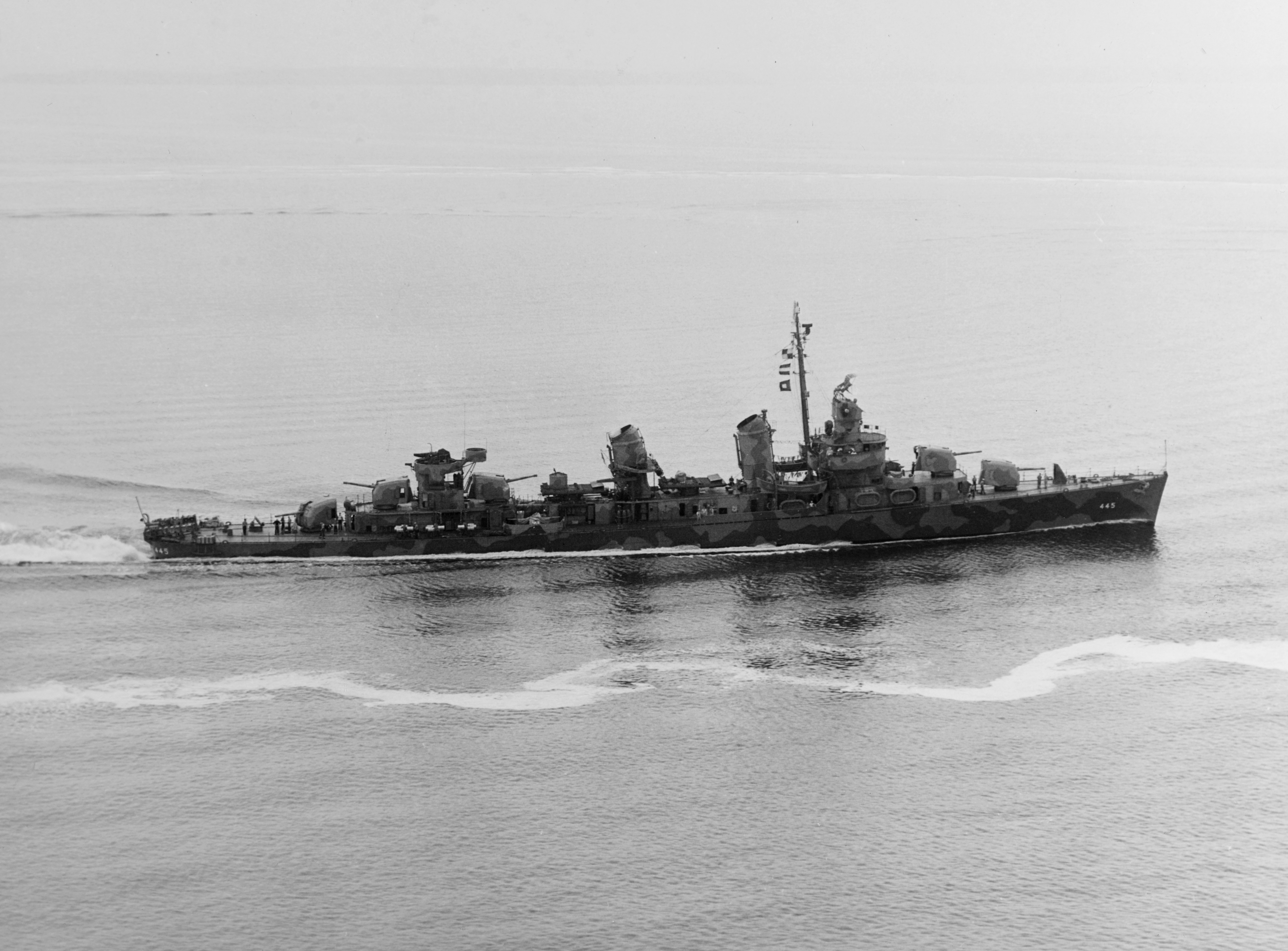
USS Fletcher maneuvering off New York on July 18, 1942.
U.S. Navy Bureau of Ships / National Archives (19-N-31245) · Public domain · Original recordImage changes
Display copies resized; original downloaded JPEG preserved.
The words
Charlestown
Charlestown Navy Yard built 14 Fletcher-class destroyers. Cassin Young, later associated with the yard through repairs and modernization, was built in California.
Did you know?
When Cassin Young entered Dry Dock 1 in 1978, its overhaul aimed to restore a 1950s appearance.
Convoy Duty
After its early training, Isherwood operated with a patrol and escort group from Argentia, Newfoundland, in 1943. These duties preceded its later Pacific service.
Destroyers
Fletcher destroyers were designed to balance speed and armament. They often screened other ships, meaning they helped protect vessels that had important roles in the fleet.
Five Inch
The main guns had a 5-inch (127 mm) caliber. Cassin Young’s wartime diagram identifies them for use against aircraft and surface targets.
Fletcher
Fletcher was a mass-produced wartime destroyer class. The Navy built 175 ships of the type, and most served in the Pacific theater.
Ocean Convoys
The Navy history records Isherwood returning to Boston with a convoy in September 1943. The ship’s Atlantic service helped protect vessels making an ocean passage.
Sea Lanes
In November 1944, Isherwood escorted convoys from advance bases to the Philippines. These supply routes supported the buildup after the Leyte landings.
Tin Can
Destroyer crews called themselves “tin can sailors,” a nickname linked to thin armor and tough conditions. Long cruises meant sharing limited space for work, meals and sleep.
Torpedoes
Torpedoes were anti-ship weapons carried in deck-mounted tubes. Cassin Young originally had a second mount between its smokestacks, illustrating how the ship’s layout changed over time.
Transatlantic
Transatlantic meant crossing the Atlantic Ocean. Isherwood’s September 1943 convoy voyage brought it back to Boston, before a November transfer to the Pacific.
Warship Class
Fletcher identified a shared design family, while DD-793 was the hull number of Cassin Young. Ships of one class could have different builders and separate service histories.
Warships
Cassin Young survived two kamikaze hits off Okinawa in 1945. Sailors were killed and wounded, and the ship required repairs before returning to peacetime service.
Sources
- “USS Cassin Young” Sign: accessible wayside transcriptU.S. National Park Service; Boston National Historical Park, Charlestown Navy Yard wayside transcript and diagram description, updated January 22, 2024
- Bow: life aboard USS Cassin YoungU.S. National Park Service; Boston National Historical Park, shipboard interpretation, updated January 18, 2023
- USS Isherwood II (DD-520)Dictionary of American Naval Fighting Ships, Office of the Chief of Naval Operations, Naval History Division; HyperWar transcription by Patrick Clancey
- USS Cassin Young: ship historyU.S. National Park Service; Boston National Historical Park, historical overview and wartime and postwar service account, updated October 23, 2026
- USS Cassin Young Virtual Tour: full textU.S. National Park Service; Boston National Historical Park, interpreted ship compartments and equipment, with source bibliography