
World War II
Puzzle 78 · Arsenal and Sustainment · Page 113 in print
Liberty Ships
U.S. yards built over 2,700 Liberty ships in 1941-1945.
Jump to a word
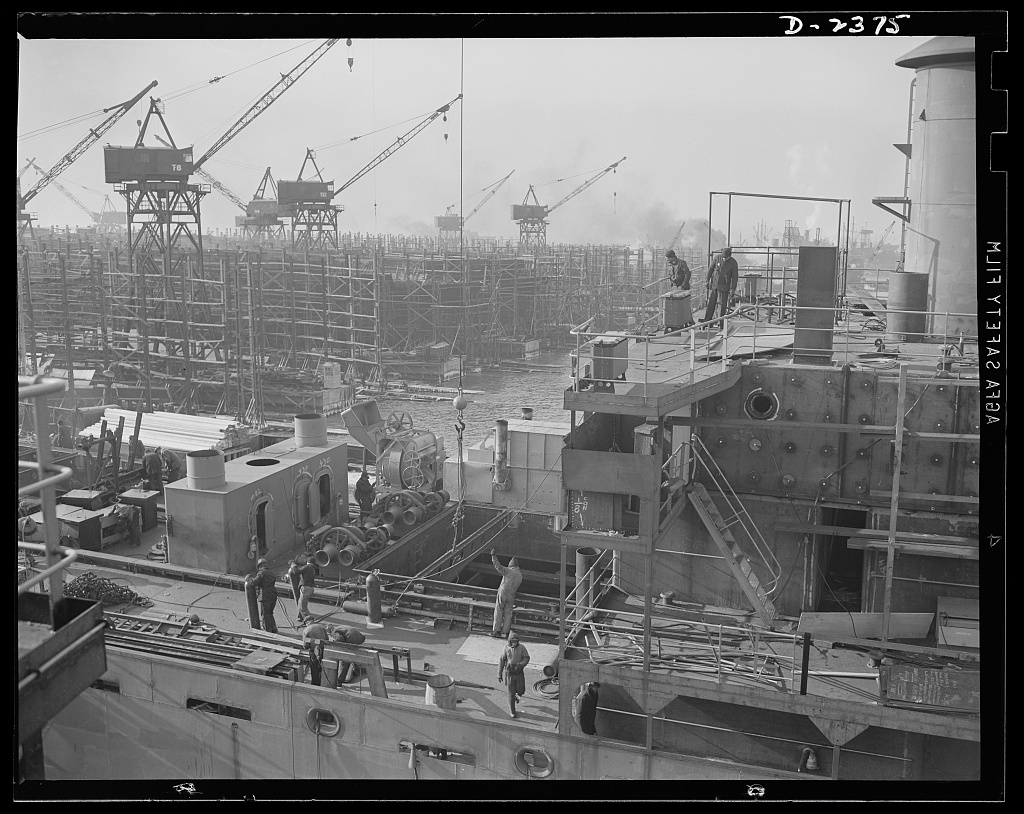
A Liberty ship under construction in Baltimore, Maryland.
Alfred T. Palmer / Library of Congress, Prints & Photographs Division, FSA/OWI Black-and-White Negatives (LC-USE6-D-002375) · Public domain · Original recordImage changes
Display copies resized; original archive JPEG preserved.
The words
Bethlehem
Bethlehem-Fairfield was the Baltimore shipyard that built John W. Brown. The vessel was launched on September 7, 1942, before beginning a career carrying wartime supplies and troops.
Reading 3 · Park Service: Liberty ship histories (opens a new tab)
Cargo Capacity
Some Liberty ships, including John W. Brown, combined cargo space with troop accommodation. Their carrying role could include supplies, equipment and soldiers on the same voyage.
Fast Build
Mass-assembly methods spread work across repeatable tasks. At Richmond, cranes moved prepared parts into place and welders joined them, helping newly trained workers contribute to production.
Freighter
A freighter carried goods between ports. Liberty ships moved varied cargoes to sustain the Allied war effort, connecting American loading ports with destinations overseas.
Liberty
The Liberty ship was an emergency cargo design adapted from a British ship. Its simple, standardized form supported rapid building as the Allies needed ships and replacement tonnage.
Did you know?
Liberty ships were named for people from many walks of life. One was named Stage Door Canteen after a club for service members.
Merchant
Civilian merchant seamen operated John W. Brown, while a U.S. Navy Armed Guard detachment handled its defensive guns. Merchant service and naval service met aboard one vessel.
Ocean Crossing
John W. Brown’s first voyage took military equipment toward the Persian Gulf. It sailed alone for much of that journey; later Mediterranean voyages used convoys.
Patrick Henry
SS Patrick Henry, the first Liberty ship, was launched on September 27, 1941. Its name honored the American Revolutionary patriot whose words helped inspire the type’s name.
Reading 1 · Park Service: Liberty ship histories (opens a new tab)
Propulsion
A triple-expansion steam engine powered Jeremiah O’Brien. Oil-fired boilers supplied the steam, reflecting a cargo-ship design that favored simple operation and rapid construction.
Robert Peary
SS Robert E. Peary’s Richmond trial reached launch in under five days in November 1942. The ship still needed outfitting afterward, so the record did not mean it was ready to sail.
Shipping Lanes
John W. Brown’s maiden voyage followed an indirect route around South America and Africa to reduce submarine encounters. Wartime routes balanced danger against the distance to a destination.
Ships
John W. Brown kept working after the war. It carried government cargoes to help rebuild Europe, extending the usefulness of a vessel built for wartime service.
Standardized
A common basic design allowed shipyards on several American coasts to build the same type. Components could be manufactured elsewhere and brought together for assembly.
Ugly Duckling
Roosevelt compared the ship’s appearance to an ugly duckling while reviewing its plans. The nickname reflected a plain, practical cargo design built for wartime needs.
Welding
At Richmond, workers welded pre-made sections after cranes moved them into position. The work opened industrial jobs to women and minority workers, who still faced unequal pay and discrimination.
Sources
- Liberty Ships and Victory Ships, America’s Lifeline in War (Teaching with Historic Places)U.S. National Park Service; Jay Michalsky, with Jean West and Teaching with Historic Places staff; lesson based on National Register and National Historic Landmark records
- Richmond Shipyard Number ThreeU.S. National Park Service; Rosie the Riveter WWII Home Front National Historical Park, historical-place account, updated September 16, 2020
- On the Prow of LibertyBowdoin College; Kathryn Miles, Bowdoin Magazine, Winter 2021, published online March 19, 2021; interviews and historical reporting
- The BROWN: S.S. John W. Brown ship historyProject Liberty Ship, Inc.; operator and preservation organization of S.S. John W. Brown, historical account of the ship and its service
- Engineering Landmark 98: SS Jeremiah O’BrienAmerican Society of Mechanical Engineers; historical engineering-landmark account, designation ceremony September 1984