
World War II
Puzzle 77 · Arsenal and Sustainment · Page 112 in print
Willow Run Liberators
At its peak, Ford’s Michigan Willow Run plant produced roughly one B-24 bomber an hour.
Jump to a word
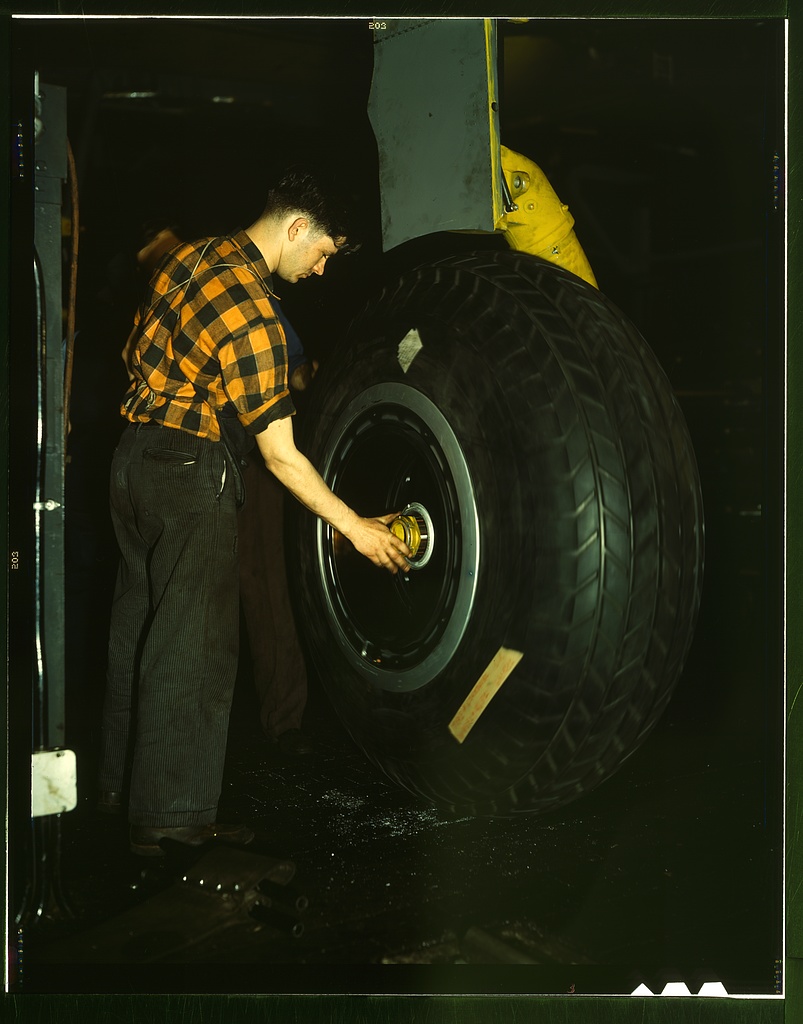
A worker inspects aircraft landing gear at Ford’s Willow Run plant in Michigan.
Howard R. Hollem / Library of Congress, Prints & Photographs Division, FSA/OWI Color Photographs (LC-DIG-fsac-1a55004) · Public domain · Original recordImage changes
Display copies resized; original archive JPEG preserved.
The words
Albert Kahn
Architect Albert Kahn worked with Ford officials on the Willow Run factory. Its layout had to accommodate parallel aircraft assembly lines inside a very large building.
Assembly Line
Willow Run’s assembly system had four parallel lines that later merged into two, then a single final line. Different stages added major components before finishing and fueling.
Automotive
Ford applied automobile mass-production methods to aircraft, but airplanes were more complex than cars. Repeated design changes disrupted the standardized manufacturing process and made the early work difficult.
Bomber Plant
The factory complex included classrooms, a hospital and worker housing as well as production buildings. An adjoining airport let completed aircraft leave under their own power.
Consolidated
Consolidated Aircraft of San Diego designed the B-24. The company’s design provided the aircraft that Ford then organized for production at Willow Run.
Ford
Ford built complete aircraft and partly assembled kits. The kits traveled to Consolidated in Fort Worth and Douglas in Tulsa, where other workers completed the airplanes.
Liberator Line
Liberator was the B-24’s name. Its production line combined separately built aircraft sections, showing how Ford divided a complex airplane into coordinated stages of work.
Michigan
The Willow Run plant stood west of Detroit in Michigan. Gasoline and tire rationing made commuting difficult, so bus services carried workers to and from the factory.
Overhead Crane
An overhead crane lifted center wing sections into and out of a permanent assembly jig. The jig held parts in position while workers assembled the wing.
Sorensen
Charles Sorensen led Ford’s production planning. He and his team worked out where machinery and workstations should stand so aircraft could pass efficiently through the factory.
Did you know?
Sorensen’s team used a 1:98-scale model of the plant to plan the placement of equipment and workstations.
Turntables
Two turntables rotated aircraft fuselages through a right-angle bend near the end of the line. They accommodated the factory’s L-shaped layout while keeping assembly moving.
War Plane
The B-24 Liberator was a four-engine military bomber. In Europe, B-24 crews attacked industrial and transport targets and also cities, making the aircraft part of the wider bombing war.
Willow Run
At its peak, Willow Run averaged a completed bomber every 63 minutes. Reaching that rate required overcoming repeated design changes and the difficulties of adapting car-building methods to aircraft.
Wings
The center wing section was joined to the fuselage and landing gear before the aircraft moved onward. Wing tips were fitted later, showing how the whole wing was assembled in stages.
Ypsilanti
The factory stood in Ypsilanti Township. The arrival of workers created a housing need, met in part by federal dormitories at Willow Run Lodge and family housing in Willow Run Village.
The Henry Ford: worker housing (opens a new tab) · The Henry Ford: production flow chart (opens a new tab)
Sources
- Willow Run Bomber PlantThe Henry Ford; curated historical set of 33 original Ford photographs and records, with interpretive captions
- Flow Chart for B-24 Production at the Willow Run Bomber Plant, 1944The Henry Ford; September 1, 1944, flow chart, Charles C. La Croix Records, object 64.167.435.3, with curatorial description
- Charles Sorensen and Others Viewing a Scale Model of the Willow Run Bomber Plant, July 1941The Henry Ford; Ford Motor Company Photographic Department, July 1941, object 64.167.833.P.75904, with curatorial description
- B-24 Bomber Wing Assembly, Ford Motor Company Willow Run Plant, 1944The Henry Ford; Ford Motor Company Photographic Department, October 13, 1944, object 84.1.1660.P.833.80663, with curatorial description
- Aerial View of the Ford Motor Company Willow Run Bomber Plant, September 1945The Henry Ford; Ford Motor Company Photographic Department, September 1945, object 84.1.1660.P.833.82126, with curatorial description
- Workers Arriving and Departing by Bus at Willow Run Bomber Plant, 1942The Henry Ford; Ford Motor Company Photographic Department, July 30, 1942, object 64.167.833.P.76924.A, with curatorial description
- Willow Run Lodge, Housing for Willow Run Bomber Plant Workers, 1945The Henry Ford; Ford Motor Company Photographic Department, 1945, object 64.167.833.P.82123.29, with curatorial description
- B-24 Bomber Assemblies Being Loaded Into a Trailer, Willow Run Bomber Plant, circa 1943The Henry Ford; circa 1943 Ford factory photographic print, object 84.1.1660.694, with curatorial description