
World War II
Puzzle 80 · Arsenal and Sustainment · Page 115 in print
PLUTO Pipeline
PLUTO’s lead and steel pipes carried fuel under the English Channel to France.
Jump to a word
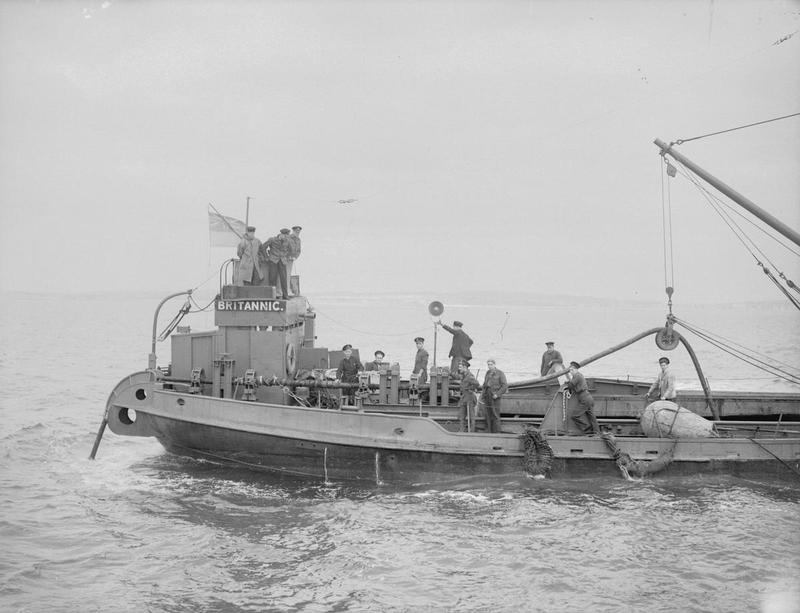
The tug Britannic joining a PLUTO pipeline between England and France at Boulogne.
E. A. Zimmerman, Royal Navy official photographer / Imperial War Museums (A 28817) · Public domain · Original recordImage changes
Display copies resized; original downloaded JPEG preserved.
The words
Bambi
Bambi linked the Isle of Wight with the Cherbourg area. Leaks and damaged lines limited its usefulness, and it closed as the focus shifted to the Dumbo crossing.
Boulogne
Boulogne’s sea terminal had to connect with inland transport. Naval work there remained dangerous: the tug Danube V detonated a mine while weighing anchor, injuring crew members.
pp. 14 and 17 · Middleton: PLUTO’s naval work (opens a new tab)
Cherbourg
Capturing and clearing Cherbourg was necessary before the first cross-Channel lines could be laid. The port’s readiness helped determine when the Bambi route could begin.
Conundrum
Conundrums were floating drums that carried coils of steel HAMEL pipe. Tugs towed them across the water as the drums turned, paying out pipe onto the seabed.
Cross-Channel
Before laying pipes to France, engineers tested a sea crossing from Swansea to Watermouth Bay. The Bristol Channel trials helped develop the methods later used across the English Channel.
D-Day
D-Day was June 6, 1944. PLUTO did not supply that day’s landings: pumping through the cross-Channel lines began months later, after the Normandy campaign.
Dumbo
Dumbo shifted the crossing to Dungeness and Boulogne. The shorter route delivered fuel later in the campaign, as Allied forces advanced farther across France.
pp. 14–17 · Middleton: PLUTO’s naval work (opens a new tab)
Hais
HAIS combined a lead pipe with protective outer layers, drawing on submarine-cable techniques. Its name joined Hartley, Anglo-Iranian and Siemens, contributors to the development work.
Did you know?
One surviving HAIS pipe section was turned into an ashtray, with a metal dish at the top and felt underneath.
Hamble
The Hamble was the English base for coastal tankers supplying Port-en-Bessin. Their deliveries were a separate part of the fuel effort from PLUTO’s undersea crossings.
Hamel
HAMEL was the steel alternative to the lead-cored HAIS pipe. Its name combined Hammick and Ellis, the engineers associated with developing this other type of PLUTO line.
Petrol
Gasoline; a British English term.
PLUTO’s petrol was fuel for the advancing armies. Pumping continued into July 1945, when the European war had ended and tankers were needed for the Far East.
Australian War Memorial: PLUTO pipes (opens a new tab) · Cambridge Dictionary: petrol (opens a new tab)
Pipeline
The seabed pipes linked Britain’s existing fuel network with new land pipelines in France. Fuel still had to move onward from the coastal terminals toward advancing Allied units.
PLUTO
PLUTO stood for Pipe Line Under the Ocean. Research began in 1942 as planners sought a way to send fuel from Britain to France beneath the sea.
Sandown
Sandown and Shanklin formed separate pumping sites on the Isle of Wight. Their installations connected the island’s overland fuel routes with the first cross-Channel pipeline system.
Undersea
Undersea pipes had to withstand pressure from within and the water outside. They also faced damage from anchors, so a laid line still needed testing and repair.
Sources
- Operation PLUTO: Force Pluto and the Naval InvolvementEric W. Middleton, Combined Operations participant; postwar research article, 19-page scanned typescript, family-preserved by Andrew Findlay
- Section of PLUTO pipeline converted to ashtrayAustralian War Memorial; HAIS pipe-section object, accession REL26467, made 1942–1945, with historical collection summary
- PLUTO pipeline test site, Watermouth Bay, IllfracombeThe D-Day Story, Portsmouth City Council; D-Day On Your Doorstep historical site account
- PLUTO Pump-houses at Shanklin, Isle of WightIsle of Wight History Centre; local historical research citing period maps, National Archives WO 272/11 and WO 272/15, and wartime engineering accounts
- Petrol: meaning in EnglishCambridge University Press; Cambridge Advanced Learner’s Dictionary & Thesaurus, British usage and American equivalent