
World War II
Puzzle 75 · Arsenal and Sustainment · Page 110 in print
Rosie the Riveter
The 1942 song “Rosie the Riveter” preceded Rockwell’s famous 1943 magazine cover.
Jump to a word
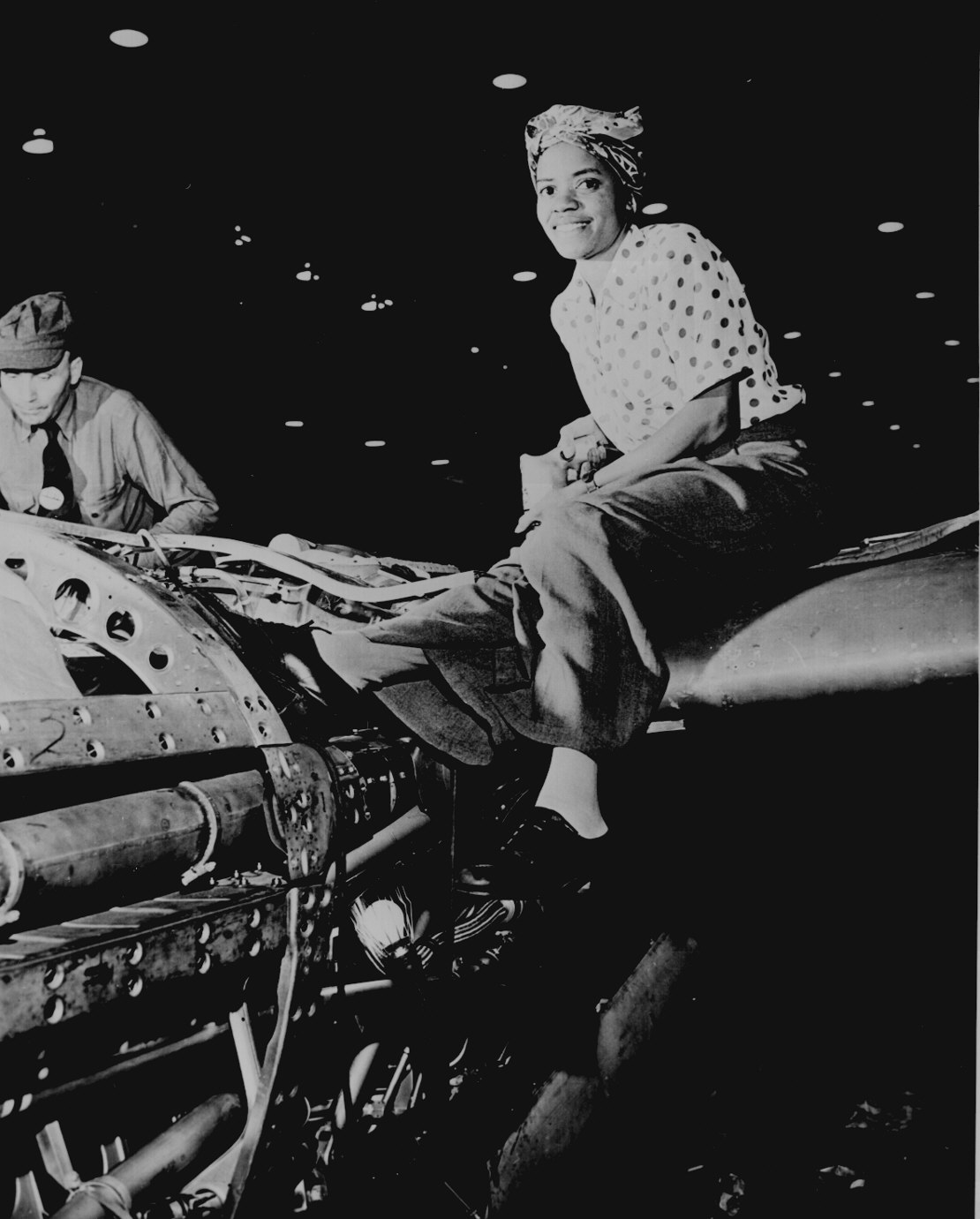
A riveter at the Lockheed Aircraft Corporation plant in Burbank, California.
Women’s Bureau / National Archives (86-WWT-3-67) · Public domain · Original recordImage changes
Display copies resized; original scan preserved.
The words
Conversion
Factories making cars or household appliances had to adapt to war orders. The War Production Board described changes to plant layouts, reused machinery and the installation of new machines.
p. 12 · War Production Board: industry report (opens a new tab)
Factories
Bay Area shipyards drew workers from across the country. Their rapid growth offered jobs but also left many newcomers struggling to find adequate housing.
Home Front
Civilian support reached beyond factory gates. Families grew vegetables, managed ration coupons and collected materials for recycling, connecting everyday household decisions with the wartime supply effort.
Industry
Not every manufacturer needed a complete factory rebuild. The War Production Board noted that some plants could make military goods by working to new drawings and specifications.
p. 12 · War Production Board: industry report (opens a new tab)
Labor
In Bay Area shipyards, women challenged hiring and union barriers. Black women faced added discrimination and were often confined to lower-paid work, even as defense jobs expanded.
Production
Willow Run’s 1944 flow chart showed aircraft moving through successive assembly stages. Four parallel lines merged into two, then one final line handled finishing and fueling.
Riveter
A worker who fastened parts with rivets, metal pins used to hold materials together.
Women’s defense jobs extended beyond riveting. They also welded, tested equipment and operated factory machinery, so Rosie’s name came to represent workers with many different skills.
WWII Museum: Rosie and women workers (opens a new tab) · Cambridge Dictionary: rivet (opens a new tab)
Rosie
The name came from a popular 1942 song by Redd Evans and John Jacob Loeb. Norman Rockwell’s magazine cover followed on May 29, 1943, depicting Rosie on her lunch break.
Did you know?
J. Howard Miller made the separate “We Can Do It!” poster for Westinghouse workers. It had limited distribution during the war and became widely familiar decades later.
War Bonds
People bought war bonds to lend money to the government. Children could contribute too, saving coins for savings stamps that they could exchange for bonds.
War Effort
Bay Area women also supported the war through volunteer work. They organized bond drives, joined civil defense activities, supported Red Cross programs and entertained service members.
War Machine
Here, war machine meant the industrial system behind the armed forces. A War Production Board report described plans to match metal supplies with orders from contractors and their suppliers.
pp. 10–11 · War Production Board: industry report (opens a new tab)
Wartime
When the war ended, employers and the government encouraged women to leave industrial jobs for returning servicemen. Some women wanted to return home, while others wanted to keep working.
Welders
Welding was one of several skilled jobs women performed in Bay Area shipyards. Others included riveting and crane operation, showing how broadly their work supported wartime production.
Women
Many women had paid jobs before the war. Wartime demand brought additional women into employment and moved others from domestic or clerical work into skilled industrial roles.
Workforce
A supply of workers also depended on support outside the factory. Wartime childcare centers helped some mothers remain at work, although the programs did not reach every family.
Sources
- Flow Chart for B-24 Production at the Willow Run Bomber Plant, 1944The Henry Ford; flow chart dated September 1, 1944, Charles C. La Croix Records, object 64.167.435.3, with curatorial description
- For Kids: Rosie the Riveter and the WWII Home FrontU.S. National Park Service; Rosie the Riveter WWII Home Front National Historical Park, educational account, updated December 19, 2024
- Rosie the Riveter: Women War Workers on the WWII Home FrontThe National WWII Museum; Brittany A. Huner, PhD, historical article published March 18, 2026, with numbered source notes
- War Production in 1942U.S. War Production Board, Division of Information; wartime report, Part II, pp. 10–13; U.S. Government Publishing Office digital transcription
- Tending the Homefront: The Many Roles of Women in the San Francisco Bay Area During World War IIU.S. National Park Service; Donna Graves, historian and Rosie the Riveter Memorial project director, historical essay, updated January 25, 2024
- Childcare on the World War II Home FrontU.S. National Park Service; Ella Wagner, PhD, Cultural Resources Office of Interpretation and Education, historical article with notes and bibliography, updated September 11, 2023
- Rivet: meaning in EnglishCambridge University Press; Cambridge Advanced Learner’s Dictionary & Thesaurus, metal-pin noun and fastening verb senses