
World War II
Puzzle 73 · Ardennes to the Rhine · Page 105 in print
Torgau Linkup
U.S. and Soviet patrols met at Leckwitz and Torgau on 25 April 1945.
Jump to a word
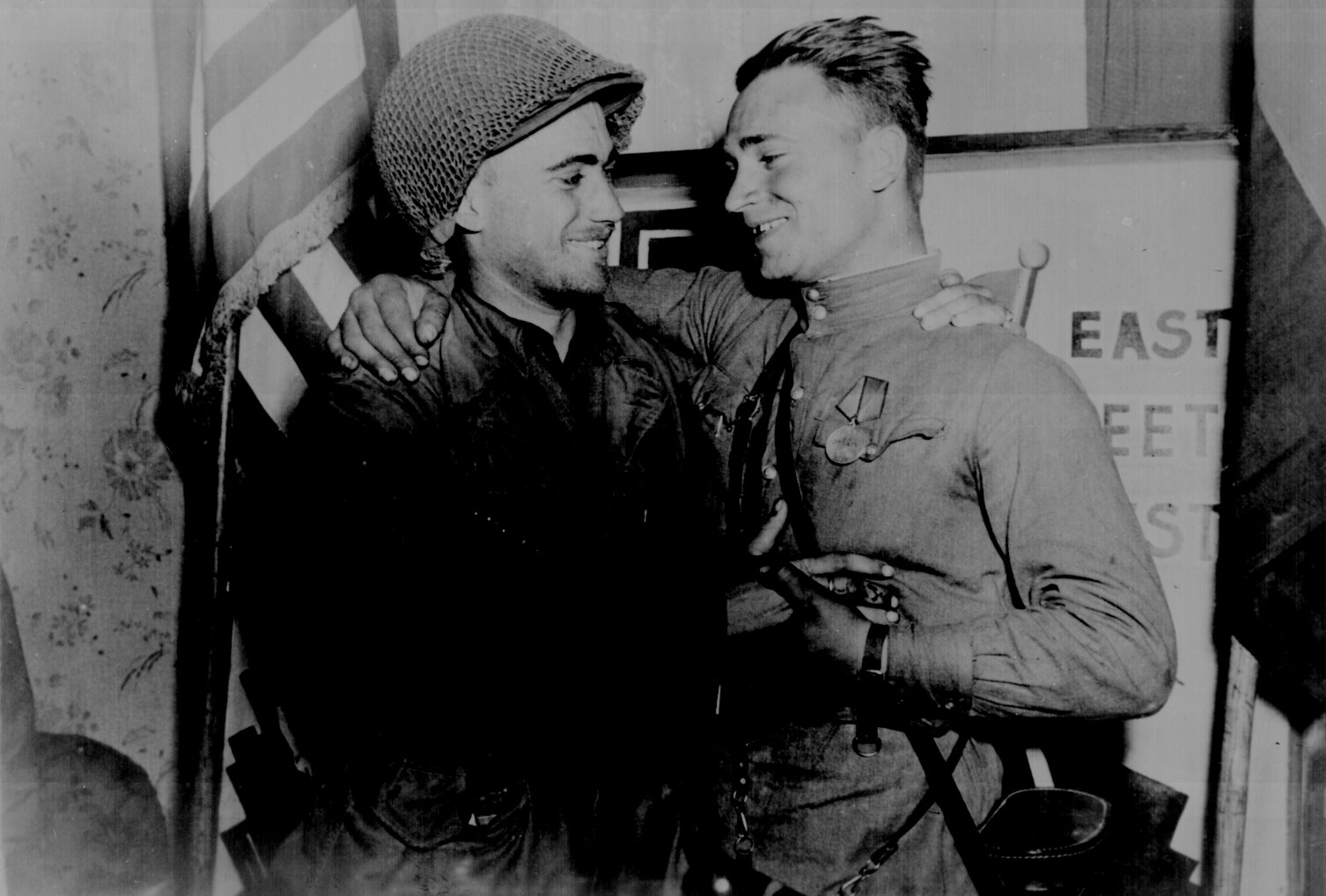
William Robertson, left, and Alexander Sylvashko near Torgau at the meeting of American and Soviet forces in April 1945.
William E. Poulson / U.S. Army Signal Corps / National Archives (111-SC-205228) · Public domain · Original recordImage changes
Display copies resized; original scan preserved.
The words
Alliance
The United States, Britain and the Soviet Union cooperated to defeat Nazi Germany. Wartime cooperation continued despite disputes over strategy and postwar arrangements.
Convergence
Soviet armies fought in the east while American and British forces opened a front in France in 1944. The combined pressure weakened Nazi Germany.
East Meets West
A bridge reenactment for the press on April 26, 1945, helped spread news of the meeting. Torgau became a public symbol of the linkup.
Elbe
The Elbe separated the approaching forces. Kotzebue’s men crossed by boat; Robertson’s group used the wreckage of Torgau’s bridge.
Ch. XIX, pp. 450–451 and 453–454, the two crossings · Army history: the Elbe patrols (opens a new tab)
Handshake
A soldier in an American patrol recalled a Soviet soldier smiling and offering his hand. Their greeting was one of several encounters on April 25, 1945.
Ch. XIX, p. 452, Craig’s patrol greeting after Kotzebue’s earlier contact · Army history: the Elbe patrols (opens a new tab)
Kotzebue
First Lieutenant Albert Kotzebue’s patrol met a Soviet horseman at Leckwitz on April 25, 1945. They then continued to the Elbe near Strehla.
Ch. XIX, pp. 449–451, Leckwitz and the river crossing · Army history: the Elbe patrols (opens a new tab)
Linkup
Kotzebue reported contact, but incorrect map coordinates delayed confirmation. Robertson later brought Soviet officers back as direct evidence of the meeting.
Ch. XIX, pp. 451 and 454–455, conflicting reports and confirmation · Army history: the Elbe patrols (opens a new tab)
Meeting
The patrol encounter at Torgau began with efforts to identify the soldiers across the river. A freed Soviet prisoner helped them communicate.
Rendezvous
A meeting arranged for a particular place and time.
Commanders met at Torgau on April 26, 1945, in the kitchen barracks of the Brückenkopf military prison. The arranged meeting followed the patrol encounters.
Torgau history: the April encounters (opens a new tab) · Cambridge Dictionary: rendezvous (opens a new tab)
Robertson
Lieutenant William Robertson reached Torgau while seeking reported Allied prisoners. His group then encountered Soviet troops across the damaged Elbe bridge.
Did you know?
Robertson’s patrol improvised an American flag from a bed sheet, using red and blue paint found in a local drugstore.
Sixty-Ninth
American patrols came from the 69th Infantry Division’s 273rd Infantry Regiment. Their separate contacts helped establish the link between the armies.
Ch. XIX, pp. 448–449 and 451–455, division and regiment · Army history: the Elbe patrols (opens a new tab)
Soviet
The Americans encountered the Soviet 58th Guards Division. Its commander, Vladimir Rusakov, welcomed Kotzebue’s patrol and another American group on the eastern bank.
Ch. XIX, p. 452, division commander and successive welcomes · Army history: the Elbe patrols (opens a new tab)
Strehla
After the encounter at Leckwitz, Kotzebue’s patrol crossed the Elbe near Strehla. This earlier contact was separate from Robertson’s meeting at Torgau.
Ch. XIX, pp. 450–451 and 453, the distinct encounters · Army history: the Elbe patrols (opens a new tab)
Torgau
Torgau had housed the German military penal system’s headquarters. Prisoner evacuation marches and reports of Allied captives formed part of the setting for Robertson’s arrival.
War's End
Germany’s surrender took effect on May 8, 1945. The Elbe meeting on April 25 had preceded the end of the European war.
Sources
- The Last Offensive, Chapter XIX: GoetterdaemmerungU.S. Army Center of Military History; Charles B. MacDonald, official history, 1973; HyperWar transcription
- U.S.-Soviet Alliance, 1941–1945U.S. Department of State, Office of the Historian; retired Milestones series, historical overview
- Encounter on the ElbeTorgau Tourismus; Wolfgang Oleschinski, head of the Dokumentations- und Informationszentrum (DIZ) Torgau; local historical account
- Surrender of Germany (1945)U.S. National Archives; Act of Military Surrender, May 7, 1945, Record Group 218, with transcript and historical context
- Rendezvous: meaning in EnglishCambridge University Press; Cambridge Advanced Learner’s Dictionary & Thesaurus, arranged-meeting sense