
World War II
Puzzle 72 · Ardennes to the Rhine · Page 104 in print
Operation Plunder
Plunder crossed the Rhine near Wesel on 23-24 March 1945; Varsity’s airborne landings followed on 24 March.
Jump to a word
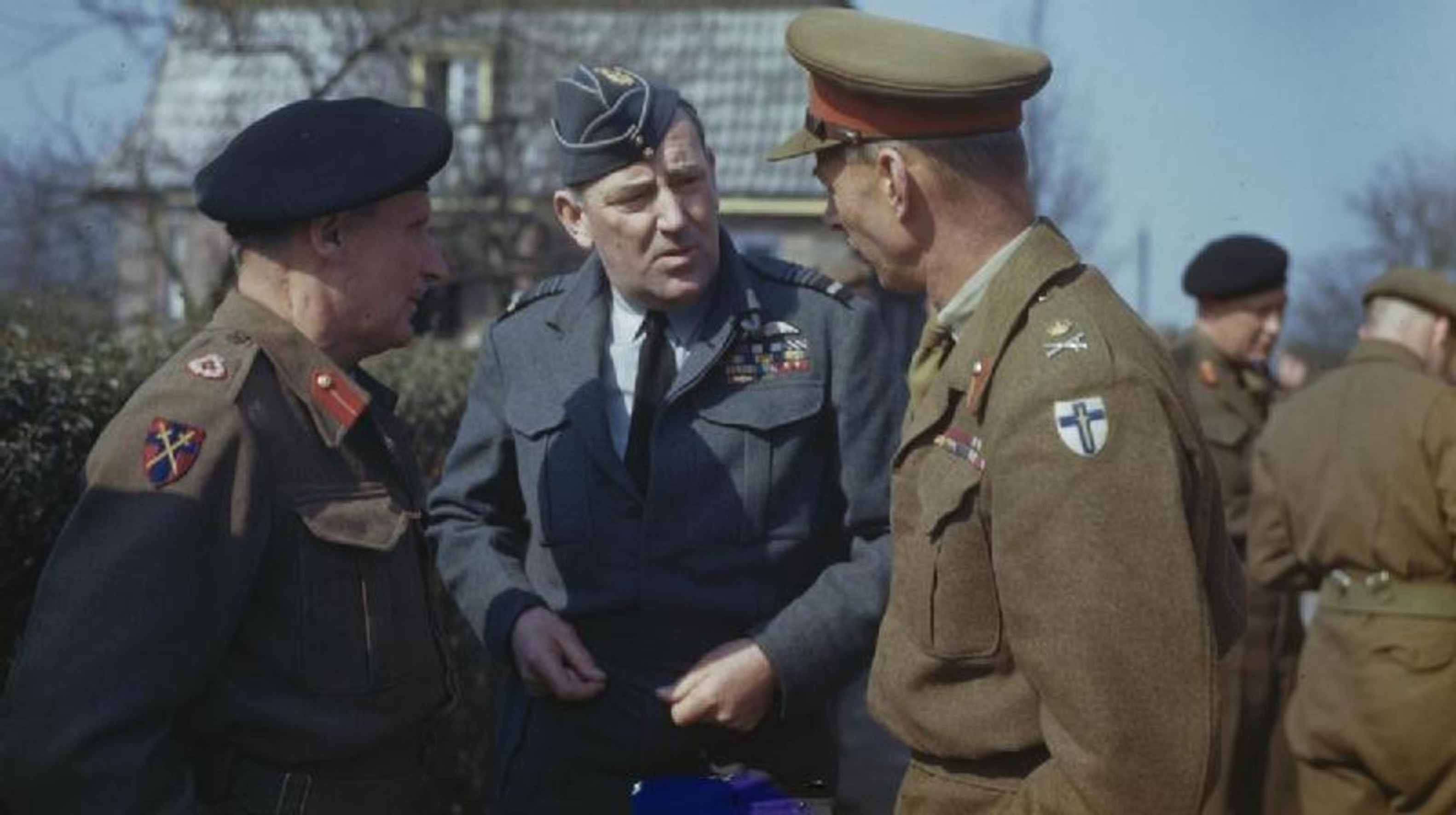
Bernard Montgomery, Arthur Coningham and Miles Dempsey after the Rhine-crossing conference at Walbeck on March 22, 1945.
Edward G. W. Malindine / Imperial War Museums (TR 2789) · Public domain · Original recordImage changes
Display copies resized; original downloaded JPEG preserved.
The words
Bailey Bridge
The Canadian-built Blackfriars crossing at Rees used Bailey bridging on pontoons. Construction from March 26 to 28, 1945, added another way across the Rhine.
P. 543 footnote, Blackfriars construction at Rees · Canadian Army: Blackfriars at Rees (opens a new tab)
Barrage
Concentrated artillery fire supporting an attack.
Heavy artillery fire supported the assault boats. It was meant to keep German defenders down while infantry reached the far bank.
Army history: the northern Rhine assault (opens a new tab) · Cambridge Dictionary: barrage (opens a new tab)
Boats
American infantry crossed in assault boats. Engineers then ferried reinforcements and equipment to strengthen the new bridgeheads.
Ch. XIV, pp. 304–307, assault boats and reinforcement · Army history: the northern Rhine assault (opens a new tab)
Bombardment
Royal Air Force bombers devastated Wesel before the commandos entered. German defenders continued resisting in the rubble.
Ch. XIV, pp. 302–303, Wesel air attack and resistance · Army history: the northern Rhine assault (opens a new tab)
Firepower
Supporting the guns required ammunition, transport and maintained roads. Plunder’s large artillery force depended on the supply effort built up before the crossing.
Parachutes
Varsity included parachute troops and glider-borne units. They landed beyond the river defenses after the ground assault had begun.
Ch. XIV, pp. 298–299, airborne forces and timing · Army history: the northern Rhine assault (opens a new tab)
Paratroopers
Paratroopers had to seize ground east of the Rhine. The wider airborne force included glider troops whose landing was exposed to heavy antiaircraft fire.
Plunder
Plunder’s ground assault began on March 23, 1945. Airborne landings followed on March 24 after Allied troops had established crossings on the far bank.
Rees
British XXX Corps crossed near Rees. Canadian engineers later built Blackfriars there to carry traffic across the river.
MacDonald, ch. XIV, p. 302; Stacey, p. 543 footnote · Army history: the northern Rhine assault (opens a new tab) · Canadian Army: Blackfriars at Rees (opens a new tab)
Simpson
Lieutenant General William Simpson commanded U.S. Ninth Army. His army crossed south of the British Second Army under Montgomery’s 21st Army Group.
Smokescreen
Artificial smoke used to hide movement or positions.
Artificial smoke concealed the Allied build-up. Its presence also alerted German defenders that an assault was approaching.
Army history: the northern Rhine assault (opens a new tab) · Cambridge Dictionary: smokescreen (opens a new tab)
Varsity
The British 6th and U.S. 17th Airborne Divisions landed east of the Rhine on March 24, 1945. Their task was to hold ground for the advancing armies.
VIII Corps
British VIII Corps held the Wesel front before Plunder. XII and XXX Corps then moved through its divisional sectors for the assault.
Ch. 22, p. 111, corps holding the front and assault formations · Survey regiment: VIII Corps before Plunder (opens a new tab)
Wesel
Wesel’s roads and potential bridge sites made it a central objective. British commandos crossed nearby to attack the city before the main assault.
Xanten
British XII Corps crossed near Xanten behind an artillery preparation. This was one sector of the coordinated Rhine assault.
Ch. XIV, p. 303, XII Corps crossing · Army history: the northern Rhine assault (opens a new tab)
Sources
- The Victory Campaign: The Operations in North-West Europe, 1944–1945Canadian Army; C. P. Stacey, Official History of the Canadian Army in the Second World War, Volume III, 1960; p. 543 footnote
- The Last Offensive, Chapter XIV: The Rhine Crossings in the NorthU.S. Army Center of Military History; Charles B. MacDonald, official history, 1973; HyperWar transcription
- Z Location or Survey in War: The Story of the 4th Durham Survey Regiment, R.A., T.A.J. T. Whetton and R. H. Ogden; participant regimental history, second edition, chapter 22, pp. 111–112; Defence Surveyors Association archive
- General William H. Simpson’s Ninth US Army and the Crossing of the RhineThe National WWII Museum; Mark T. Calhoun, March 28, 2023
- Operation VARSITYThe Royal Irish, Virtual Military Gallery; regimental account of March 24, 1945
- Barrage: meaning in EnglishCambridge University Press; Cambridge Advanced Learner’s Dictionary & Thesaurus, military attack sense
- Smokescreen: meaning in EnglishCambridge University Press; Cambridge Advanced Learner’s Dictionary & Thesaurus, literal military sense