
World War II
Puzzle 71 · Ardennes to the Rhine · Page 103 in print
Remagen Bridgehead
The Remagen bridge was captured on 7 March 1945 and collapsed on 17 March.
Jump to a word
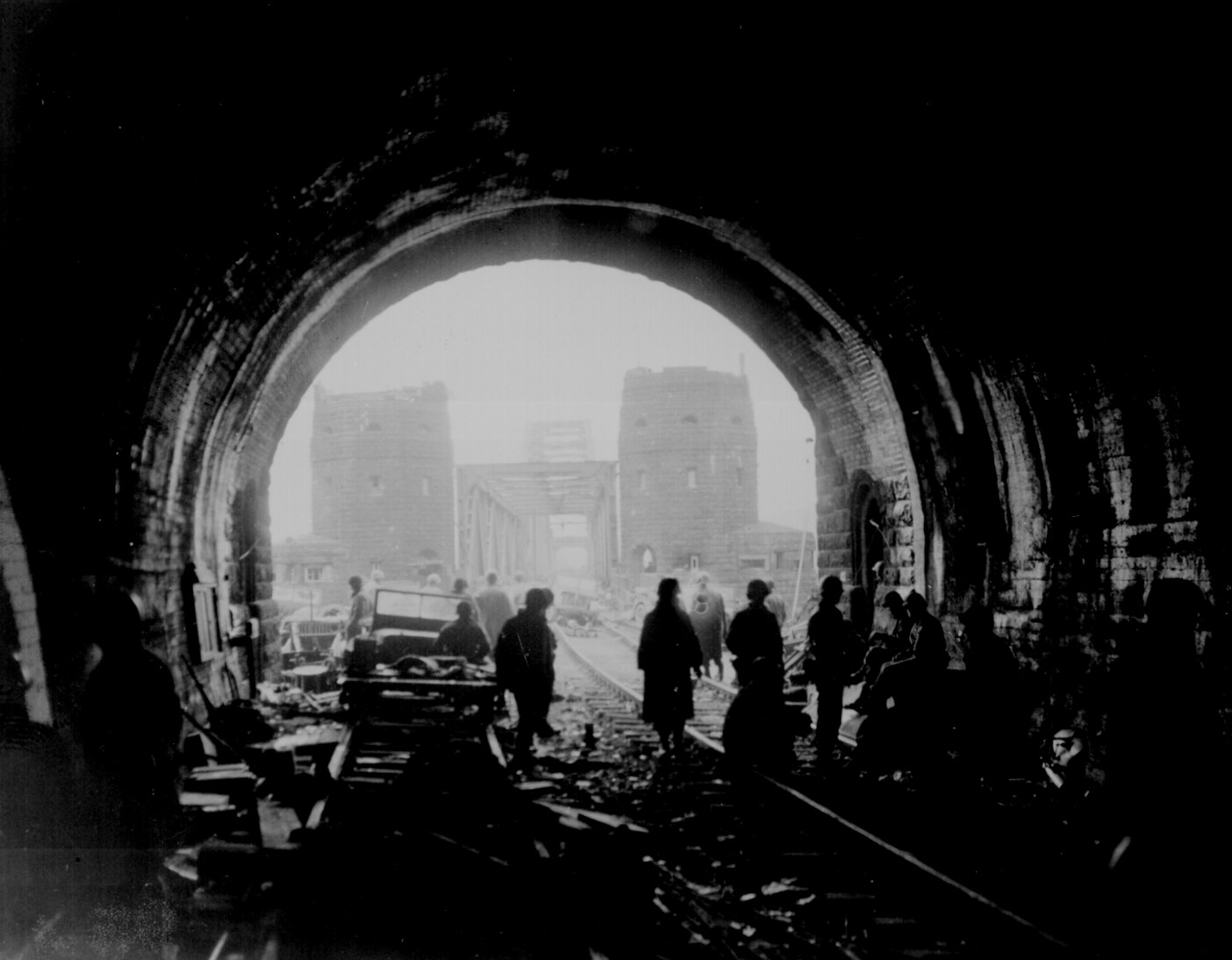
The Remagen railway bridge, seen from the tunnel at its eastern end, on March 11, 1945.
William Spangle / U.S. Army Signal Corps / National Archives (111-SC-201973) · Public domain · Original recordImage changes
Display copies resized; original scan preserved.
The words
Bratge
Willi Bratge was Remagen’s local combat commander until Hans Scheller took over. As an American prisoner, he survived a German death sentence imposed in his absence.
Ch. XI, pp. 208–210 and 230, command succession and sentence · Army history: Remagen and its bridges (opens a new tab)
Bridgehead
An advanced position held in enemy territory.
American troops expanded their position east of the Rhine despite German counterattacks. Reinforcements turned the captured crossing into a base for further operations.
Holocaust Museum: the Remagen bridgehead (opens a new tab) · Cambridge Dictionary: bridgehead (opens a new tab)
Demolition
German commanders delayed destroying the bridge to let retreating troops cross. That decision gave Americans a chance to capture it.
Ch. XI, pp. 213–216, withdrawal and delayed demolition · Army history: Remagen and its bridges (opens a new tab)
Erpeler Ley
The Erpeler Ley rose behind the bridge’s eastern end. Railway tracks entered a tunnel through this steep hill beside the crossing.
Ch. XI, p. 213, eastern end and tunnel · Army history: Remagen and its bridges (opens a new tab)
Explosives
The explosives damaged the bridge without destroying it. Americans then made repairs so that more troops and vehicles could cross.
Foothold
The bridge collapsed on March 17, 1945, killing engineers at work. Temporary crossings were already operating, so the American foothold endured.
Ch. XI, pp. 227 and 229–230, temporary bridges, collapse and continued operations · Army history: Remagen and its bridges (opens a new tab)
Hoge
Brigadier General William Hoge commanded the 9th Armored Division’s Combat Command B. He ordered the force to seize the unexpected crossing.
Ch. XI, pp. 214–215, combat command and capture decision · Army history: Remagen and its bridges (opens a new tab)
Ludendorff
The railway bridge was named for the First World War general Erich Ludendorff. Russian prisoners of war were used in its construction.
Pershing
New Pershing tanks supported the infantry advancing through Remagen. Damage at the bridge approach halted the tanks while infantry continued the crossing on foot.
Pontoon
A boat or float supporting a temporary bridge.
Engineers used pontoon ferries before bridges were complete. These floating rafts carried troops and equipment while construction and repair work continued.
Army history: Remagen and its bridges (opens a new tab) · Cambridge Dictionary: pontoon (opens a new tab)
Remagen
Remagen lay between Bonn and Koblenz. Its rough eastern terrain made it an unlikely planned crossing, but the surviving bridge changed Allied operations.
Rhine
The Rhine was a major barrier on the route into Germany. Capturing a standing bridge offered an alternative to crossing it in assault boats.
Seizure
On March 7, 1945, American infantry rushed the damaged bridge after German explosions failed to bring it down. The capture gave Allied commanders an unexpected crossing.
Timmermann
Lieutenant Karl Timmermann led the infantry across the damaged bridge. Sergeant Alexander Drabik was credited as the first American soldier to reach the far bank.
Zangen
Gustav von Zangen led the German Fifteenth Army. He anticipated an American thrust toward Remagen while Model emphasized defending Bonn.
Ch. XI, pp. 209–210, competing expectations · Army history: Remagen and its bridges (opens a new tab)
Sources
- The Last Offensive, Chapter XI: A Rhine Bridge at RemagenU.S. Army Center of Military History; Charles B. MacDonald, official history, 1973; HyperWar transcription
- Crossing the Rhine at RemagenThe National WWII Museum; Edward G. Lengel, March 6, 2020
- Capture of the Bridge at RemagenUnited States Holocaust Memorial Museum, Holocaust Encyclopedia
- First Across the Rhine: The Bridge at RemagenThe Tank Museum; Stuart Wheeler, March 7, 2025
- Bridgehead: meaning in EnglishCambridge University Press; Cambridge Advanced Learner’s Dictionary & Thesaurus, bridgehead entry
- Pontoon: meaning in EnglishCambridge University Press; Cambridge Advanced Learner’s Dictionary & Thesaurus, bridge sense