
World War II
Puzzle 70 · Ardennes to the Rhine · Page 102 in print
McAuliffe and Nuts
McAuliffe rejected Bastogne’s surrender demand with “Nuts!” on 22 December 1944.
Jump to a word
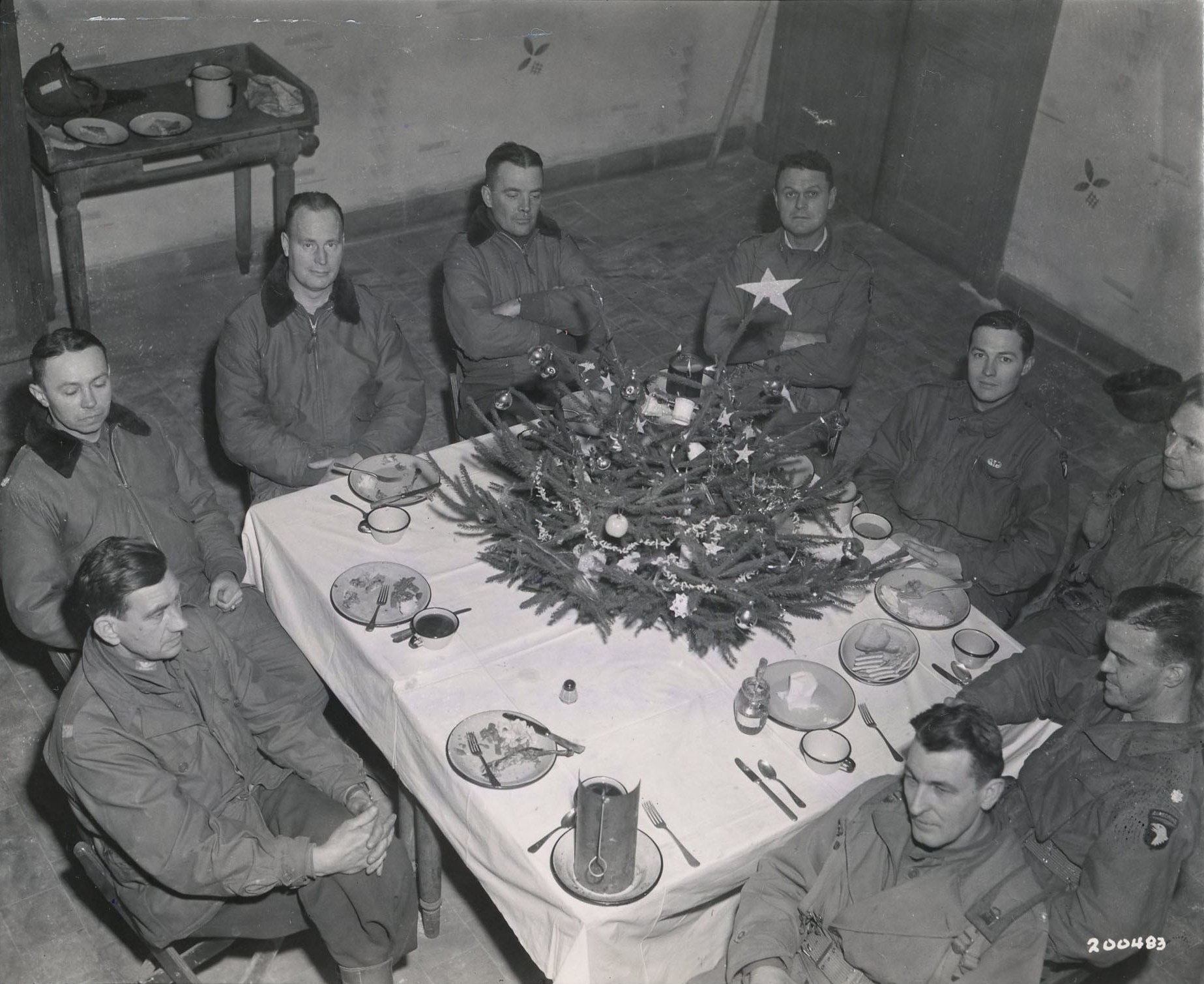
Anthony McAuliffe and his staff at Christmas dinner in Bastogne's Heintz Barracks on December 25, 1944.
U.S. Army / National Archives (111-SC-200483) · Public domain · Original recordImage changes
Display copies resized; original downloaded JPEG preserved.
The words
Courage
Bastogne’s defenders faced the surrender threat while cut off. They held the perimeter, sharing supplies while awaiting relief.
Ch. XIX, pp. 460–461 and 466–467, shortages, isolation and the ultimatum · Army history: Bastogne’s defense (opens a new tab)
Defiance
The typed answer rejected surrender without negotiating terms. It was addressed to the German commander and signed simply “The American Commander.”
German Envoys
Two German officers and two enlisted men approached under white flags. The officers were blindfolded before being escorted to an American command post.
Harper
Colonel Joseph Harper delivered the written reply to the envoys. He and medic Ernest Premetz helped explain the American slang.
U.S. Army: the surrender demand and reply (opens a new tab) · Army history: Harper’s regiment (opens a new tab)
Leadership
McAuliffe consulted his staff before choosing the formal answer. Harry Kinnard suggested repeating the commander’s first reaction.
Luttwitz
Heinrich von Lüttwitz commanded XLVII Panzer Corps. Cole records that he acknowledged responsibility for the ultimatum in 1960, after earlier denying it.
Ch. XIX, pp. 450–451 and 467, note 14 · Army history: Bastogne’s defense (opens a new tab)
McAuliffe
Brigadier General Anthony McAuliffe rejected the demand. His staff turned his initial response into the formal message delivered to the Germans.
Moore
Lieutenant Colonel Ned Moore informed McAuliffe of the demand. As acting chief of staff, he also briefed the headquarters staff.
Nuts
An emphatic refusal.
The reply was typed on a full sheet of paper. Its single-word answer required an explanation for the German officers.
Relief
The first armored linkup brought access rather than instant security. Fighting continued around Assenois before trucks and ambulances could enter Bastogne.
Ch. XXI, pp. 554–555, linkup and clearance of the road · Army history: the relief of Bastogne (opens a new tab)
Resolve
Holding Bastogne required more than a refusal. McAuliffe’s staff regrouped paratroopers, armor and other units to strengthen a thin perimeter.
Ch. XIX, pp. 471–472, defensive reorganization · Army history: Bastogne’s defense (opens a new tab)
Stand Fast
General Troy Middleton’s order was to hold Bastogne. Its western road connections made the town valuable to the German advance.
Ch. XIX, p. 444, the order and westward roads · Army history: Bastogne’s defense (opens a new tab)
Surrender
The envoys asked for the surrender of Bastogne’s encircled forces. McAuliffe’s answer left the American defense in place.
Ch. XIX, p. 467, demand and rejection · Army history: Bastogne’s defense (opens a new tab)
Third Army
General George Patton’s Third Army attacked north toward Bastogne. Its 4th Armored Division opened contact with the garrison on December 26, 1944.
Ch. XXI, pp. 508–509 and 554–555, mission and contact · Army history: the relief of Bastogne (opens a new tab)
Ultimatum
The German demand allowed two hours for surrender. It threatened artillery fire if the Americans refused.
Sources
- The Ardennes: Battle of the Bulge, Chapter XIX: The Battle of BastogneU.S. Army Center of Military History; Hugh M. Cole, official history, 1965; HyperWar transcription
- The story of the NUTS! replyU.S. Army; Kenneth J. McAuliffe Jr., December 8, 2013; account drawing on staff and envoy recollections
- The Ardennes: Battle of the Bulge, Chapter XXI: The III Corps’ Counterattack Toward BastogneU.S. Army Center of Military History; Hugh M. Cole, official history, 1965; HyperWar transcription
- The Ardennes: Battle of the Bulge, Chapter XIII: VIII Corps Attempts To Delay the EnemyU.S. Army Center of Military History; Hugh M. Cole, official history, 1965; HyperWar transcription