
World War II
Puzzle 69 · Ardennes to the Rhine · Page 101 in print
Bastogne Siege
Fourth Armored Division opened a corridor to Bastogne’s defenders on 26 December 1944.
Jump to a word
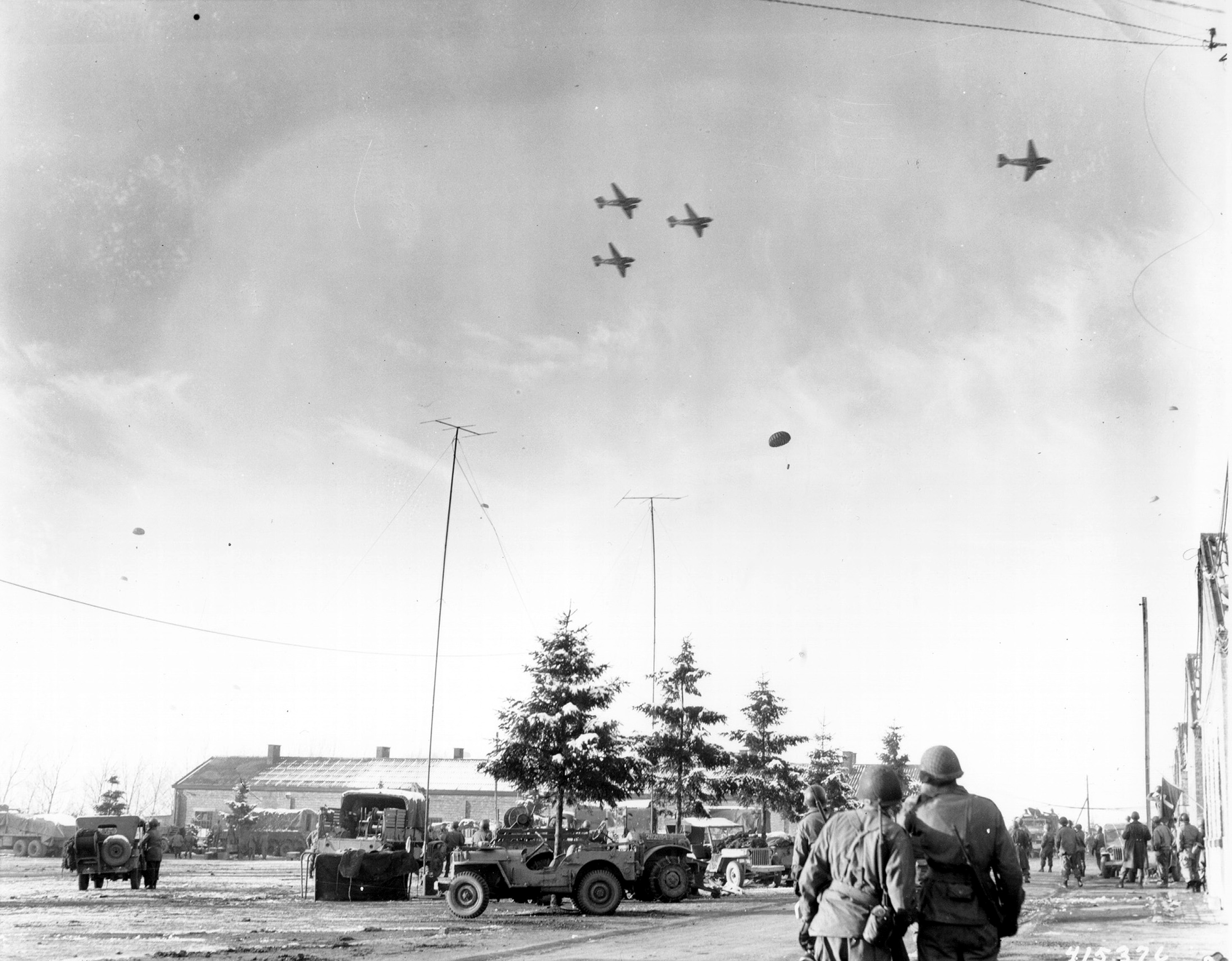
Troops of the 101st Airborne Division watch a supply drop at Bastogne on December 26, 1944.
U.S. Army Signal Corps · Public domain · Original recordImage changes
Display copies resized; original downloaded JPEG preserved.
The words
Abrams
Lieutenant Colonel Creighton Abrams commanded the 37th Tank Battalion. He proposed the dash through Assenois that helped open the route into Bastogne.
Air Drop
When the weather cleared on December 23, 1944, supply flights could reach Bastogne. Transport aircraft dropped parachute loads into the surrounded position.
Bastogne
Bastogne’s roads opened routes westward through the Ardennes. Holding the town denied German forces a valuable junction during their offensive.
Ch. XIX, p. 444, opening objective and road complex · Army history: Bastogne’s defense (opens a new tab)
Christmas
German tanks and infantry attacked on December 25, 1944. American defenders held key positions even as the siege continued.
Ch. XIX, pp. 477–479, the Christmas Day attack · Army history: Bastogne’s defense (opens a new tab)
Cobra King
The Sherman Cobra King led Charles Boggess’s column toward Bastogne on December 26, 1944. Its crew linked up with American defenders north of Assenois.
Did you know?
Cobra King’s name began with C because it belonged to Company C, following a tank-company naming practice.
Command Post
The 101st Airborne Division directed the defense from Heintz Barracks. Headquarters staff received the German surrender demand and prepared the American reply.
Fourth Armored
On December 26, 1944, the 4th Armored Division opened a narrow corridor. The route needed securing before supplies could move freely.
Ch. XXI, pp. 553–555, contact and road clearance · Army history: the relief of Bastogne (opens a new tab)
Foxholes
American soldiers guarded the approaches from foxholes. German envoys seeking surrender passed these positions before their message reached division headquarters.
Garrison
Bastogne’s defenders included paratroopers, tank crews, engineers and artillerymen. These different units shared the task of holding the perimeter.
Ch. XIX, pp. 459–461 and 471–472, combined defense · Army history: Bastogne’s defense (opens a new tab)
Kinnard
Lieutenant Colonel Harry Kinnard was the division’s operations officer. He suggested turning McAuliffe’s spontaneous “Nuts!” into the formal reply to the surrender demand.
Noville
Noville guarded the northern approach to Bastogne. Its defenders delayed German armor before withdrawing toward the town on December 20, 1944.
Ch. XIX, pp. 451–455, Noville defense and withdrawal · Army history: Bastogne’s defense (opens a new tab)
Resupply
Air supply used both parachutes and gliders. Gliders carried ammunition that was difficult to pack efficiently into containers for parachute delivery.
Shelling
German guns struck Bastogne’s perimeter and the town itself. The defenders had to hold their positions under repeated artillery fire.
Ch. XIX, pp. 464–465, attacks and shelling · Army history: Bastogne’s defense (opens a new tab)
Siege
German troops cut Bastogne’s roads, isolating its defenders. Air supply helped sustain the perimeter until a ground corridor opened.
Ch. XIX, pp. 460–461; ch. XXI, pp. 554–555 · Army history: Bastogne’s defense (opens a new tab) · Army history: the relief of Bastogne (opens a new tab)
Team Desobry
Team Desobry combined tanks and infantry at Noville. Paratroopers reinforced the blocking force as German attacks threatened the northern approach.
Ch. XIX, pp. 451–452, roadblock and reinforcement · Army history: Bastogne’s defense (opens a new tab)
Sources
- The Ardennes: Battle of the Bulge, Chapter XXI: The III Corps’ Counterattack Toward BastogneU.S. Army Center of Military History; Hugh M. Cole, official history, 1965; HyperWar transcription
- The Ardennes: Battle of the Bulge, Chapter XIX: The Battle of BastogneU.S. Army Center of Military History; Hugh M. Cole, official history, 1965; HyperWar transcription
- ‘Cobra King’ led 4th Armored Division column that relieved BastogneU.S. Army Europe; Dave Melancon, February 25, 2009; tank identity and historical relief account
- The story of the NUTS! replyU.S. Army; Kenneth J. McAuliffe Jr., December 8, 2013; account drawing on staff recollections
- Air Borne to the AirborneU.S. Army; Louise A. Arnold-Friend, U.S. Army Military History Institute, December 26, 2007