
World War II
Puzzle 68 · Ardennes to the Rhine · Page 100 in print
Ardennes Counteroffensive
Germany attacked the Ardennes on 16 December 1944.
Jump to a word
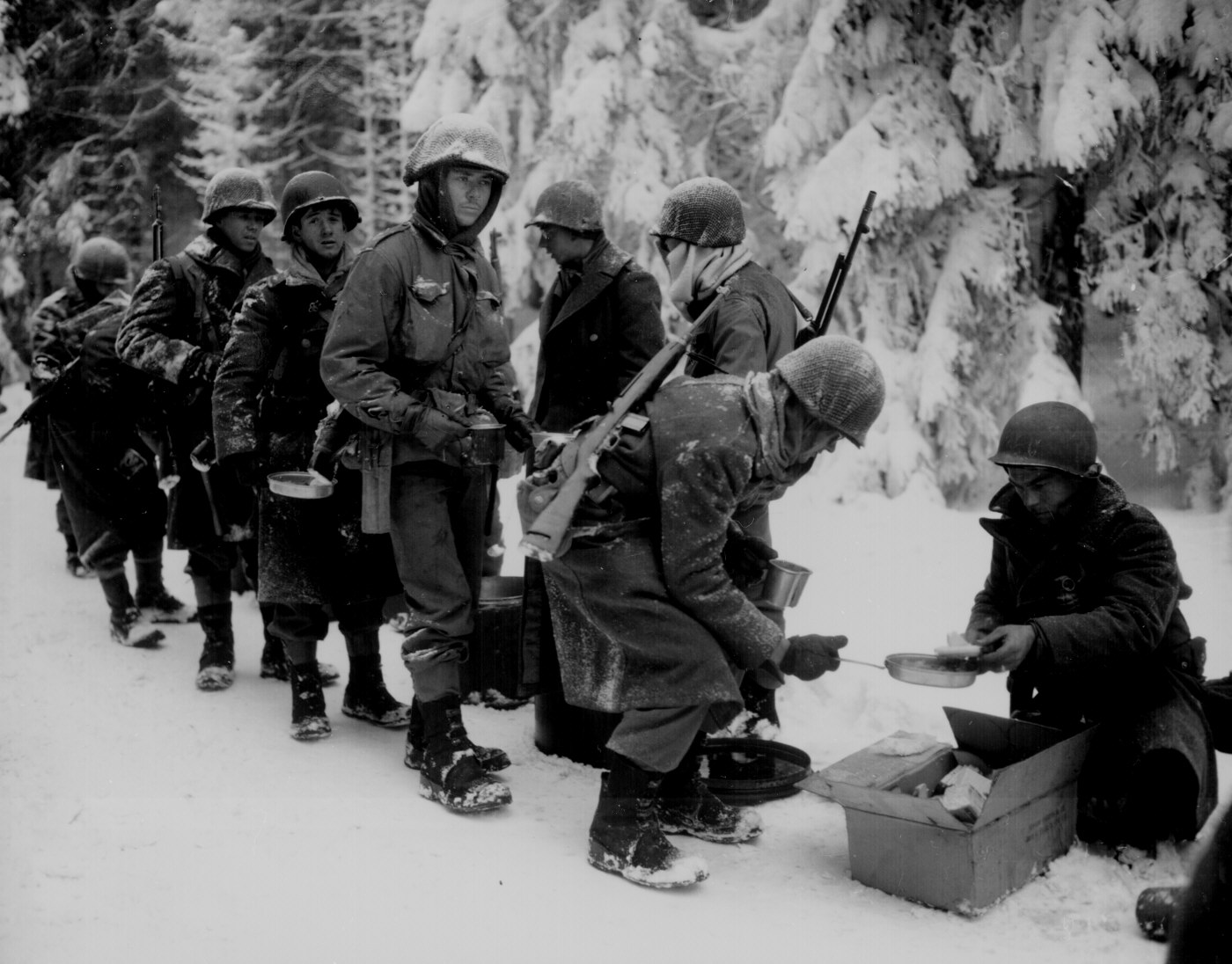
Men of the 347th Infantry Regiment receive food on their way to La Roche, Belgium, on January 13, 1945.
Newhouse / U.S. Army Signal Corps / National Archives (111-SC-198849) · Public domain · Original recordImage changes
Display copies resized; original scan preserved.
The words
Ardennes
American commanders had counted on the Ardennes Forest as a barrier. Germany’s surprise attack on December 16, 1944, broke through a thinly held front.
Brandenberger
Erich Brandenberger’s Seventh Army protected the offensive’s southern flank. Its mainly infantry force had far less armor than the two panzer armies.
Ch. IX, pp. 211–212, flank mission and limited forces · Army history: the southern flank (opens a new tab)
Bulge
The battle took its familiar name from the bulge German troops created in the Allied front. Their aim was to split the Allied armies and capture Antwerp.
Dietrich
Josef “Sepp” Dietrich commanded the northern Sixth Panzer Army. Its SS divisions included the formation responsible for the Malmedy massacre.
Army history: forces and terrain (opens a new tab) · Holocaust Museum: the Malmedy massacre (opens a new tab)
Elsenborn
American resistance at Elsenborn Ridge held the offensive’s northern shoulder. It denied German forces roads they needed to carry the attack westward.
Greif
German commandos used American uniforms and equipment to confuse Allied troops. Their sabotage and the rumors surrounding them disrupted the response to the offensive.
Hodges
General Courtney Hodges commanded First Army. As the German breakthrough developed, he allowed V Corps to decide on withdrawing toward Elsenborn.
Ch. V, pp. 102–103, Gerow’s requests and Hodges’ authorization · Army history: the northern attack (opens a new tab)
Losheim Gap
Losheim Gap lay on a German route toward Malmédy and St. Vith. The surrounding terrain restricted movement to roads.
Ch. III, pp. 44–45, attack routes and restricted movement · Army history: forces and terrain (opens a new tab)
Malmedy
On December 17, 1944, troops of Peiper’s combat group murdered American prisoners near Baugnez, south of Malmedy. The victims had surrendered after their convoy was attacked.
Manteuffel
Hasso von Manteuffel’s Fifth Panzer Army sought routes across the Meuse. One corps was ordered to seize the St. Vith road network.
Ch. VII, p. 141, army briefing and corps mission · Army history: Fifth Panzer Army (opens a new tab)
Peiper
Joachim Peiper led a combat group of the 1st SS Panzer Division. Its troops committed the Malmedy massacre; he was later convicted in the war-crimes trial.
Rochefort
Rochefort linked roads toward the Meuse. Panzer Lehr fell back there after a failed attempt to relieve trapped German troops.
Ch. III, pp. 43–44; ch. XXII, p. 569 · Army history: before the Meuse (opens a new tab) · Army history: forces and terrain (opens a new tab)
Skorzeny
Otto Skorzeny organized Operation Greif to seize a Meuse crossing and create confusion behind Allied lines. The disguised operation depended on a rapid German breakthrough.
St Vith
St. Vith’s roads made it a key objective. American defenders delayed the German advance there, giving the Allies time to respond elsewhere.
Wacht am Rhein
Watch on the Rhine.
This cover name suggested a defensive battle at the Rhine. The actual plan aimed at crossing the Meuse and capturing Antwerp.
Ch. II, pp. 20–21, cover name and the two-phase plan · Army history: planning the offensive (opens a new tab)
Sources
- The Ardennes: Battle of the Bulge, Chapter III: Troops and TerrainU.S. Army Center of Military History; Hugh M. Cole, official history, 1965; HyperWar transcription
- The Ardennes: Battle of the Bulge, Chapter IX: The Attack by the German Left Wing, 16–20 DecemberU.S. Army Center of Military History; Hugh M. Cole, official history, 1965; HyperWar transcription
- The Ardennes: Battle of the Bulge, Chapter XXII: The Battle Before the MeuseU.S. Army Center of Military History; Hugh M. Cole, official history, 1965; HyperWar transcription
- The Ardennes: Battle of the Bulge, Chapter V: The Sixth Panzer Army AttackU.S. Army Center of Military History; Hugh M. Cole, official history, 1965; HyperWar transcription
- The Ardennes: Battle of the Bulge, Chapter II: Planning the CounteroffensiveU.S. Army Center of Military History; Hugh M. Cole, official history, 1965; HyperWar transcription
- The Ardennes: Battle of the Bulge, Chapter VII: Breakthrough at the Schnee EifelU.S. Army Center of Military History; Hugh M. Cole, official history, 1965; HyperWar transcription
- The Bloodiest Battle: The Battle of the Bulge Loomed Large 70 Winters AgoU.S. National Archives, Prologue, Winter 2014, Vol. 46, No. 4
- Victory in EuropeNational Army Museum; Battle of the Bulge section
- The Malmedy MassacreUnited States Holocaust Memorial Museum, Holocaust Encyclopedia; Background, The Massacre and Trial sections
- Operation Greif: German Commandos Sow Chaos Dressed in US UniformsThe National WWII Museum; Mark T. Calhoun, June 30, 2023
- The Battle of the BulgeThe National WWII Museum; Keith Huxen, December 18, 2019