
World War II
Puzzle 67 · Ardennes to the Rhine · Page 99 in print
Hurtgen Forest
The U.S. 9th and 28th Infantry Divisions suffered heavy losses in Hurtgen’s woods in autumn 1944.
Jump to a word
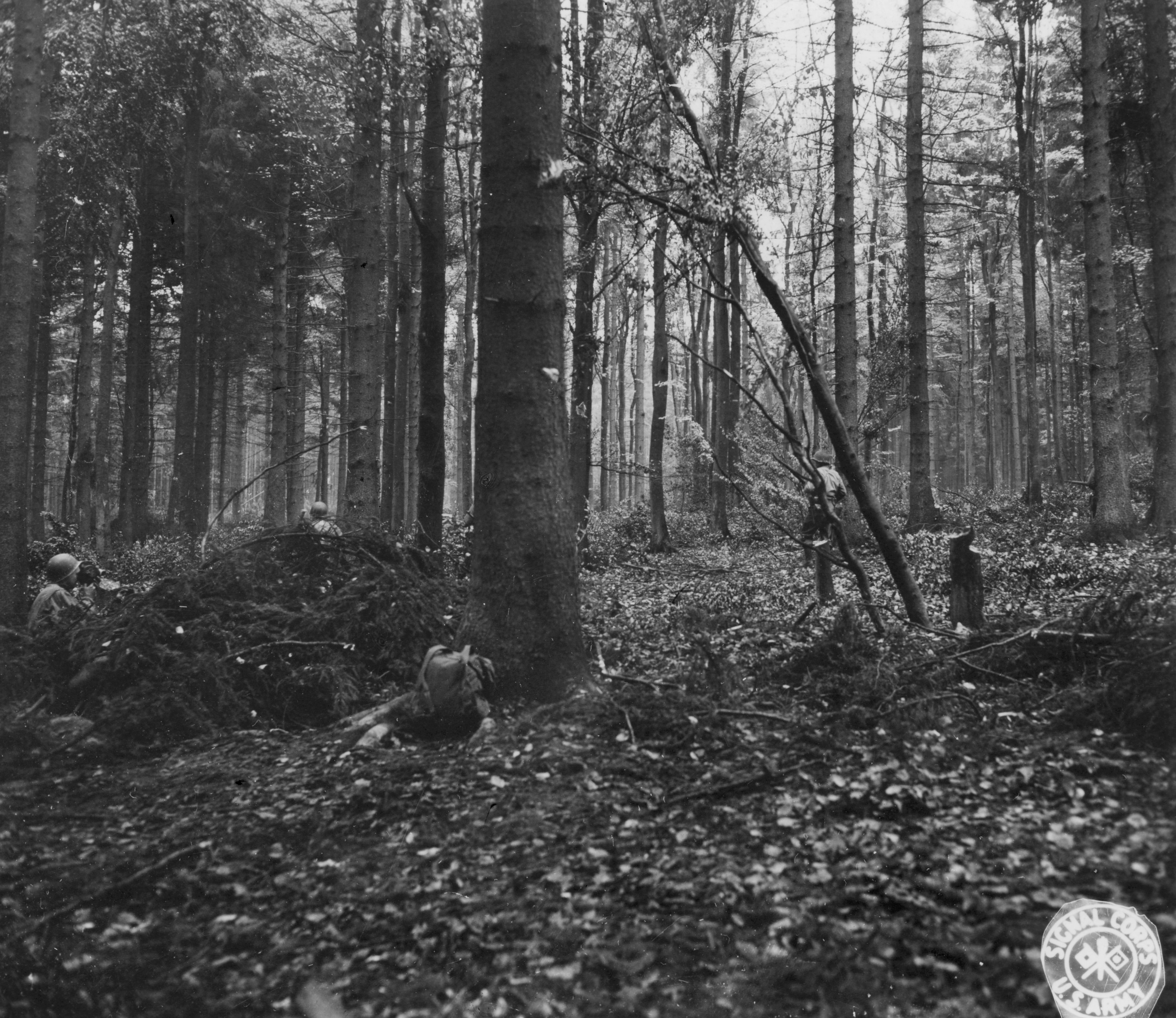
Infantrymen of Company E, 110th Infantry Regiment, move through Hürtgen Forest near Vossenack on November 2, 1944.
Pfc. W. Goodman / U.S. Army Signal Corps / Signal Corps Archive (SC 334972) · Public domain · Original recordImage changes
Display copies resized; original downloaded JPEG preserved.
The words
Attrition
Gradual wearing down through continuing losses.
Repeated attacks brought heavy losses without a quick breakthrough. The Bundesarchiv describes strong German defenses, difficult terrain and weather that prolonged the struggle.
Historischer Hintergrund, prolonged fighting and defensive obstacles · German Federal Archives: Hürtgenwald (opens a new tab)
Bloody Bucket
The nickname refers to the 28th Division’s red keystone patch. Its shape and color made the insignia resemble a bucket.
The division history and patch explanation · Pennsylvania Guard: the keystone patch (opens a new tab)
Death Factory
American soldiers called the battlefield Death Factory. Mines, snipers and heavy guns inflicted losses in a forest that offered no easy way forward.
Historischer Hintergrund, American name and battlefield hazards · German Federal Archives: Hürtgenwald (opens a new tab)
Forest
Dense woodland, difficult terrain and bad weather hindered movement and support. German bunkers and minefields strengthened a landscape already unfavorable to the attackers.
Historischer Hintergrund, terrain and defenses · German Federal Archives: Hürtgenwald (opens a new tab)
Hemingway
Ernest Hemingway accompanied Allied infantry into the Hürtgen forest as a civilian war correspondent. His reporting brought readers an account of frontline soldiers’ experience.
World War II section, infantry travel and correspondent role · National Archives: Hemingway at war (opens a new tab)
Hurtgen
Hürtgen lay in the northern Eifel, southeast of Aachen. What American commanders expected to be a passage toward the Rhine became prolonged, costly fighting.
Historischer Hintergrund, geography and the mistaken expectation · German Federal Archives: Hürtgenwald (opens a new tab)
Kall Trail
The narrow Kall Trail linked troops beyond the gorge with their rear. Disabled tanks could block this vital supply route.
Ch. XV, pp. 344–345 and 354–355, supply route and stalled tanks · Army history: the November Schmidt attack (opens a new tab)
Log Bunkers
German troops built heavy log emplacements where pillboxes were absent. These low positions strengthened the forest defenses.
Ch. XV, p. 349, Raffelsbrand defenses · Army history: the November Schmidt attack (opens a new tab)
Roer Dams
The dams threatened flooding downstream. Yet the original November plan contained no recorded mission to continue beyond Schmidt and seize them.
Ch. XV, pp. 341–342, the omitted dam objective · Army history: the November Schmidt attack (opens a new tab)
Salinger
The writer J. D. Salinger served in Army counterintelligence, questioning captured German soldiers. His unit fought in the Hürtgen forest.
Army service paragraphs, counterintelligence and Hurtgen · Nixon Foundation: Salinger’s Army service (opens a new tab)
Schmidt
The 28th Division took Schmidt, but German tanks and infantry counterattacked. American defenders withdrew as their position collapsed.
Ch. XV, pp. 355–356, the November 4 counterattack · Army history: the November Schmidt attack (opens a new tab)
Tree Bursts
Shell explosions among treetops.
The 109th Infantry dug frantically for protection from tree bursts. Even small movements in the forest brought further casualties.
Ch. XV, p. 348, the 109th Infantry’s exposed salient · Army history: the November Schmidt attack (opens a new tab)
Twenty-Eighth
Norman Cota’s 28th Division attacked toward Schmidt. Its regiments also had to protect flanks and open supporting routes.
Ch. XV, pp. 342–344, division command and divided tasks · Army history: the November Schmidt attack (opens a new tab)
Vossenack
The 112th Infantry captured Vossenack on November 2. Its ridge position remained exposed to German observation from nearby heights.
Ch. XV, pp. 348–349, capture and observation · Army history: the November Schmidt attack (opens a new tab)
West Wall
West Wall positions blocked the Monschau Corridor. American plans sought to approach them from front and rear after taking Schmidt.
Ch. XV, p. 341, planned double assault · Army history: the November Schmidt attack (opens a new tab)
Sources
- The Siegfried Line Campaign, Chapter XV: The Second Attack on SchmidtU.S. Army Center of Military History; Charles B. MacDonald, official history, 1963; HyperWar transcription
- Die „Todesfabrik“ – Einsatzkarten zur Schlacht im HürtgenwaldBundesarchiv; historical context and operational maps RH 26-275/16K, with postwar annotations; German-language account
- Hemingway on War and Its AftermathU.S. National Archives, Prologue, Spring 2006; Thomas Putnam, John F. Kennedy Library
- Salinger The HeroRichard Nixon Foundation, February 6, 2010; historical and literary essay
- Deployed Pennsylvania Guard Soldiers Earn Their Combat PatchU.S. Army; Staff Sgt. Jonathan Campbell, Joint Force Headquarters – Pennsylvania National Guard, March 27, 2024