
World War II
Puzzle 07 · Fighter Command and the Blitz · Page 19 in print
London Blitz
The London Blitz began on September 7, 1940, with large daylight raids on the docks of East London. German bombers returned that night, beginning sustained attacks on the capital.
Jump to a word
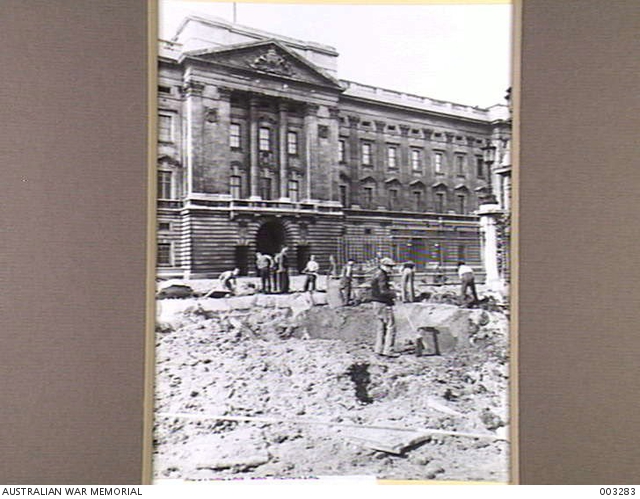
A bomb crater outside Buckingham Palace, about October 1940.
Unknown British official photographer / Australian War Memorial (003283) · Public domain · Original recordImage changes
Display copies resized; original downloaded JPEG preserved.
The words
Air Raid Siren
Sirens sounded warnings of approaching raids. A surviving Air Raid Precautions card distinguished a wavering warning from a continuous tone meaning the raiders had passed.
Card transcript, Air Raid Warning Signals · National Archives: warning card (opens a new tab)
Blitz
The Blitz brought sustained German bombing to London and other British cities. The RAF Museum traces London’s large-scale attacks to September 7, 1940, when daylight raids continued into the night.
Churchill
Winston Churchill was Britain’s prime minister during the Blitz. His first premiership lasted from 1940 to 1945; the official biography describes him leading an all-party coalition government.
Civilian
Civilians lived through bombing while maintaining households and work. London Museum records people outside military service volunteering as wardens, firefighters and medical workers before the raids.
Preparation and the “phoney war” · London Museum: the Blitz (opens a new tab)
Daylight Raids
The opening attacks on London’s docks came in daylight on September 7, 1940. Bombers returned that night, linking the daytime raids with the sustained bombing that followed.
Docks
The docks were London’s port facilities, where ships and warehouses handled goods. The RAF Museum identifies the docks of East London as targets of the September 7, 1940 raids.
East End
The East End’s dockside districts were among the first areas hit in the sustained London raids. The RAF Museum records fires there still visible after the opening night.
Incendiary
Incendiary bombs started fires. London Museum records their use against east London’s docks on September 7, 1940, connecting this term with the burning warehouses in the opening raids.
When did the Blitz begin? · London Museum: the Blitz (opens a new tab)
London
London became the focus of large-scale German attacks on September 7, 1940. The RAF Museum places this change of target within the wider campaign against Britain’s fighter defenses.
Morale
Morale concerned people’s confidence under pressure. London Museum describes mutual help alongside fear and trauma, showing why the familiar image of cheerful endurance tells only part of the story.
Morrison
The Morrison was an indoor steel shelter used inside a house. IWM’s catalog of Shelter at Home, a 1941 government film, describes one placed in a suburban living room.
Did you know?
In the film’s catalog description, a sheet is spread over the shelter and crockery is set out for tea. Its flat top could serve as a dining table.
NPB 11071, description and production date · IWM: Shelter at Home, 1941 (opens a new tab)
Propaganda
The government used films to encourage support for the war. London Museum identifies London Can Take It!, a 1940 propaganda film, with efforts to sustain morale.
The Blitz spirit · London Museum: the Blitz (opens a new tab)
Shelter
Londoners sought protection in many kinds of shelter. London Museum records official shelters alongside improvised refuges in shop basements, church crypts and the Tilbury shelter beneath a warehouse.
Did you know?
Shared shelters could develop their own social life. The museum describes singing and Christmas celebrations, alongside crowded conditions and tensions between people from different backgrounds.
Londoners took shelter underground · London Museum: the Blitz (opens a new tab)
Tube
London’s Underground railway provided shelter in tunnels and on station platforms. The RAF Museum describes the addition of bunks and first-aid facilities as stations took on this wartime role.
Did you know?
Canteens opened within the Tube system, and shelter marshals helped maintain order and provide first aid. The stations became places where people spent long periods, alongside their railway function.
Underground station section · RAF Museum: shelters and wardens (opens a new tab)
Warden
Air Raid Precautions wardens gave local advice and helped protect civilians. The warning card listed nearby wardens and first-aid posts, while the RAF Museum describes duties including maintaining the blackout.
Did you know?
The RAF Museum describes most wardens as unpaid, part-time volunteers who also held daytime jobs. Their civil-defense work was an additional responsibility alongside ordinary employment.
National Archives: warning card (opens a new tab) · RAF Museum: shelters and wardens (opens a new tab)
Sources
- Air Raid PrecautionsThe National Archives
- The Battle of Britain Phase FourRoyal Air Force Museum
- Air Raid Shelter ProtectionRoyal Air Force Museum
- London’s Blitz: A city at warLondon Museum
- History of Sir Winston ChurchillUK Government
- SHELTER AT HOME [Main Title]Imperial War Museums