
World War II
Puzzle 08 · Fighter Command and the Blitz · Page 20 in print
Coventry Raid
Coventry’s November 1940 raid killed over 500 people and destroyed the cathedral.
Jump to a word
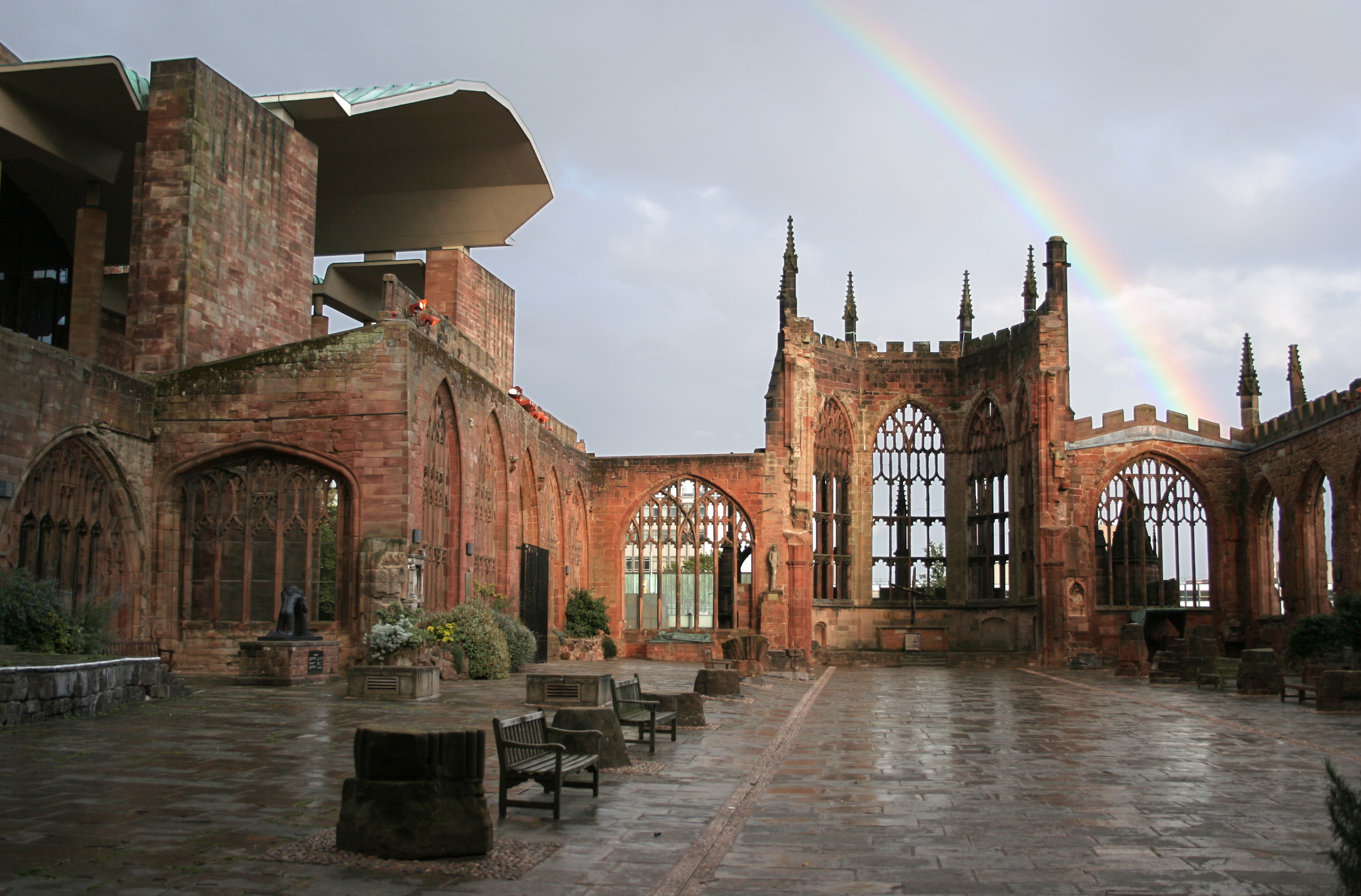
Coventry Cathedral’s ruins beneath a rainbow in October 2006.
Andrew Walker (walker44) / Coventry Cathedral Ruins with Rainbow · CC BY-SA 3.0 · Original recordImage changes
Display copies resized; original downloaded JPEG preserved.
The words
Air Attack
The raid targeted an industrial city whose factories supplied the war effort. Richards lists motor, aero-engine and component works among the German force’s assigned objectives.
The Blitz, pp. 210–211 · Richards: The Blitz, ch. VII (opens a new tab)
Air Raid
German bombers attacked Coventry through the night of November 14–15, 1940. Richards records the attacks continuing until shortly before six the following morning.
The Blitz, pp. 210–211 · Richards: The Blitz, ch. VII (opens a new tab)
Blackout
The blackout reduced light that might guide enemy aircraft. A surviving Air Raid Precautions card shows how controlling household lighting formed part of civilians’ wartime responsibilities.
Did you know?
The warning card named doors and skylights as well as windows. Householders had to consider every opening through which indoor light might show.
Card transcript, Lighting Restrictions · National Archives: warning card (opens a new tab)
Cathedral
St Michael’s medieval cathedral burned after incendiary bombs struck it on November 14, 1940. Its remains were preserved as a reminder of war, linking the wartime damage with the later ruins shown here.
Did you know?
The medieval building began as a parish church. It became the cathedral of the new Diocese of Coventry in 1918, long after the church itself was built.
Coventry
Coventry was a major center of war production. Its factories, homes and medieval center were damaged in the November 1940 raid, bringing industrial and civilian life into this puzzle.
Did you know?
Coventry adopted Kiel as a German twin city in 1947, followed by Dresden in 1956. The city’s account links its postwar history with international peace and reconciliation.
Daimler
Daimler’s works linked Coventry’s vehicle and engine industries with the war effort. The city council records a major factory fire there during the raid.
City account, fact 10 · Coventry Council: the November raid (opens a new tab)
Firestorm
The city council describes “firestorms” in Coventry after the raid. Its account records continued heat and darkness at midday on the following day, conveying the extent of the fires.
City account, fact 11 · Coventry Council: the November raid (opens a new tab)
Goering
Reichsmarschall (Reich marshal) Hermann Göring commanded the Luftwaffe in 1940. He helped develop Nazi policies to rob and murder Jews and was convicted of war crimes and crimes against humanity at Nuremberg.
RAF Museum: Hermann Göring (opens a new tab) · USHMM: Göring and Nazi crimes (opens a new tab)
Heinkel
Heinkel He 111 bombers of Kampfgruppe 100 led the Coventry attack. Richards describes this specialist unit taking a pathfinding role, locating the target before the main bomber force arrived.
The Blitz, p. 210 · Richards: The Blitz, ch. VII (opens a new tab)
Incendiaries
Incendiaries were bombs intended to start fires. The city’s account records their use alongside high explosives, helping explain the widespread burning described elsewhere in this puzzle.
City account, facts 6 and 10 · Coventry Council: the November raid (opens a new tab)
Inferno
The printed word describes the huge blaze at the Daimler works. Coventry’s council uses it for factory buildings burned by high-explosive and incendiary bombs during the raid.
City account, fact 10 · Coventry Council: the November raid (opens a new tab)
Moonlight
The full moon mattered to planning night raids. An Air Ministry note recorded intelligence that a large German attack was expected at full moon in November 1940.
AIR 2/5238, Intelligence, paras. 1–3 · National Archives: raid plans (archived) (opens a new tab)
Night Raids
Coventry’s attack formed part of the Luftwaffe’s night bombing of industrial cities. Richards describes further raids against ports and manufacturing centers after the Coventry attack in November 1940.
The Blitz, pp. 211–212 · Richards: The Blitz, ch. VII (opens a new tab)
Searchlight
Searchlights tried to illuminate raiders for guns and night fighters. Richards describes their difficulty holding aircraft in the beam, especially when clouds or height obstructed the light.
The Blitz, pp. 201–202 · Richards: The Blitz, ch. VII (opens a new tab)
X-Gerat
X-Gerät was the radio-guidance system used by Kampfgruppe 100. Richards connects this equipment with the unit’s pathfinding role at Coventry, explaining how navigation supported the night attack.
The Blitz, p. 210 · Richards: The Blitz, ch. VII (opens a new tab)
Sources
- 20 facts you might not know about the Coventry BlitzCoventry City Council
- Air Raid PrecautionsThe National Archives
- Commander in Chief of the LuftwaffeRoyal Air Force Museum
- Moonlight Sonata and Cold WaterThe National Archives (Internet Archive copy)
- Royal Air Force 1939–1945, Volume I: The Fight at Odds, Chapter VII, The BlitzHMSO (HyperWar mirror)
- The RuinsCoventry Cathedral
- Hermann Göring’s Role in the HolocaustUnited States Holocaust Memorial Museum