
World War II
Puzzle 06 · Fighter Command and the Blitz · Page 18 in print
Biggin Hill
Heavy bombing in summer 1940 damaged Biggin Hill’s operations room. Fighter control moved to the ballroom in Towerfields, a nearby house in Keston, allowing the station to keep directing its squadrons.
Jump to a word
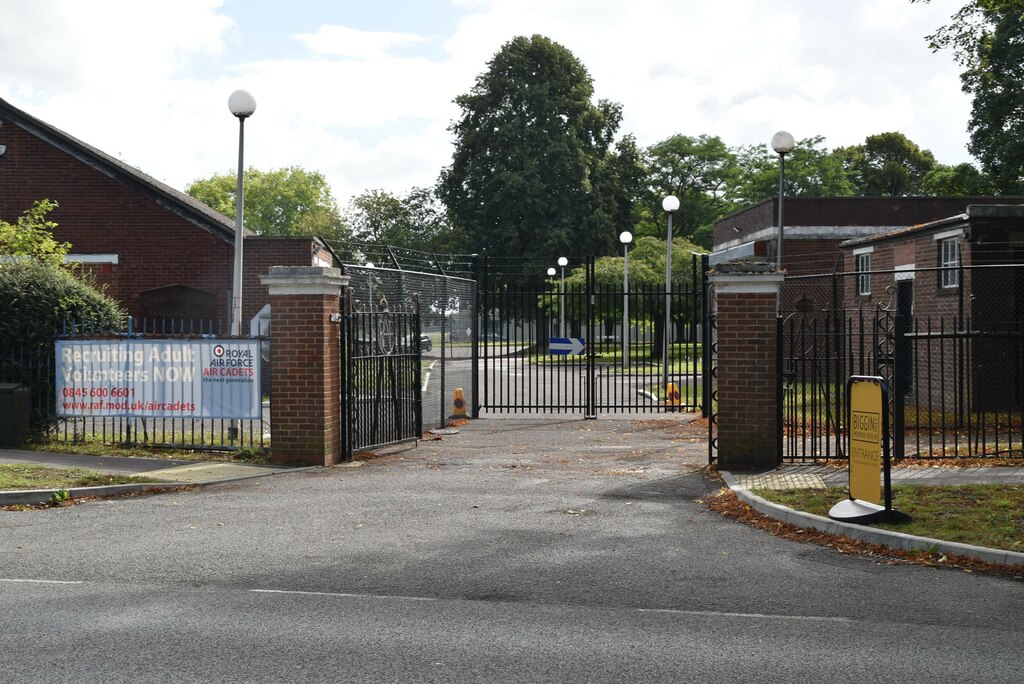
The entrance to the former RAF Biggin Hill, photographed in August 2020.
N Chadwick / Former RAF Biggin Hill · CC BY-SA 2.0 · Original recordImage changes
Display copies resized; original downloaded JPEG preserved.
The words
Aerodrome
British term for an airfield.
Air Chief Marshal Sir Hugh Dowding’s despatch described pilots resting away from their aerodromes. The term places the airfield within the wider life of a fighter station.
Despatch, para. 197 · Dowding’s despatch, p. 4556 (opens a new tab) · Merriam-Webster: aerodrome (opens a new tab)
Airfield
Biggin Hill opened as a military landing ground in 1917. The site later expanded into a fighter airfield, with operational buildings and aircraft dispersal areas.
Official list entry, History · Historic England: Biggin Hill pens (opens a new tab)
Biggin Hill
Biggin Hill was one of No. 11 Group’s sector stations. The museum records its operations room moving to a ballroom at Towerfields after bombing damage in summer 1940.
Historic England: Uxbridge bunker (opens a new tab) · Biggin Hill Museum: staff recollections (opens a new tab)
Control Tower
The printed term refers to West Malling’s control tower, built in 1939–1940. West Malling was a Biggin Hill satellite, and its tower combined airfield traffic control with weather and signals offices.
Did you know?
The tower’s ground floor included a pilots’ room and forecast facilities. Above were the main control room and weather and signals offices, with a glazed observation room on the top floor.
Official list entry, Plan and History · Historic England: West Malling tower (opens a new tab)
Dispersal
Dispersal spread fighters around the airfield in protected pens. At Biggin Hill, 12 Type E pens were arranged around the perimeter track before the Battle of Britain.
Did you know?
Each pen originally contained two aircraft bays separated by a central wall, with a ground-crew shelter at the rear. The layout placed shelter close to the parked aircraft.
Official list entry, History and Details · Historic England: Biggin Hill pens (opens a new tab)
Fighter Base
Biggin Hill developed as a fighter base between the wars. Its 1938 experiments helped connect radio communication and ground control with aircraft in the air.
Official list entry, History · Historic England: Biggin Hill pens (opens a new tab)
Hangar
Hangars sheltered aircraft and supported work on them. Historic England records damage to Biggin Hill’s hangars during the bombing of August 1940.
Official list entry, History · Historic England: Biggin Hill pens (opens a new tab)
Kent
West Malling in Kent was a satellite of Biggin Hill. Its control tower’s official history connects the county’s airfields with No. 11 Group’s defense network.
Official list entry, Location and History · Historic England: West Malling tower (opens a new tab)
Royal Air Force
The Royal Air Force operated Biggin Hill within Fighter Command. Its warning network passed information through national, group and sector headquarters before squadrons received orders to intercept incoming raids.
Historic England: Uxbridge bunker (opens a new tab) · Bentley Priory Museum: control system (opens a new tab)
Runway
Biggin Hill’s hard runways were completed in March 1940. They formed part of an expansion that also added a perimeter track and aircraft pens.
Official list entry, History · Historic England: Biggin Hill pens (opens a new tab)
Scramble
A rapid takeoff in response to an alert.
The sector operations room sent launch orders to fighter airfields. The museum describes this response to incoming raid reports as part of the warning network linking headquarters with individual squadrons.
Bentley Priory Museum: control system (opens a new tab) · Merriam-Webster: scramble (opens a new tab)
Sector
Biggin Hill controlled one district within No. 11 Group. Information moved from group headquarters to sector operations rooms, which then issued orders to fighter airfields in their area.
Historic England: Uxbridge bunker (opens a new tab) · Bentley Priory Museum: control system (opens a new tab)
Squadron
Dowding’s despatch quotes Air Vice Marshal Keith Park describing three Spitfire squadrons concentrated at Biggin Hill. The squadron was the flying unit within the larger station and command network.
Despatch, para. 202 · Dowding’s despatch, p. 4556 (opens a new tab)
Station
Biggin Hill’s station staff included women working as plotters. The museum records Ann Galley’s service from 1941 to 1944, describing her work at the relocated operations room’s map table.
Did you know?
Galley also remembered dressing up and putting on performances with other servicewomen at Keston Village Hall. Her recollection describes a social life alongside the station’s demanding work.
Wartime memories, Ann Galley · Biggin Hill Museum: staff recollections (opens a new tab)
Wing Commander
Wing commander was an RAF rank. The museum places Adolf “Sailor” Malan’s Biggin Hill wing-command appointment in March 1941 and his appointment as station commander in 1943.
Did you know?
Malan’s nickname “Sailor” came from his time in the navy. The museum records that he joined the RAF in 1936, bringing an earlier service career to his later role as a fighter pilot.
Biographical account, command appointments · Biggin Hill Museum: Sailor Malan (opens a new tab)
Sources
- Group of three Fighter Dispersal Pens at Biggin Hill Airport, list entry 1444385Historic England
- Group Operations Room, list entry 1392556Historic England
- Wartime memoriesRAF Biggin Hill Museum & Chapel
- Control Tower, list entry 1390914Historic England
- Operations Room ClockBentley Priory Museum
- ‘Sailor’ Malan’s BirthdayRAF Biggin Hill Museum & Chapel
- Dowding’s Battle of Britain despatch, London Gazette supplement 37719, p. 4556The London Gazette
- Aerodrome — Definition & MeaningMerriam-Webster
- Scramble — Definition & MeaningMerriam-Webster