
World War II
Puzzle 05 · Fighter Command and the Blitz · Page 17 in print
Spitfire Squadrons
No. 19 Squadron received its first Spitfire at Duxford on August 4, 1938.
Jump to a word
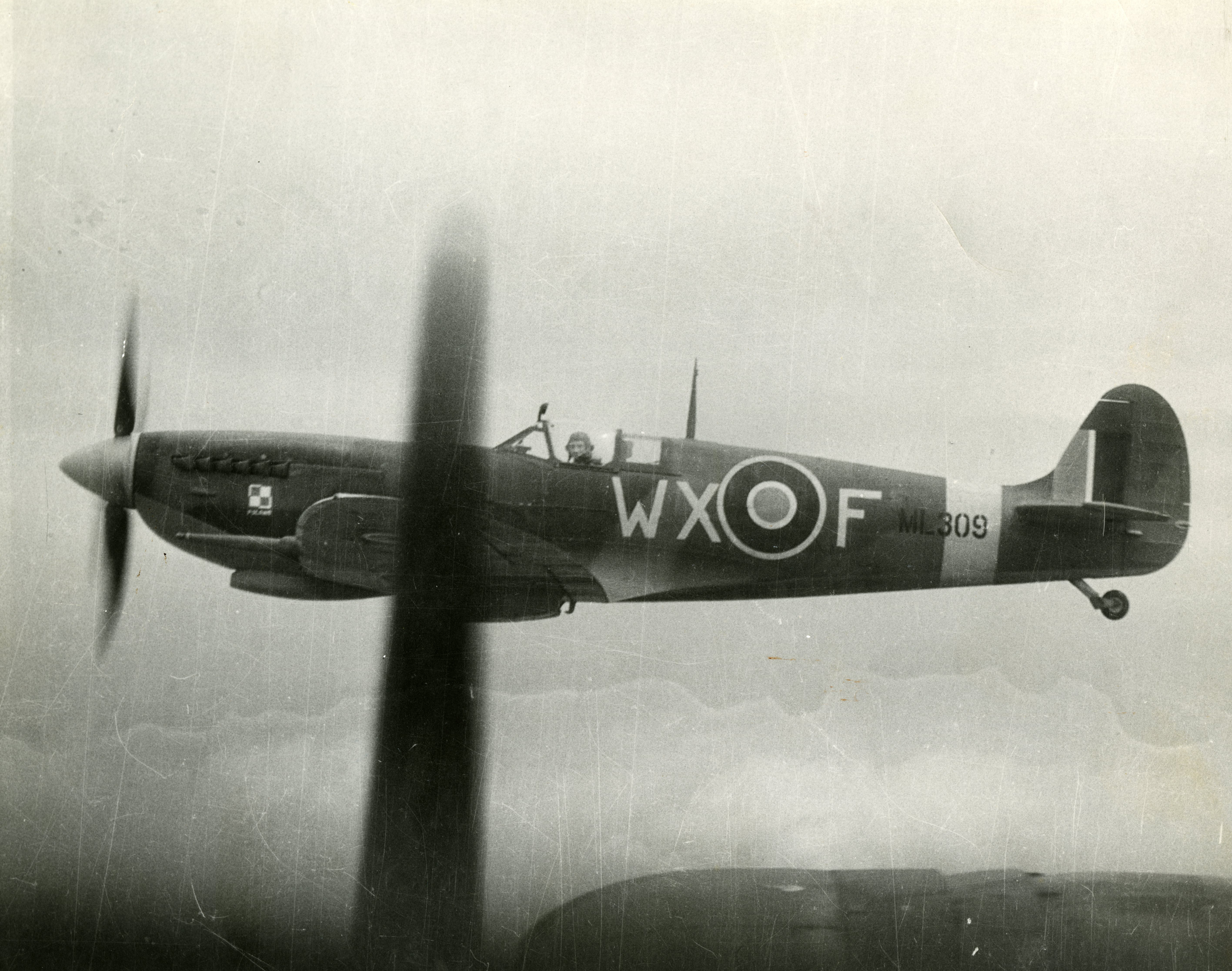
An RAF Spitfire flying beside a B-17 on bomber-escort duty.
The archive identifies a bomber-escort scene; it does not date this photograph to the Battle of Britain.
U.S. Air Force / National Museum of the U.S. Air Force (180422-F-FN604-032) · Public domain · Original recordImage changes
Display copies resized; original archive JPEG preserved.
The words
Ailerons
Ailerons controlled the Spitfire’s roll, tilting its wings from side to side. IWM’s catalog of a 1940 inspection film records ground crew checking these moving wing surfaces.
NASA: aircraft parts and controls (opens a new tab) · IWM: Spitfire inspection film (opens a new tab)
Duxford
RAF Duxford was the airfield where No. 19 Squadron received its first Spitfire Mk I on August 4, 1938. The location anchors this puzzle’s account of the fighter’s introduction.
Elevator
The elevator was the moving part of the horizontal tail that controlled nose-up and nose-down motion. The RAF Museum’s component list distinguishes elevators from the fixed tailplane.
NASA: aircraft parts and controls (opens a new tab) · RAF Museum: component terminology (opens a new tab)
Engine
The early Spitfire used a Rolls-Royce Merlin engine. IWM’s catalog of the 1940 inspection film describes the Flight Mechanic checking the Merlin, oil cooler and air intake.
Did you know?
The inspection film was made at RAF Northolt in early summer 1940 with No. 609 Squadron aircraft. Its catalog lists several specialists, including a rigger, electrician and instrument repairer.
AMY 1, description III · IWM: Spitfire inspection film (opens a new tab)
Flaps
Flaps formed part of the Spitfire’s landing controls. IWM’s catalog of a training film produced in 1947 records flap checks during the approach and their raising after landing.
AMY 360, reel two · IWM: later Spitfire cockpit-drill film (opens a new tab)
Fuselage
The fuselage was the aircraft’s central body. In IWM’s catalog of the 1940 Spitfire inspection film, work inside it included tests by the Wireless Operator and Electrician.
AMY 1, description IV · NASA: aircraft parts and controls (opens a new tab) · IWM: Spitfire inspection film (opens a new tab)
Gun Camera
A gun camera recorded a fighter’s attack. IWM catalogs Spitfire camera-gun footage from 1940, with captions identifying details such as the pilot, aircraft, target and date of the encounter.
ARY 211-1, summary and description · IWM: camera-gun film records (opens a new tab)
Mitchell
R. J. Mitchell led the design work that became the Spitfire. The RAF Museum traces how he and his team developed an earlier fighter design into the new aircraft.
Radiator
The radiator belonged to the Spitfire’s engine-cooling system. The RAF Museum lists it separately from radiator shutters, while IWM’s later cockpit-drill record includes radiator checks before flight and landing.
RAF Museum: component terminology (opens a new tab) · IWM: later Spitfire cockpit-drill film (opens a new tab)
Rudder
The rudder was the moving surface at the vertical tail, controlling side-to-side nose motion. The RAF Museum’s assembly terminology lists rudders separately from elevators, which controlled a different movement.
NASA: aircraft parts and controls (opens a new tab) · RAF Museum: component terminology (opens a new tab)
Spitfire
The Spitfire entered RAF service with No. 19 Squadron on August 4, 1938. It later fought over Dunkirk and in the Battle of Britain, placing this fighter within the chapter.
Did you know?
After the prototype’s first flight, test pilot Joseph Summers reportedly asked that nothing be changed. The RAF Museum explains that he wanted to report his observations before modifications, rather than declare the design perfect.
Supermarine
Supermarine was the company behind the Spitfire. Its earlier racing seaplanes helped shape the design’s background, while production of the new fighter required specialist manufacturing and subcontractors.
Did you know?
Mitchell’s earlier Model 224 had fixed landing gear and an unsuccessful cooling system. The Spitfire emerged from further work by his team, rather than from an entirely successful first attempt.
Tailplane
The fixed horizontal tailplane helped steady the aircraft’s nose in pitch, its up-and-down motion. The RAF Museum’s list separates tailplane assemblies from the elevators attached to the horizontal tail.
NASA: aircraft parts and controls (opens a new tab) · RAF Museum: component terminology (opens a new tab)
Undercarriage
British term for an aircraft’s landing gear.
The Spitfire’s wheels could retract after takeoff. IWM’s later cockpit-drill film catalog describes the landing gear being raised in flight and lowered again for the approach to land.
AMY 360, reel two · IWM: later Spitfire cockpit-drill film (opens a new tab) · Cambridge Dictionary: undercarriage (opens a new tab)
Wing
The Spitfire’s elliptical wing was part of its distinctive design. The RAF Museum explains that this shape allowed a thin wing, reducing the resistance known as drag.
Sources
- Spitfire assembly numbersRoyal Air Force Museum
- DAILY INSPECTION OF A SPITFIRE [Main Title]Imperial War Museums
- The first flight of the SpitfireRoyal Air Force Museum
- RAF CAMERA GUN FOOTAGE [Allocated Title]Imperial War Museums
- Airplane Parts and FunctionNASA Glenn Research Center
- Spitfire: Fighter Aircraft SupremeRoyal Air Force
- COCKPIT DRILL - SPITFIRE MK V [Main Title]Imperial War Museums
- Meaning of undercarriage in EnglishCambridge University Press & Assessment