
World War II
Puzzle 04 · Fighter Command and the Blitz · Page 16 in print
Hawker Hurricane
Hawker’s eight-gun fighter served alongside the Spitfire during the Battle of Britain.
Jump to a word
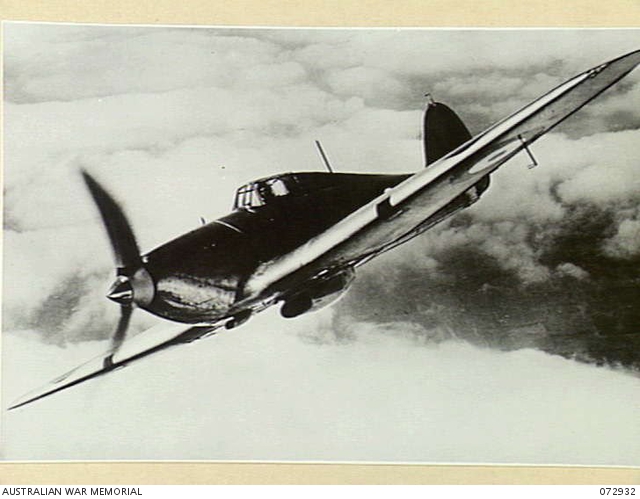
A Royal Air Force Hawker Hurricane in flight.
Australian War Memorial (072932) · Public domain · Original recordImage changes
Display copies resized; original downloaded JPEG preserved.
The words
Air Battle
The Hurricane belonged to Britain’s fighter defense against German air raids. The RAF Museum’s account of August 18, 1940 describes attacks by bomber formations and fighter escorts on airfields and radar facilities.
Camm
Sydney Camm designed the Hurricane around established construction methods. The RAF Museum describes a tubular metal structure and fabric-covered fuselage, linking the designer’s name with the aircraft’s practical engineering.
Canopy
The canopy covered the Hurricane’s cockpit. Pilot Richard Barclay’s diary, quoted by the RAF Museum, describes flying with it open during the fighting on September 15, 1940.
Did you know?
Before taking off, Barclay grabbed a pair of Irvin trousers. His diary linked that extra clothing with his decision to leave the canopy open for a better view.
PDF page 3, Richard Barclay’s diary · RAF Museum: pilot accounts (6-page PDF) (opens a new tab)
Cockpit
The cockpit was the pilot’s position inside the fighter. Barclay’s account connects this small space with a practical concern: being able to see other aircraft clearly.
PDF page 3, Richard Barclay’s diary · RAF Museum: pilot accounts (6-page PDF) (opens a new tab)
Dogfight
The printed term describes close fighter combat. The Hurricane’s maneuverability mattered in these encounters; the RAF Museum identifies it as one reason pilots found the aircraft effective.
Eight Guns
The Hurricane entered RAF service with eight machine guns. This term identifies the armament of the early fighter, whose role alongside the Spitfire is described in the RAF Museum’s Hurricane I record.
Fabric Wing
Fabric was a working part of some Hurricane wings, treated to hold it taut. The Science Museum’s conservation study documents such a wing on its preserved Hurricane.
Did you know?
The study illustrates a small patch used to stabilize a tear in the wing covering. Conservation work can preserve fabric in place rather than replacing the whole covering.
Introduction; Figures 3 and 6 · Science Museum: aircraft fabric (opens a new tab)
Fighter Pilot
Hurricane pilots moved between flying and periods on the ground. In the RAF Museum’s September 15, 1940 account, Barclay returned to a dispersal hut, while pilots also gave combat reports to intelligence officers.
PDF page 3, lull between raids · RAF Museum: pilot accounts (6-page PDF) (opens a new tab)
Hawker
The Hawker Aircraft Company designed the Hurricane in 1934, and the fighter entered service in 1937. The manufacturer’s name links the aircraft with Britain’s prewar development of faster fighters.
Hurricane
The Hurricane was a mainstay of Fighter Command in 1940. The RAF Museum records 32 squadrons by September, showing the scale of its role beside the Spitfire.
Merlin Engine
The Rolls-Royce Merlin powered both the Hurricane and the Spitfire. The RAF Museum’s aircraft biographies place the same engine name in both entries, connecting the two British fighters in this chapter.
Messerschmitt
Messerschmitt fighters escorted German bombers during the Battle of Britain. The RAF Museum’s August 18, 1940 account names Bf 109 and Bf 110 aircraft, placing both types among the Hurricane’s opponents.
Monoplane
The Hurricane used a single main wing on each side. The RAF Museum’s guide identifies the Hurricane Mk I, entering service in 1937, as the RAF’s first eight-gun monoplane.
PDF page 6, Hurricane Mk I · RAF Museum: Battle of Britain guide (opens a new tab)
Propeller
The Hurricane’s engine drove a propeller to produce thrust. A Smithsonian collection record preserves a Rotol Hurricane blade from a three-blade, variable-pitch propeller made with wood and metal.
Did you know?
Rotol began in 1937 as a joint venture between Rolls-Royce and Bristol. The Smithsonian records a Hurricane propeller blade from this manufacturer, showing that aircraft production drew on specialist suppliers.
Object A19601434000 · Smithsonian: Hurricane propeller blade (opens a new tab)
Stuka
The Stuka was Germany’s Junkers Ju 87 dive-bomber. The RAF Museum records Stukas, escorted by Bf 109 fighters, in raids on August 18, 1940, during the Hurricane’s Battle of Britain service.
Sources
- The Hardest DayRoyal Air Force Museum
- Hawker Hurricane IIcRoyal Air Force Museum
- 15 September 1940Royal Air Force Museum
- Hawker Hurricane 1Royal Air Force Museum
- Doping at the Science Museum: the conservation challenge of doped fabric aircraft in the Flight galleryScience Museum Group Journal
- The Battle of Britain: Highlights for KS3 and KS4 visitsRoyal Air Force Museum
- Rotol Hurricane Variable Pitch Propeller BladeSmithsonian National Air and Space Museum
- Squadron & Personal BiographiesRoyal Air Force Museum