
World War II
Puzzle 65 · Breakout, Pursuit, and Holland · Page 94 in print
Nijmegen Bridge
U.S. 504th Parachute Infantry troops crossed the Waal in canvas boats under fire on 20 September 1944.
Jump to a word
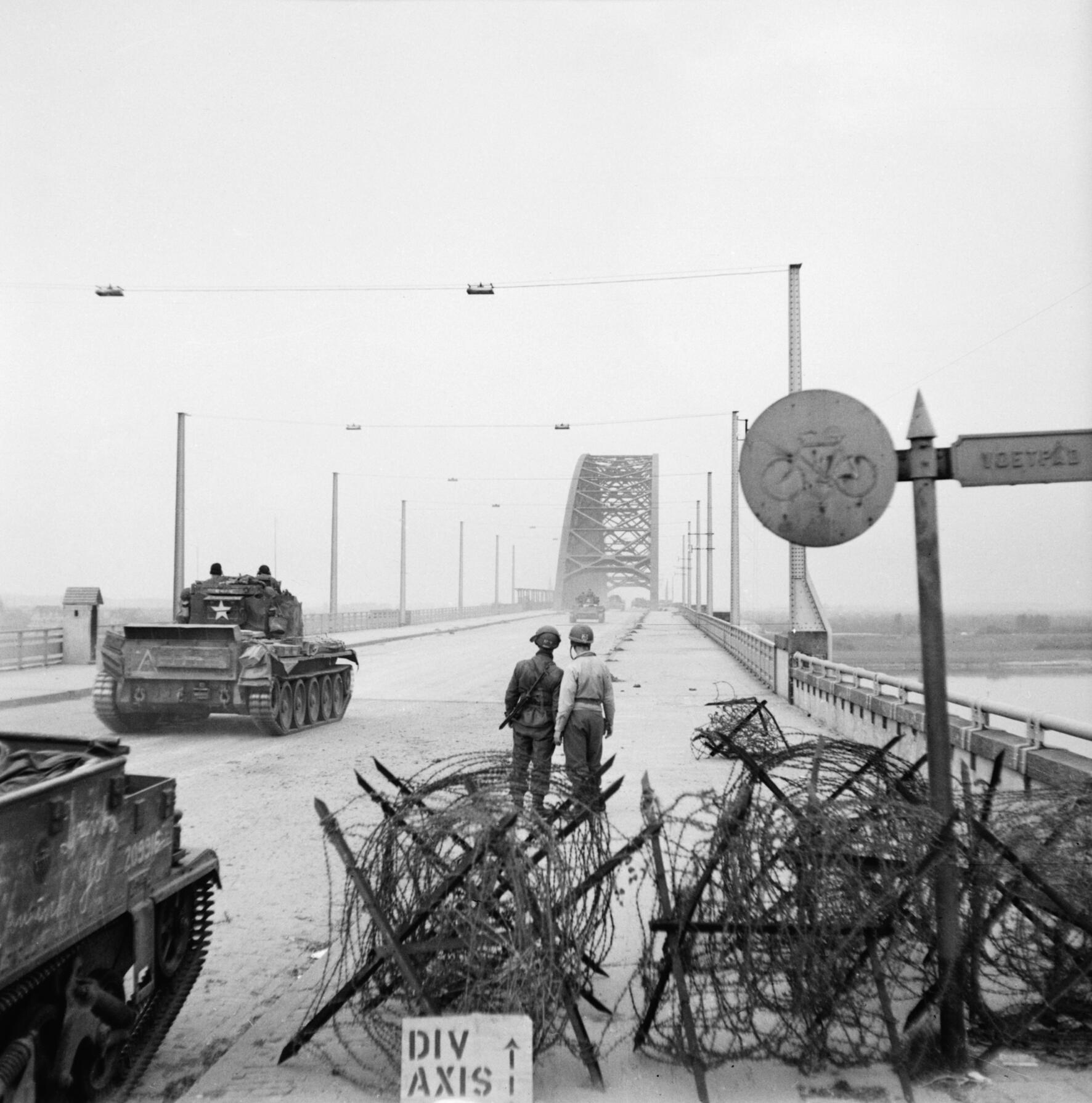
Cromwell tanks of the 2nd Welsh Guards cross the Nijmegen bridge on September 21, 1944.
Norman Midgley / No. 5 Army Film and Photographic Unit / Imperial War Museums (B 10172) · Public domain · Original recordImage changes
Display copies resized; original downloaded JPEG preserved.
The words
Air Transport
Airborne divisions arrived by parachute and glider. The aircraft delivered troops and equipment to bridge objectives ahead of the ground column advancing from Belgium.
Opening account, airborne and ground components · Army Heritage Center: glider experience (opens a new tab)
Airborne Corps
A headquarters controlling several airborne divisions.
Lieutenant General Browning’s British Airborne Corps was to direct airborne operations on the ground. The First Allied Airborne Army retained overall command.
Ch. VI, pp. 127–128, command arrangements · Army history: airborne and ground commands (opens a new tab)
Corridor
Here, the narrow route linking Allied bridgeheads.
Much of XXX Corps’ advance followed a narrow causeway. Traffic jams, German counterattacks and marshy ground made the route vulnerable and restricted movement around blockages.
XXX Corps section, causeway and marshes · National Army Museum: Market Garden (opens a new tab)
Eindhoven
Eindhoven lay near the southern end of the planned airborne route. Beyond it, the British ground column had to cross successive waterways toward Nijmegen and Arnhem.
The plan, sequence of objectives · National Army Museum: Market Garden (opens a new tab)
Gavin
Brigadier General James Gavin commanded the 82nd Airborne Division. He regarded the high ground southeast of Nijmegen as essential to protecting the bridge objectives.
Ch. VII, pp. 154–156, Six Bridges and a Ridge · Army history: bridges, ridge and highway (opens a new tab)
Grave
The 504th Parachute Infantry captured the Maas bridge near Grave on September 17. Keeping this crossing intact helped open the route for British ground forces.
Ch. VII, pp. 159–160, Taking the Objectives · Army history: bridges, ridge and highway (opens a new tab)
Groesbeek
The ridge near Groesbeek overlooked the surrounding flat country. Holding it helped protect the airborne positions against a possible German counterattack from the Reichswald.
Ch. VII, pp. 155–156, ridge and eastern approaches · Army history: bridges, ridge and highway (opens a new tab)
Hell's Highway
The 101st Airborne Division defended the road north from Eindhoven toward Grave. Its troops nicknamed this extended, vulnerable stretch Hell’s Highway.
Ch. VII, pp. 142–143, the road mission · Army history: bridges, ridge and highway (opens a new tab)
Horrocks
Lieutenant General Brian Horrocks commanded British XXX Corps. He planned the ground thrust toward Eindhoven, with the Guards Armoured Division leading the advance.
Ch. VI, pp. 132–133, Operation GARDEN · Army history: airborne and ground commands (opens a new tab)
Market Garden
Market was the airborne operation to seize and hold bridges. Garden was the ground advance intended to link the divisions and continue toward Arnhem.
Opening account, the two operational components · Army Heritage Center: glider experience (opens a new tab)
Netherlands
Market Garden sought a route through the Netherlands into Germany. Success at Nijmegen did not secure the intended crossing at Arnhem or achieve the wider plan.
The plan, Landings and XXX Corps sections · National Army Museum: Market Garden (opens a new tab)
Nijmegen
Nijmegen’s road and rail bridges carried the route across the Waal. The crossing by American paratroopers helped British and American forces capture the bridges.
Main account, the two bridge objectives · Liberation Route Europe: Waal crossing (opens a new tab)
Waal River
American paratroopers crossed the Waal in canvas boats on September 20. Under heavy fire, men were killed and wounded as they attacked the northern approaches.
Main account, the boat crossing and losses · Liberation Route Europe: Waal crossing (opens a new tab)
Waco Glider
The CG-4A Waco carried troops and equipment. One artillery party’s off-target landing left men wounded and much equipment lost.
Lloyd Click account, loading and off-target landing · Army Heritage Center: glider experience (opens a new tab)
XXX Corps
British XXX Corps helped the 82nd Airborne capture Nijmegen bridge. It could not reach the Arnhem bridge before German forces overwhelmed the defenders there.
XXX Corps and Landings sections, Nijmegen and Arnhem · National Army Museum: Market Garden (opens a new tab)
Sources
- The Siegfried Line Campaign, Chapter VI: Operation MARKET-GARDENU.S. Army Center of Military History; Charles B. MacDonald, official history, 1963; HyperWar transcription
- Operation Market-GardenU.S. Army Heritage and Education Center; Michael E. Lynch, August 21, 2007
- The Siegfried Line Campaign, Chapter VII: Invasion From the SkyU.S. Army Center of Military History; Charles B. MacDonald, official history, 1963; HyperWar transcription
- Operation Market GardenNational Army Museum; historical campaign account
- Waal crossingLiberation Route Europe Foundation; Waal crossing historical and memorial account