
World War II
Puzzle 64 · Breakout, Pursuit, and Holland · Page 93 in print
Siegfried Line
Germany restored the Westwall’s bunkers and obstacles as Allied troops approached in 1944.
Jump to a word
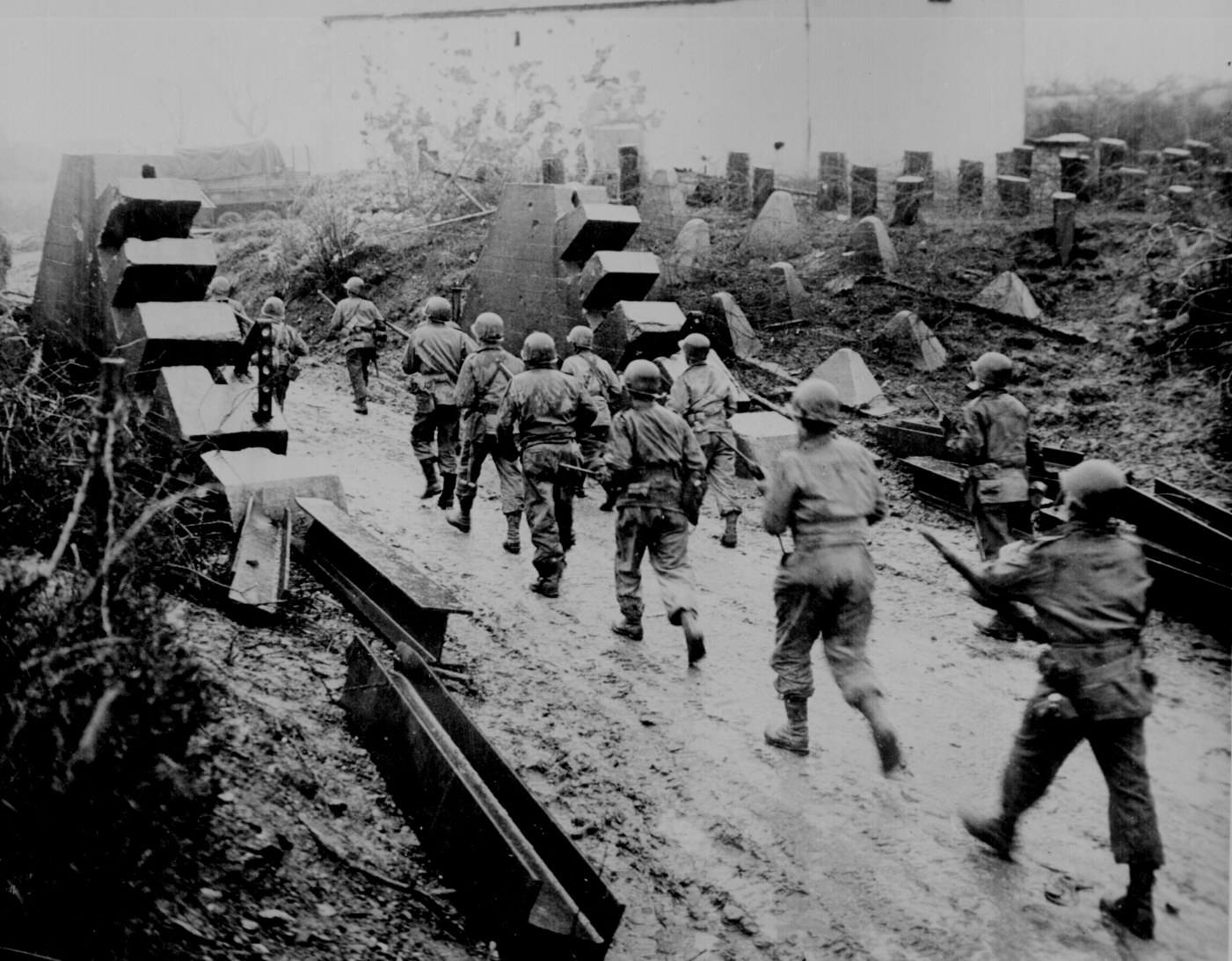
American soldiers pass through the Siegfried Line in 1945.
Office of War Information / National Archives (208-YE-193) · Public domain · Original recordImage changes
Display copies resized; original scan preserved.
The words
Ammunition
Ammunition shortages restricted artillery support during the October 2 attack. The corps study records that planned fire against German batteries had to be reduced.
Printed p. 15 (PDF page 18), artillery preparation · XIX Corps: the October 1944 assault (opens a new tab)
Booby Traps
Near Raffelsbrand in November, booby traps reinforced wire, mines and defended positions. The forest attack brought American infantry heavy losses and little progress.
Ch. XV, p. 349, the 110th Infantry’s forest attack · Army history: the November forest fighting (opens a new tab)
Clipper
Operation Clipper began on November 18. British and American formations attacked around Geilenkirchen to remove the German salient between their neighboring fronts.
Ch. XXIII, pp. 544–546, four-phase plan · Army history: Operation Clipper (opens a new tab)
Demolitions
Demolition teams accompanied the infantry assault. The corps study notes that pillbox defenders often surrendered before the attackers needed explosive charges.
Printed p. 25 (PDF page 28), demolition charges · XIX Corps: the October 1944 assault (opens a new tab)
Dragon's Teeth
Rows of concrete projections were intended to obstruct tanks. The Army history describes them as one element of defenses also exploiting rivers and difficult terrain.
Ch. II, pp. 33–34, antitank barriers · Army history: terrain and the West Wall (opens a new tab)
Embrasure
An opening in a fortification for firing weapons.
The pillboxes’ firing openings mattered to both defenders and attackers. The corps study describes combat centered on these small apertures in the fortified positions.
Printed pp. 25 and 40 (PDF pages 28 and 43), fortified openings · XIX Corps: the October 1944 assault (opens a new tab)
Grenades
Grenades were among the weapons used in the October pillbox fighting. The wartime account places them alongside infantry fire and heavier support.
Printed p. 40 (PDF page 43), the 117th Infantry assault · XIX Corps: the October 1944 assault (opens a new tab)
Hitler
Hitler ordered accelerated West Wall construction in May 1938. The state foundation documents coercive labor discipline and the later use of foreign forced laborers.
Main history, construction order and forced labor · West Wall Foundation: building and labor (opens a new tab)
Luxembourg
V Corps approached the West Wall through Luxembourg. Patrols along the Our and Sauer Rivers found German positions being hurriedly occupied as American forces advanced.
Ch. III, pp. 55–56, the 5th Armored Division’s reconnaissance · Army history: Luxembourg and Eifel approaches (opens a new tab)
Machine Guns
Machine guns served both sides in the assault. American gunners supporting the attack also suffered casualties from German mortar fire.
Printed p. 40 (PDF page 43), supporting guns and mortar losses · XIX Corps: the October 1944 assault (opens a new tab)
Obstacles
The Wurm River, wet ground and railway embankments obstructed the attack. The landscape presented barriers beyond the concrete defenses themselves.
Printed p. 30 (PDF page 33), details of defenses · XIX Corps: the October 1944 assault (opens a new tab)
Prum
Prüm was an important Eifel communications center. The September plan assigned it to American infantry, while armored troops farther south were directed toward Bitburg.
Ch. III, p. 40, planned objectives · Army history: Luxembourg and Eifel approaches (opens a new tab)
Siegfried Line
The West Wall comprised belts of fortifications along Germany’s western approaches. Its strength varied, with denser defenses around Aachen and weaker stretches elsewhere.
Ch. II, pp. 30–34, defensive purpose and uneven density · Army history: terrain and the West Wall (opens a new tab)
Stolberg
The Stolberg Corridor offered a relatively open route southeast of Aachen. River valleys, industry and nearby forests still complicated the American attempt to advance.
Ch. IV, pp. 67–68, the corridor and terrain · Army history: the Stolberg Corridor (opens a new tab)
Tank Ditch
Antitank ditches were intended to obstruct armored vehicles. In the XIX Corps assault area, the wartime study found them incomplete and limited in extent.
Printed p. 30 (PDF page 33), antitank obstacles · XIX Corps: the October 1944 assault (opens a new tab)
Sources
- The Siegfried Line Campaign, Chapter 4: VII Corps Penetrates the LineU.S. Army Center of Military History; Charles B. MacDonald, official history, 1963; HyperWar transcription
- The Siegfried Line Campaign, Chapter 15: The Second Attack on SchmidtU.S. Army Center of Military History; Charles B. MacDonald, official history, 1963; HyperWar transcription
- The Siegfried Line Campaign, Chapter 23: The Geilenkirchen SalientU.S. Army Center of Military History; Charles B. MacDonald, official history, 1963; HyperWar transcription
- The Siegfried Line Campaign, Chapter 2: The First U.S. ArmyU.S. Army Center of Military History; Charles B. MacDonald, official history, 1963; HyperWar transcription
- The Siegfried Line Campaign, Chapter 3: V Corps Hits the West WallU.S. Army Center of Military History; Charles B. MacDonald, official history, 1963; HyperWar transcription
- Breaching the Siegfried LineU.S. Army Headquarters XIX Corps, January 12, 1945; original wartime study, Combined Arms Research Library scan
- Geschichte bis 1945Stiftung Grüner Wall im Westen – Mahnmal ehemaliger Westwall; Rhineland-Palatinate state foundation; German-language history