
World War II
Puzzle 63 · Breakout, Pursuit, and Holland · Page 92 in print
Aachen
Aachen’s garrison surrendered on 21 October 1944.
Jump to a word
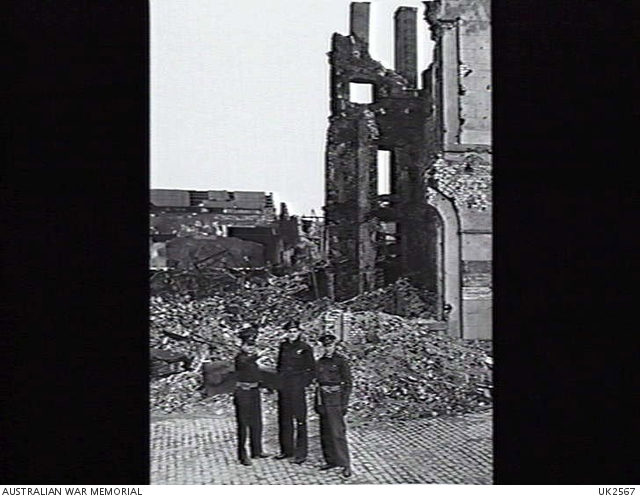
RAAF and RCAF airmen survey the damaged buildings of Aachen on February 23, 1945.
Cyril Hampden Isaac / Australian War Memorial (UK2567) · Public domain · Original recordImage changes
Display copies resized; original downloaded JPEG preserved.
The words
Aachen
The German garrison surrendered after weeks of fighting around and inside Aachen. American military government then took over the city’s administration.
Opening account, surrender and military government · City of Aachen: liberation and occupation (opens a new tab)
Charlemagne
Charlemagne made Aachen a principal residence and built its palace chapel. The cathedral’s history also describes his violent conquest and Christianization of the Saxons.
Opening biography, Aachen as capital, and Carolingian Renaissance · Aachen Cathedral: Charlemagne (opens a new tab)
First Army
Lieutenant General Courtney Hodges commanded First Army. Its VII and XIX Corps approached Aachen from different directions, seeking to surround the city and continue eastward.
Opening campaign account and the encirclement plan, notes 5 and 18 · Fontenot: command and city fighting (opens a new tab)
Flamethrowers
Weapons that project burning fuel.
Two-man flamethrower teams accompanied American infantry companies during the assault. They were among the weapons used against defenders resisting inside the city’s buildings.
Ch. XIII, p. 310, infantry support weapons · Army history: the Aachen city assault (opens a new tab)
Germany
The city describes Aachen’s capture as liberation for people persecuted by the Nazis and for forced laborers. Germany’s nationwide surrender came more than six months later.
Opening account, liberation and the later national surrender · City of Aachen: liberation and occupation (opens a new tab)
House-to-House
German defenders used buildings and pillboxes to resist the assault. American infantry needed close support from heavier weapons as the fighting moved through the city.
The city assault, notes 47–50, defended buildings and support · Fontenot: command and city fighting (opens a new tab)
Huebner
Major General Clarence Huebner commanded the 1st Infantry Division. He initially favored taking the hills south of Aachen as part of an encirclement.
Division command and the encirclement plan, notes 2 and 18 · Fontenot: command and city fighting (opens a new tab)
Lousberg
The Lousberg dominated Aachen’s northern edge. Americans called it Observatory Hill because of its tower; Task Force Hogan took the heights on October 19.
Ch. XIII, pp. 309 and 315, terrain and capture · Army history: the Aachen city assault (opens a new tab)
Panther Tank
The Army history places Mark V Panther tanks near Alsdorf during the encirclement. This was the wider front, beyond the fighting inside Aachen.
Ch. XII, p. 283, German armored strength · Army history: the front around Aachen (opens a new tab)
Quellenhof
Wilck initially established headquarters in the Quellenhof hotel in Farwick Park. American troops captured the hotel before his final surrender from a separate bunker.
Ch. XIII, pp. 307, 314–316, headquarters and capture · Army history: the Aachen city assault (opens a new tab)
Roer River
The Roer was an objective beyond Aachen. The American plan combined isolating the city with other forces continuing east and northeast toward the river.
Ch. XII, p. 284, encirclement and further advance · Army history: the front around Aachen (opens a new tab)
Seitz
Colonel John F. R. Seitz commanded the 26th Infantry. Two of its battalions assaulted Aachen, supported by armor, artillery and other attached forces.
The 26th Infantry’s task and supporting arms, notes 42–43 · Fontenot: command and city fighting (opens a new tab)
Tiger Tank
Mark VI Tiger tanks served on the surrounding Aachen front. They supported German efforts to counter the American advance rather than constituting the city’s entire defense.
Ch. XII, pp. 283 and 290–291, tanks and counterattacks · Army history: the front around Aachen (opens a new tab)
Urban Combat
The assault required more than infantry entering buildings. Tanks, tank destroyers, engineers and artillery supported the battalions, while fighting also continued around the city.
The city assault, notes 47–49, combined support and wider fighting · Fontenot: command and city fighting (opens a new tab)
Wilck
Colonel Gerhard Wilck commanded the German garrison. He surrendered on October 21 after American troops reached the bunker where his headquarters had moved.
Ch. XIII, pp. 307 and 315–316, command and surrender · Army history: the Aachen city assault (opens a new tab) · Army history: the front around Aachen (opens a new tab)
Sources
- The Siegfried Line Campaign, Chapter XIII: Assault on the CityU.S. Army Center of Military History; Charles B. MacDonald, official history, 1963; HyperWar transcription
- The Siegfried Line Campaign, Chapter XII: Closing the CircleU.S. Army Center of Military History; Charles B. MacDonald, official history, 1963; HyperWar transcription
- Aachen: The Battle for Charlemagne’s City, September-October 1944The Army Historical Foundation; Colonel Gregory Fontenot, USA-Ret.; On Point historical article
- Aachen 1944 und der Weg in die DemokratieStadt Aachen; municipal history and commemoration; German-language account
- CharlemagneAachen Cathedral; official English-language history