
World War II
Puzzle 62 · Breakout, Pursuit, and Holland · Page 91 in print
Paris Liberation
French Resistance fighters, Leclerc’s 2nd Armoured Division and the U.S. 4th Infantry Division helped liberate Paris on 25 August 1944. That day, Charles de Gaulle addressed the crowd at the Hotel de Ville.
Jump to a word
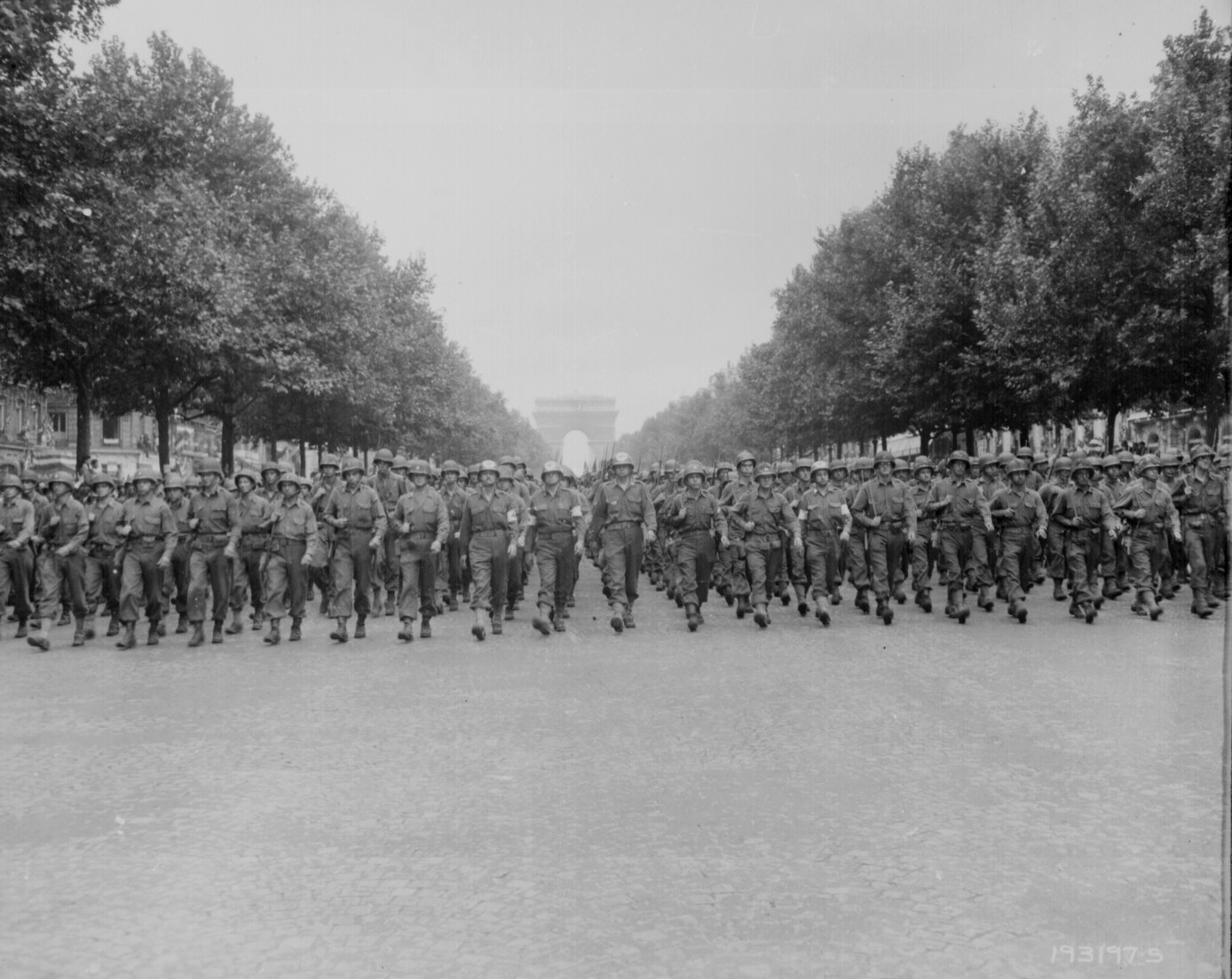
The 28th Infantry Division marches down the Champs-Élysées in Paris on August 29, 1944.
Poinsett / U.S. Army Signal Corps / National Archives (111-SC-193197) · Public domain · Original recordImage changes
Display copies resized; original scan preserved.
The words
Choltitz
Dietrich von Choltitz commanded the German forces in Paris. Captured on August 25, he signed the surrender in the presence of Resistance leader Rol-Tanguy.
Final paragraphs, capture and capitulation · French defense ministry: Paris liberated (opens a new tab)
De Gaulle
After joining Leclerc at Montparnasse station, de Gaulle went to the Hôtel de Ville. There he met Resistance leaders and delivered his celebrated liberation speech.
Historical account, arrival and Hôtel de Ville · De Gaulle Foundation: August 25–26 (opens a new tab)
Free French
The Free French movement grew around de Gaulle in London after his June 1940 appeal. It gained British recognition and support from overseas territories.
Historical entry, appeal and political organization · National Assembly: Free French origins (opens a new tab)
French Forces
French and Spanish soldiers of La Nueve reached Paris on August 24. Leclerc’s division and other Allied troops entered the next morning.
The August 24 column and August 25 entry · French defense ministry: Paris liberated (opens a new tab)
Insurrection
An armed uprising against established authority.
Calls for insurrection appeared on August 19. Residents built barricades across the city before the arrival of Leclerc’s division and other Allied troops.
The uprising and barricades, August 19–25 · French defense ministry: Paris liberated (opens a new tab)
Leclerc
Leclerc commanded the 2nd Armoured Division sent toward Paris. He entered the capital on August 25 and received the German commander’s surrender.
Historical account, Leclerc and the 2nd Armoured Division · De Gaulle Foundation: August 25–26 (opens a new tab)
Liberation
The uprising was followed by Allied troops entering Paris. German strongpoints still had to be overcome before the garrison’s surrender on August 25.
Final fighting and capitulation · French defense ministry: Paris liberated (opens a new tab)
Maquis
French Resistance groups based in remote areas.
Many young men avoiding compulsory labor in Germany hid in rural camps. Some of these refuges developed into armed resistance groups beyond the cities.
Des camps refuges aux maquis combattants · French defense ministry: maquis origins (opens a new tab)
Parade
On August 26, de Gaulle rekindled the Unknown Soldier’s flame beneath the Arc de Triomphe. He then walked down the Champs-Élysées before cheering crowds.
Historical account, the August 26 procession · De Gaulle Foundation: August 25–26 (opens a new tab)
Paris
The capital’s liberation carried political importance as well as military value. Occupation had brought repression and deportation, continuing into the summer of 1944.
Opening account, political stakes and repression · French defense ministry: Paris liberated (opens a new tab)
Pursuit
Beyond the Seine, Allied commanders hoped to reach the Rhine before German forces could organize the West Wall. The advance became a race against regrouping defenders.
Ch. XXXII, pp. 675–676, the Rhine objective · Army history: pursuit beyond the Seine (opens a new tab)
Rapid Advance
At the end of August, American infantry used improvised truck transport to keep moving. Destroyed bridges and dwindling gasoline complicated the rapid progress into early September.
Ch. XXXII, pp. 680–681, motorized infantry and fuel · Army history: pursuit beyond the Seine (opens a new tab)
Spearhead
The force leading an advance.
The 3rd Armored Division led VII Corps toward Mons in early September. Its forward columns pressed ahead while infantry divisions moved up on the flanks.
Ch. XXXII, pp. 681–682, the drive to Mons · Army history: pursuit beyond the Seine (opens a new tab)
Supply Chain
Liberating Paris also meant feeding a city cut off from much of its normal supply. Allied planners weighed civilian relief against the needs of advancing troops.
Ch. XXIX, pp. 589–590, relief and military transport · Army history: Paris and its supply needs (opens a new tab)
Supply Crisis
By early September, some American formations ran out of gasoline during the pursuit. Capturing ground rapidly did not ensure that enough fuel reached the leading units.
Ch. XXXII, pp. 680–682, pursuit halted by fuel shortage · Army history: pursuit beyond the Seine (opens a new tab)
Sources
- Breakout and Pursuit, Chapter XXIX: The Liberation of ParisU.S. Army Center of Military History; Martin Blumenson, official history, 1961; HyperWar transcription
- Breakout and Pursuit, Chapter XXXII: Towards the Heart of GermanyU.S. Army Center of Military History; Martin Blumenson, official history, 1961; HyperWar transcription
- Le 25 aout 1944, Paris libéréFrench Ministry of the Armed Forces; Mission Libération, August 23, 2024; French-language account
- Descente des Champs-Elysées, 26 août 1944Fondation Charles de Gaulle; French-language historical account
- 18 juin 1940 — Appel du général de Gaulle — La France libreFrench National Assembly; Histoire et Patrimoine; French-language historical account
- 1943. Les conséquences du STO dans la création des maquisFrench Ministry of the Armed Forces; Chemins de mémoire; French-language historical account