
World War II
Puzzle 61 · Breakout, Pursuit, and Holland · Page 90 in print
Falaise Pocket
Polish troops held Hill 262 near Falaise until Canadian forces reached them on 21 August 1944.
Jump to a word
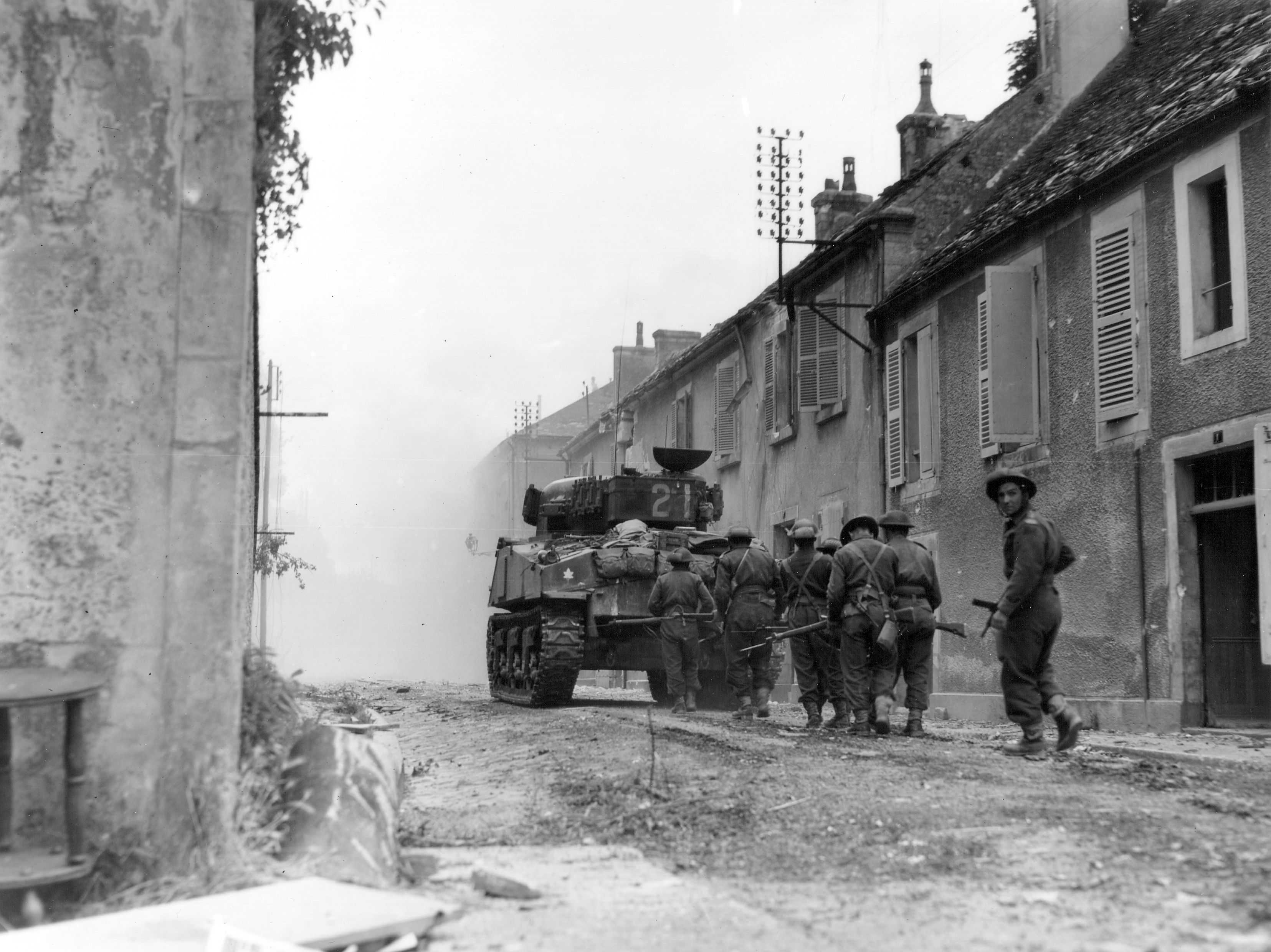
Les Fusiliers Mont-Royal supported by a Sherbrooke Fusiliers Sherman tank in Falaise on August 17, 1944.
Donald I. Grant / Canada. Dept. of National Defence / Library and Archives Canada / PA-115568 · Public domain · Original recordImage changes
Source scan levels adjusted; resized for display.
The words
Argentan
Bradley halted the American XV Corps south of Argentan on August 13. Canadian forces were still north of Falaise, leaving a gap between the armies.
Ch. XXVI, p. 506, Bradley’s halt · Army history: the developing pocket (opens a new tab)
Canadians
Canadian forces advanced from the north toward the German escape corridor. The Canadian Grenadier Guards later relieved the surrounded Polish troops on the heights.
Closing the gap and Mace hill · Veterans Affairs Canada: the Falaise gap (opens a new tab)
Cauldron
Here, a metaphor for a confined battle area.
The Montormel Memorial describes a cauldron of Falaise. The image conveys a confined battlefield where retreating troops faced Allied positions and repeated attacks.
Maczuga section, the confined battlefield · Montormel Memorial: fighting on August 20 (opens a new tab)
Chambois
Polish troops joined American forces at Chambois on August 19. The meeting helped close the gap, but fighting over the remaining openings continued.
Closing the gap and Mace hill · Veterans Affairs Canada: the Falaise gap (opens a new tab)
Closing the Gap
Closing the gap required more than a single linkup. Canadian and Polish troops still had to block scattered openings while German forces attacked to escape.
Mace hill, remaining openings after the linkup · Veterans Affairs Canada: the Falaise gap (opens a new tab)
Destruction
The road from Moissy toward Coudehard became clogged with wrecked German equipment. Bombardment and gunfire killed and wounded men trying to pass through.
Moissy et Saint-Lambert, the congested road · Montormel Memorial: fighting on August 20 (opens a new tab)
Domfront
American pressure around Domfront endangered the German southern flank. German armor became tied to defensive fighting there as commanders struggled to organize another counterattack.
Ch. XXVI, pp. 516–517, southern pressure · Army history: the developing pocket (opens a new tab)
Envelopment
An advance around an enemy’s flanks.
The Allies pressed around the German forces from different directions. American troops near Argentan formed the southern jaw while Canadian forces approached from the north.
Ch. XXVI, pp. 506–507, the two jaws · Army history: the developing pocket (opens a new tab)
Escape Route
The bridge at Saint-Lambert and the ford at Moissy offered ways across the Dives. Congestion and Allied fire made these remaining passages dangerous.
Moissy et Saint-Lambert, river crossings · Montormel Memorial: fighting on August 20 (opens a new tab)
Falaise Pocket
German forces withdrew inside a narrowing pocket west of the Dives. Their escape depended on keeping the eastern exit open long enough for the retreat.
Ch. XXVII, pp. 528–529, withdrawal and geography · Army history: closing the pocket (opens a new tab)
Maczuga
Polish for “mace,” a heavy striking weapon.
The Polish commander named the wooded hill Maczuga, or mace. The position stood east of the Canadian line, in the path of German escape efforts.
Mace hill, the Polish position · Veterans Affairs Canada: the Falaise gap (opens a new tab)
Mont Ormel
Polish troops held the heights despite attacks from inside and outside the pocket. They continued directing artillery fire against German columns attempting to withdraw.
Maczuga section, defended heights and artillery · Montormel Memorial: fighting on August 20 (opens a new tab)
Poles
The 1st Polish Armoured Division held its hill position under repeated attack. Surrounded and short of supplies, its troops endured until Canadian relief arrived.
Mace hill, isolation and relief · Veterans Affairs Canada: the Falaise gap (opens a new tab)
Trapped
Some German units surrendered when they could not force a passage. Others escaped through remaining crossings, so the encirclement did not capture everyone inside it.
Moissy et Saint-Lambert and Chambois, escape and surrender · Montormel Memorial: fighting on August 20 (opens a new tab)
Typhoon
RAF Typhoons attacked retreating columns with rockets and cannon. Alongside artillery and ground forces, these fighter-bombers inflicted losses on German troops and transport around the gap.
Closing the Gap at Falaise, pp. 35–37, aircraft and road columns · Hallion: air attacks around Falaise (opens a new tab)
Sources
- Breakout and Pursuit, Chapter XXVI: The Argentan-Falaise PocketU.S. Army Center of Military History; Martin Blumenson, official history, 1961; HyperWar transcription
- Breakout and Pursuit, Chapter XXVII: Closing the PocketU.S. Army Center of Military History; Martin Blumenson, official history, 1961; HyperWar transcription
- D-Day and the Battle of NormandyVeterans Affairs Canada; historical sheet
- 20 Août 1944 : La contre-attaque du 2ème SS-PZKORPSMémorial de Montormel; French-language battlefield museum account
- D-Day 1944: Air Power Over the Normandy Beaches and BeyondRichard P. Hallion; Air Force History and Museums Program, 1994; HyperWar transcription