
World War II
Puzzle 60 · Breakout, Pursuit, and Holland · Page 89 in print
Mortain Counterattack
U.S. 30th Division held Mortain’s heights, 7-12 August 1944.
Jump to a word
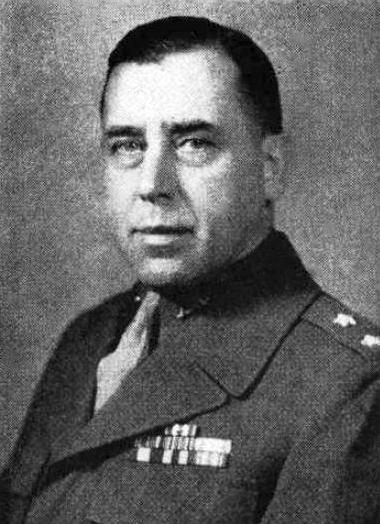
An undated portrait of Leland S. Hobbs, commander of the 30th Infantry Division during World War II.
U.S. Army Signal Corps / U.S. War Department · Public domain · Original recordImage changes
Display copies resized; original downloaded JPEG preserved.
The words
Allied Lines
The 30th Division defended the corridor opened by the Normandy breakout. A German advance to Avranches threatened to cut off American forces moving into Brittany.
Opening account, the Avranches corridor · WWII Museum: the 30th Division at Mortain (opens a new tab)
Counterattack
Hitler chose an attack toward Avranches instead of a withdrawal. The aim was to cut the American corridor and divide the forces exploiting the breakout.
Opening account, Hitler’s alternatives and plan · Montormel Memorial: Operation Lüttich (opens a new tab)
Das Reich
The 2nd SS Panzer Division attacked around Mortain. Earlier, on June 10, 1944, members of Das Reich massacred civilians at Oradour-sur-Glane and destroyed the village.
Montormel Memorial: Operation Lüttich (opens a new tab) · Holocaust Museum: Oradour-sur-Glane (opens a new tab)
Hausser
Seventh Army commander Hausser doubted that capturing Avranches would settle the battle. He expected holding it and attacking farther northeast to be more difficult.
Army history: the Mortain counterattack (opens a new tab) · Army history: German command and plans (opens a new tab)
Hobbs
Major General Leland Hobbs commanded the 30th Infantry Division. His troops had fought in the Normandy breakout before taking over the exposed Mortain sector.
Opening account, division command and Normandy service · WWII Museum: the 30th Division at Mortain (opens a new tab)
Lost Battalion
Men of the 2nd Battalion, 120th Infantry, were surrounded east of Mortain. Short of food, ammunition and medical supplies, they held out until relief on August 12.
Hill defense, supply shortage and relief · WWII Museum: the 30th Division at Mortain (opens a new tab)
Luttich
Lüttich was the German code name for the counteroffensive. The plan called for a surprise night attack from the Mortain area toward the Avranches corridor.
The plan’s name and intended advance · Montormel Memorial: Operation Lüttich (opens a new tab)
Mortain
The high ground east of Mortain gave American artillery observers views of German movements below. Their radio reports helped direct fire against the advancing forces.
Hill defense, artillery observers · WWII Museum: the 30th Division at Mortain (opens a new tab)
Old Hickory
Old Hickory was the 30th Division’s nickname, dating to its World War I formation. In August 1944, the division bore the main attack around Mortain.
Division origins and the German attack · WWII Museum: the 30th Division at Mortain (opens a new tab)
Panzer Lehr
Panzer Lehr’s reconnaissance battalion was assigned to patrol the deep southern flank. This was a supporting task beside the main armored advance toward Avranches.
Ch. XXIV, p. 461, force assignments · Army history: the Mortain counterattack (opens a new tab)
SS Panzer
SS tank and other armored formations.
The 2nd SS Panzer Division was assigned to attack around Mortain. The 1st SS Panzer Division was to follow and exploit an initial success.
Ch. XXIV, pp. 460–461, attack echelons · Army history: the Mortain counterattack (opens a new tab)
V Corps
The 30th Division had prepared to join V Corps. Its sudden move into VII Corps’ sector left little time to reconnoiter the Mortain positions.
Ch. XXIV, p. 472, planned and actual assignment · Army history: the Mortain counterattack (opens a new tab)
Vire
German forces around Vire had to maintain a connected front while units assembled for Mortain. Defensive commitments limited the armor available for the counterattack.
Ch. XXIV, pp. 457–458, front and available divisions · Army history: the Mortain counterattack (opens a new tab)
Von Kluge
Von Kluge carried out Hitler’s counterattack plan despite doubts about its prospects. Pressed by the deteriorating situation, he launched before all expected reinforcements arrived.
Planning and incomplete concentration · Montormel Memorial: Operation Lüttich (opens a new tab)
Waffen-SS
The Waffen-SS was the SS’s military branch. Its units fought major campaigns and participated in the Holocaust, including mass shootings and service as concentration-camp guards.
Opening overview, combat and crimes · Holocaust Museum: the Waffen-SS (opens a new tab)
Sources
- Breakout and Pursuit, Chapter XXIV: The Mortain CounterattackU.S. Army Center of Military History; Martin Blumenson, official history, 1961; HyperWar transcription
- The 30th Infantry Division’s Heroic Stand at Mortain, August 1944The National WWII Museum; Ed Lengel, April 2, 2020
- Luttich – La contre-offensive allemandeMémorial de Montormel; French-language battlefield museum account
- Breakout and Pursuit, Chapter XXIII: Opportunities and IntentionsU.S. Army Center of Military History; Martin Blumenson, official history, 1961; HyperWar transcription
- Oradour-sur-GlaneUnited States Holocaust Memorial Museum; Holocaust Encyclopedia
- Waffen-SSUnited States Holocaust Memorial Museum; Holocaust Encyclopedia