
World War II
Puzzle 59 · Breakout, Pursuit, and Holland · Page 88 in print
Operation Cobra
Cobra began west of Saint-Lo on 25 July 1944 with about 1,500 heavy bombers attacking the German line.
Jump to a word
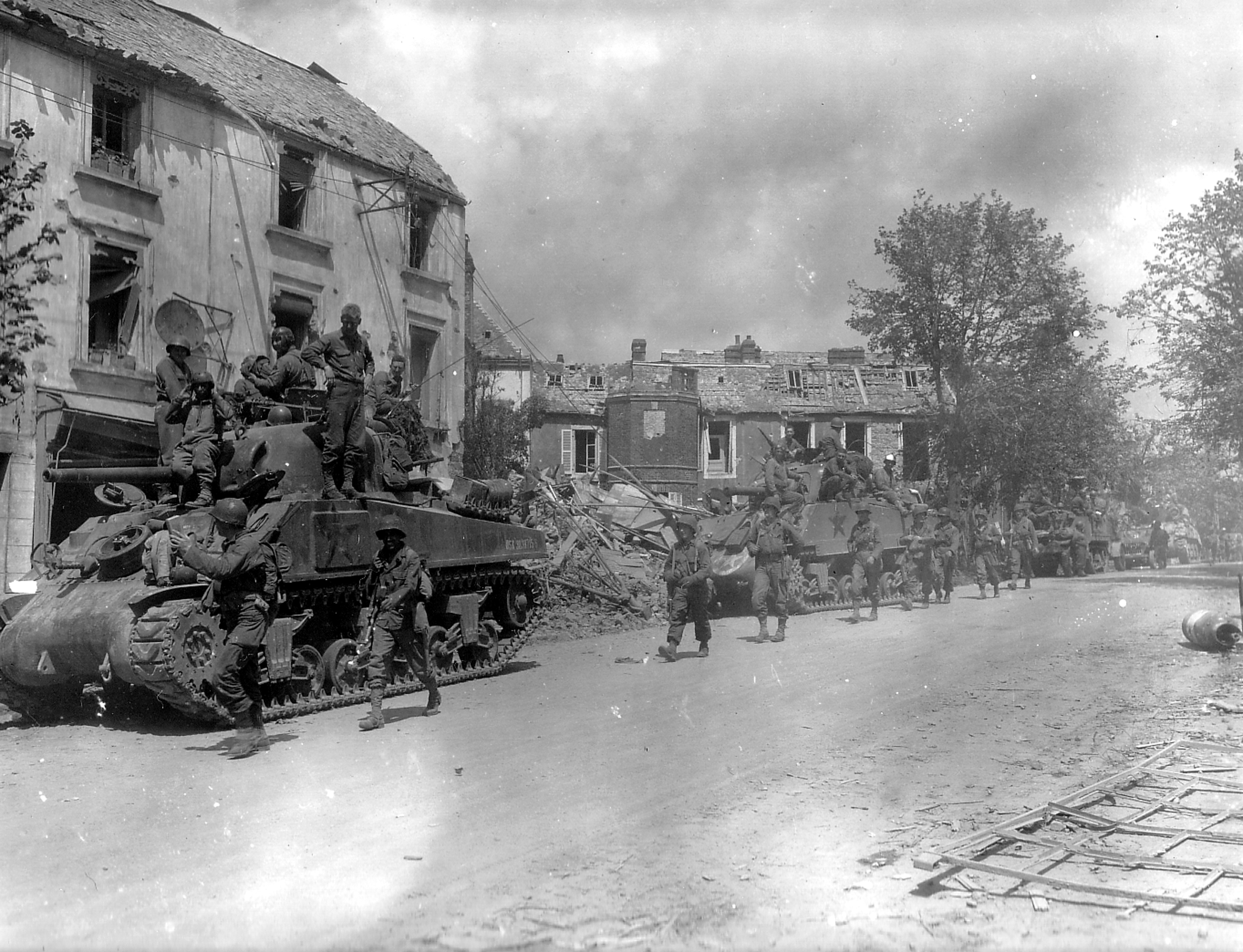
American armored and infantry forces passing through Coutances in July 1944 during the Normandy breakout.
U.S. Army Signal Corps / National Archives (111-SC-199774) · Public domain · Original recordImage changes
Display copies resized; original downloaded JPEG preserved.
The words
Air Liaison
By late July, radio links connected tank columns with supporting pilots. Liaison officers could request reconnaissance and attacks as the ground advance unfolded.
pp. 11–12, armored column cover · Hallion: air support in Normandy (opens a new tab)
Anti-Aircraft
German ground fire remained dangerous despite Allied control of the air. Low-flying fighter-bombers still suffered losses while supporting troops during the breakout.
p. 43, July 25–August 7 losses · Hallion: air support in Normandy (opens a new tab)
Avranches
As the breakout developed, Avranches became a gateway toward Brittany. Its river crossings and converging roads made keeping the narrow corridor open essential.
Ch. XVI, pp. 312–313, the Avranches corridor · Army history: routes beyond Normandy (opens a new tab)
Bombers
The July 25 attack combined heavy bombers, medium bombers and fighter-bombers. Their different assignments formed a timed sequence before the ground assault.
pp. 231–232, planned sequence and forces · Air Force history: the COBRA bombardment (opens a new tab)
Carpet Bombing
Heavy bombers concentrated their loads over a designated area to disrupt German defenses. The bombardment also struck American positions, exposing the dangers of close support.
pp. 231–234, target area and misplaced bombs · Air Force history: the COBRA bombardment (opens a new tab)
Collins
Major General J. Lawton Collins commanded VII Corps. He also reported on P-47 strafing to air commander Elwood Quesada as ground and air forces developed cooperation.
p. 16, Collins and fighter-bomber support · Hallion: air support in Normandy (opens a new tab)
Coutances
The planned westward thrust toward Coutances threatened German escape routes. Armored forces were assigned blocking positions south of the town as the breakthrough developed.
Ch. XIV, p. 264, the second thrust · Army history: the westward thrust (opens a new tab)
Flak
Gunfire directed against aircraft.
From July 25 to August 7, antiaircraft fire caused more IX Tactical Air Command aircraft losses than enemy fighters.
p. 43, recorded causes of aircraft losses · Hallion: air support in Normandy (opens a new tab)
Marigny
Marigny marked one flank of the planned infantry breach. Securing it would help armored and motorized forces pass through toward the west.
Ch. XI, pp. 214–215, infantry and exploitation plan · Army history: preparations for COBRA (opens a new tab)
McNair
Lieutenant General Lesley J. McNair was killed when American bombs fell among American troops on July 25. His death was part of the bombardment’s friendly casualties.
p. 234, short bombing on July 25 · Air Force history: the COBRA bombardment (opens a new tab)
Napalm
Jellied gasoline used as an incendiary.
Napalm was among the incendiaries carried by P-47 fighter-bombers in the European campaign. Jellied gasoline was also described among developing weapons in COBRA preparations.
Hallion: air support in Normandy (opens a new tab) · Army history: preparations for COBRA (opens a new tab)
Rockets
Rocket-firing equipment was among the new developments promising better ground support. It formed part of a broader effort to improve cooperation between aircraft and troops.
Ch. XI, p. 208, developing air-support weapons · Army history: preparations for COBRA (opens a new tab)
Short Bombs
Bombs fell short during both the aborted July 24 operation and the July 25 attack. American troops were killed and wounded despite precautions.
pp. 229–234, the two days distinguished · Air Force history: the COBRA bombardment (opens a new tab)
Strafing
Attacking ground targets with an aircraft’s guns.
P-47s used machine-gun fire against ground targets, including transport vehicles. Such attacks were one way fighter-bombers supported the Normandy advance alongside bombing missions.
p. 16, gun armament and ground attacks · Hallion: air support in Normandy (opens a new tab)
VII Corps
Bradley assigned VII Corps the main breakthrough effort. Infantry would open and secure a passage, then armored and motorized formations would exploit it.
Ch. XI, p. 215, the main effort · Army history: preparations for COBRA (opens a new tab)
Sources
- Breakout and Pursuit, Chapter 11: COBRA PreparationsU.S. Army Center of Military History; Martin Blumenson, official history, 1961; HyperWar transcription
- Breakout and Pursuit, Chapter 16: Breakthrough Becomes BreakoutU.S. Army Center of Military History; Martin Blumenson, official history, 1961; HyperWar transcription
- Breakout and Pursuit, Chapter 14: The Breakthrough DevelopedU.S. Army Center of Military History; Martin Blumenson, official history, 1961; HyperWar transcription
- D-Day 1944: Air Power Over the Normandy Beaches and BeyondRichard P. Hallion; Air Force History and Museums Program, 1994; HyperWar transcription
- The Army Air Forces in World War II, Volume III, Chapter 8: The Battle of FranceOffice of Air Force History; Wesley Frank Craven and James Lea Cate, editors; official history; HyperWar transcription