
World War II
Puzzle 58 · Breakout, Pursuit, and Holland · Page 87 in print
Bocage Country
American “Rhino” tank modifications cut through Normandy hedgerows for infantry-tank attacks.
Jump to a word
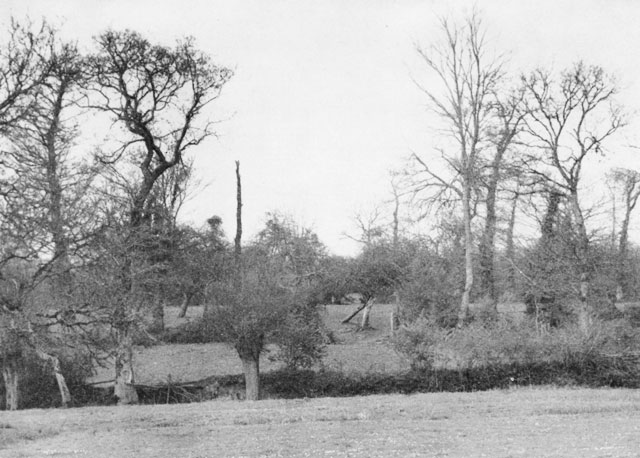
Ditches and hedgerows around an orchard near Hill 32 in Normandy.
U.S. Army / Historical Division, War Department (St-Lô, p. 27) · Public domain · Original recordImage changes
Display copies resized; original downloaded JPEG preserved.
The words
Ambush
In early August 1944, twisting roads and steep valleys offered German defenders opportunities for ambush as the U.S. 1st Infantry Division advanced toward Mortain.
Ch. XXIII, pp. 443–444, the drive to Mortain · Army history: the later Mortain advance (opens a new tab)
Bocage
Farmland enclosed by thick hedges and earthen banks.
The bocage broke the battlefield into small enclosed spaces. Defenders could turn each field into a separate obstacle, slowing the American advance inland.
Section I, The Operational Setting, enclosed terrain · Doubler: hedgerows and combined arms (opens a new tab)
Bradley
Lieutenant General Omar Bradley ordered mass production of Culin’s hedgecutter after a July demonstration. Ordnance units then equipped tanks for the coming COBRA attack.
Ch. XI, pp. 206–207, hedgecutter production · Army history: preparations for COBRA (opens a new tab)
Culin
Sergeant Curtis Culin helped develop a successful tank hedgecutter. Bradley backed mass production, while other American units were devising their own ways through the hedges.
Army Ordnance Collection: the Rhino (opens a new tab) · Doubler: hedgerows and combined arms (opens a new tab)
Encirclement
Taking Martinville Ridge threatened the German defenders of Hill 122 with isolation. The aim was to force withdrawal before American troops cut their escape through Saint-Lô.
Ch. VIII, pp. 154–155, intended maneuver · Army history: the Saint-Lô approaches (opens a new tab)
Hedgerows
Thick growth covered substantial earthen banks between fields. These barriers blocked vehicles, concealed defenders and limited what troops could see beyond the next enclosure.
Section I, The Operational Setting, banks and visibility · Doubler: hedgerows and combined arms (opens a new tab)
Martinville
The 29th Division advanced toward Saint-Lô along Martinville Ridge. German counterattacks caused casualties, while one battalion remained isolated ahead of the main force.
Last Phase of the Battle, pp. 107–111, ridge and isolated battalion · War Department history: Saint-Lô (opens a new tab)
Mines
Mines and booby traps reinforced the hedgerow defenses. During the July 11, 1944, advance, American infantry fought past a sunken road protected by antipersonnel mines.
Opening Attack on St-Lô, pp. 54–55, first obstacles · War Department history: Saint-Lô (opens a new tab)
Normandy
Beyond the beaches, American troops met enclosed fields and narrow lanes. The landscape limited observation and made neighboring units difficult to coordinate.
Section I, The Operational Setting, command and terrain · Doubler: hedgerows and combined arms (opens a new tab)
Panzers
German tanks or armored formations.
Panzer Lehr attacked west of the Vire on July 11, 1944. Its tanks and infantry penetrated American positions near le Désert.
XIX Corps Attacks West of the Vire, pp. 37–42, counterattack · War Department history: Saint-Lô (opens a new tab)
Rhino Tank
A Rhino carried projecting metal teeth that let a tank break through an earthen hedge bank. It could make a new field entrance without relying on existing gaps.
Did you know?
The Ordnance Collection illustrates the Rhino attachment on an M5A1 Stuart light tank.
Rhino history, new entrances and tank attachments · Army Ordnance Collection: the Rhino (opens a new tab)
Rommel
Generalfeldmarschall (field marshal) Erwin Rommel commanded Army Group B. Before D-Day, he favored stopping the invasion near the coast, fearing Allied aircraft would disrupt reserve movements.
Ch. II, pp. 19–22, coastal defense and reserve debate · Army history: German command in France (opens a new tab)
Saint-Lo
Saint-Lô was an important road hub in the American advance. Bombing, artillery and street fighting left much of the town in ruins.
Last Phase of the Battle, pp. 118–120, capture and destruction · War Department history: Saint-Lô (opens a new tab)
Sherman Tank
Shermans could carry hedgecutters, while infantry, engineers and artillery supplied other parts of the attack. Their crews learned to coordinate with infantry in the enclosed fields.
Section II, The Solution; Section III, Conclusions, coordinated arms · Doubler: hedgerows and combined arms (opens a new tab)
Wehrmacht
Nazi Germany’s armed forces: army, navy and air force.
The Wehrmacht defended German-occupied France. The German Historical Museum also documents its participation in Nazi war crimes, including the murder of civilians.
Army history: German command in France (opens a new tab) · German Historical Museum: Wehrmacht (opens a new tab)
Sources
- Breakout and Pursuit, Chapter XXIII: Opportunities and IntentionsU.S. Army Center of Military History; Martin Blumenson, official history, 1961; HyperWar transcription
- Breakout and Pursuit, Chapter VIII: The Battle for St. LôU.S. Army Center of Military History; Martin Blumenson, official history, 1961; HyperWar transcription
- Breakout and Pursuit, Chapter XI: COBRA PreparationsU.S. Army Center of Military History; Martin Blumenson, official history, 1961; HyperWar transcription
- Breakout and Pursuit, Chapter II: The EnemyU.S. Army Center of Military History; Martin Blumenson, official history, 1961; HyperWar transcription
- St-Lô, 7 July–19 July 1944Historical Division, U.S. War Department; American Forces in Action series; HyperWar transcription
- Busting the Bocage: American Combined Arms Operations in France, 6 June–31 July 1944Captain Michael D. Doubler; Combat Studies Institute, U.S. Army Command and General Staff College, 1988; HyperWar transcription
- Historical Collection Highlights: RhinoU.S. Army Ordnance Corps and School; historical collection account
- Die WehrmachtDeutsches Historisches Museum, LeMO; German-language historical overview