
World War II
Puzzle 57 · Overlord and the Assault Beaches · Page 84 in print
Hobart Funnies
Specialist tanks cleared Normandy beach obstacles on 6 June 1944.
Jump to a word
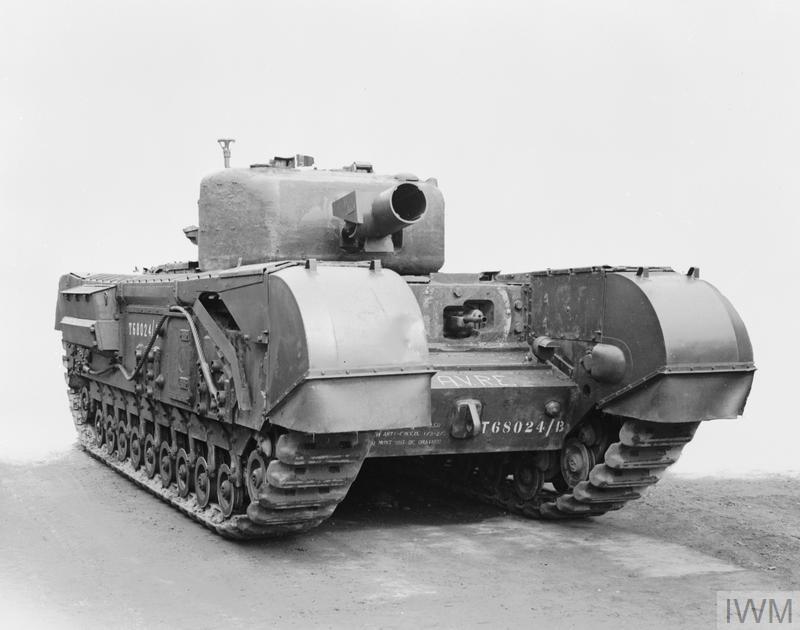
A Churchill AVRE with its spigot mortar during preparations for the Normandy landings in 1944.
British official photographer / Imperial War Museums (MH 9509) · Public domain · Original recordImage changes
Display copies resized; original downloaded JPEG preserved.
The words
Armour
Armor sheltered the Crab’s crew while its flail struck the ground ahead. Slow movement and clouds of dirt still made mine clearing dangerous.
Opening description, crew protection and hazards · Tank Museum: the Crab and its crew (opens a new tab)
AVRE
Assault Vehicle Royal Engineers, a tank adapted for engineering tasks.
The Churchill-based AVRE carried engineer stores and equipment for overcoming defenses. Its crew combined Royal Engineer specialists with a Royal Armoured Corps driver.
AVRE paragraphs, engineering stores and crew · Tank Museum: Hobart’s specialist vehicles (opens a new tab)
Bobbin
The Bobbin unrolled a reinforced canvas track across soft sand or mud. It helped following vehicles cross ground where they might otherwise become bogged down.
AVRE equipment paragraph, Bobbin trackway · Tank Museum: Hobart’s specialist vehicles (opens a new tab)
Bridge Layer
At Bernières on Juno, an AVRE placed a small assault bridge over the sea wall. This helped open a route off the beach.
Ch. V, p. 110, Bernières beach exits · Canadian Army history: beach exits (opens a new tab)
Crab
The Crab adapted a Sherman tank for mine clearing. Its flail equipment worked ahead of the vehicle, opening a path while the crew stayed under armor.
Did you know?
The museum’s Crab began as a Chrysler-built Sherman in April 1943, then was converted in Britain.
Opening description and collection identity · Tank Museum: the Crab and its crew (opens a new tab)
Crocodile
The Crocodile adapted the heavily armored Churchill into a flame-throwing tank. It belonged to Hobart’s family of vehicles for specialized assault tasks.
Did you know?
The Tank Museum’s Crocodile combines a tank built in October 1945 with a separately acquired flame-thrower trailer.
Opening history, Churchill adaptation and Hobart · Tank Museum: the Churchill Crocodile (opens a new tab)
DD Tanks
Duplex Drive amphibious tanks.
DD tanks were meant to swim ashore ahead of the infantry. Rough seas and late arrivals made their support uneven across the landing beaches.
Ch. II, p. 37; Ch. V, pp. 101–103 and 107, swimming tanks · Canadian Army history: beach exits (opens a new tab)
Flail
A rotating drum with chains that strike the ground.
The flail was mounted ahead of the Crab’s hull. Its chains struck the ground to set off mines before the tank passed over them.
Opening description, rotating drum and chains · Tank Museum: the Crab and its crew (opens a new tab)
Flamethrower
The Crocodile retained a main gun alongside its flame weapon. The conversion gave an existing tank design a specialized role in attacks on defended positions.
Opening history; Tank facts, main and flame weapons · Tank Museum: the Churchill Crocodile (opens a new tab)
Funnies
The Funnies were adaptations for specific jobs: crossing obstacles, clearing mines or attacking fortifications. Most used Sherman or Churchill tank designs.
Enter the Funnies; Sherman and Churchill base vehicles · Tank Museum: Hobart’s specialist vehicles (opens a new tab)
Gap Assault
Opening beach exits required tanks, bulldozers and engineers working together. Dunes, flooded ground, mines and enemy fire made the work difficult; assault engineers suffered casualties.
Ch. V, pp. 106–107 and 110, opening routes inland · Canadian Army history: beach exits (opens a new tab)
Hobart
Major-General Percy Hobart trained the 79th Armoured Division. Its units provided other formations with specialized vehicles for particular assault missions.
Tank Museum: Hobart’s specialist vehicles (opens a new tab) · Tank Museum: the Churchill Crocodile (opens a new tab)
Mine Clearing
Dust created by the flail could hide the crew’s view and prevent effective gunfire. Mine clearing demanded slow movement under dangerous conditions.
Opening description, limited visibility and walking-speed work · Tank Museum: the Crab and its crew (opens a new tab)
Minesweeping
At Nan Green on Juno, Crabs cleared mines while AVREs filled an anti-tank ditch and armored bulldozers improved routes inland.
Ch. V, p. 107, coordinated clearance on Nan Green · Canadian Army history: beach exits (opens a new tab)
Petard
The AVRE’s Petard was a demolition mortar for obstacles and fortifications. Reloading involved a foredeck hatch, exposing the crew to danger during combat.
AVRE and Petard paragraphs, role and exposed reloading · Tank Museum: Hobart’s specialist vehicles (opens a new tab)
Sources
- Sherman CrabThe Tank Museum, Bovington; collection record and vehicle provenance
- Tanks on D-DayThe Tank Museum; David Fletcher, May 9, 2024
- Churchill CrocodileThe Tank Museum, Bovington; collection record and composite vehicle provenance
- The Victory Campaign: The Operations in North-West Europe, 1944–1945Canadian Army official history, Volume III; Colonel C. P. Stacey; HyperWar transcription of the 1966 printing