
World War II
Puzzle 56 · Overlord and the Assault Beaches · Page 83 in print
Mulberry Harbour
Mulberry harbours used floating Whale roadways on Beetle pontoons to reach the Normandy shore.
Jump to a word
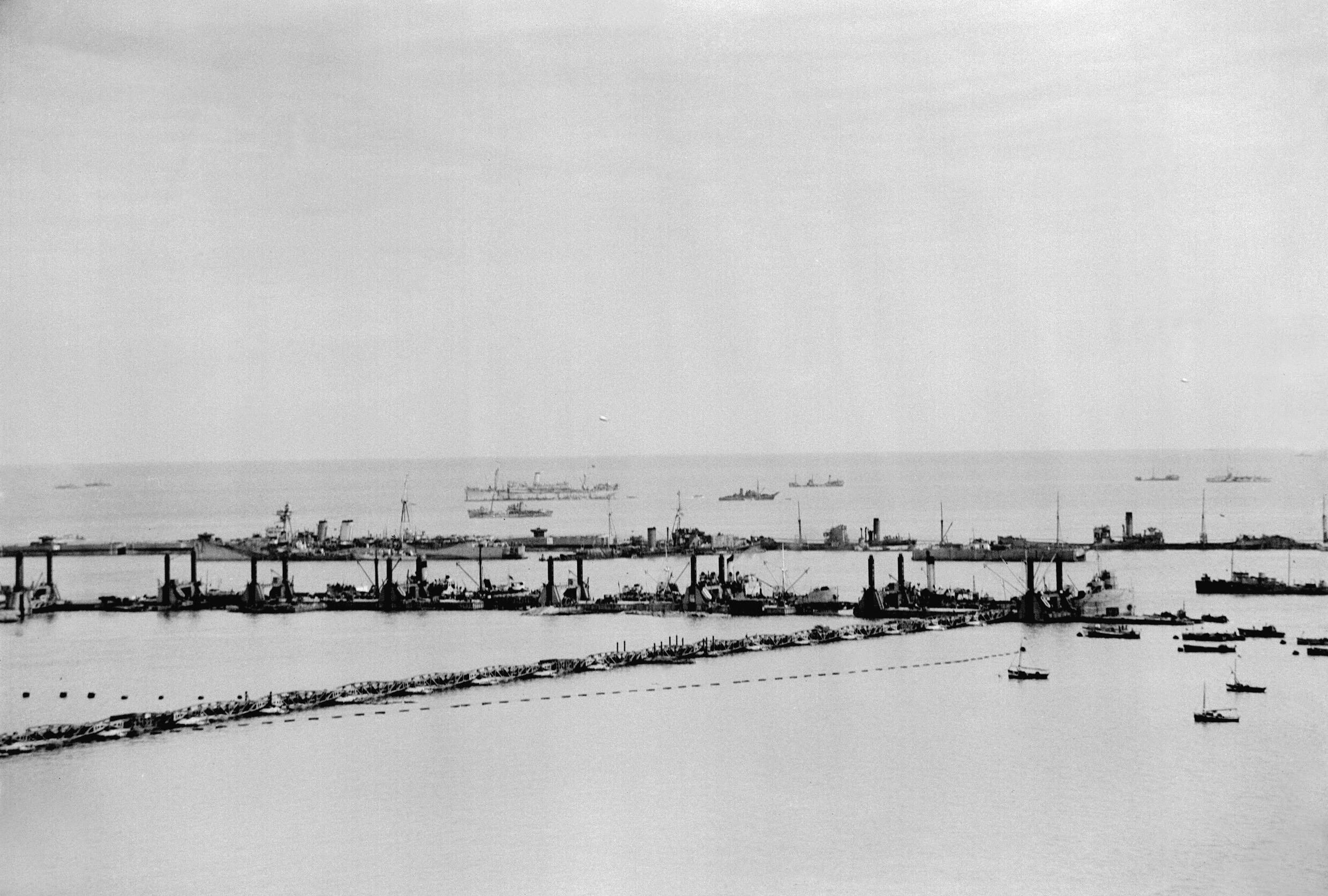
Mulberry B at Arromanches as the artificial harbor began operating in June 1944.
E. E. Allen, Royal Navy official photographer / Imperial War Museums (A 24675) · Public domain · Original recordImage changes
Display copies resized; original downloaded JPEG preserved.
The words
Army Engineers
At Omaha, U.S. Army engineers prepared beach exits and organized supply handling. Their work linked unloading on the shore with movement inland.
Ch. VII, pp. 282–284; Ch. X, pp. 381–383 · Army history: beach supply and the storm (opens a new tab)
Arromanches
Arromanches was the site of Mulberry B, serving British and Canadian forces. It was one of two artificial ports built for the invasion.
Opening project history, the two harbor sites · Civil Engineers: prefabricated harbors (opens a new tab)
Bombardon
Bombardons were hollow steel floating breakwaters outside the concrete barrier. They were intended to reduce swell in deeper water.
Ch. V, pp. 71–72, outer floating breakwater · Stanford: the Mulberry harbor design (opens a new tab)
Breakwaters
Breakwaters sheltered craft moving between anchored ships and shore. At Omaha, sunken ships joined the Phoenix caissons to create a longer protective line.
Ch. VII, pp. 277–278, linked shelter systems · Army history: beach supply and the storm (opens a new tab)
Caisson
A large hollow concrete chamber.
Caissons floated for towing and were flooded to sink into position. Uneven flooding could make a unit list dangerously or capsize.
Ch. V, pp. 69–70 and 73, towing and controlled sinking · Stanford: the Mulberry harbor design (opens a new tab)
Duck
An amphibious cargo truck, officially designated DUKW.
The harbor plan called for DUKW trucks to ferry cargo ashore, alongside barges, landing craft and Rhino ferries.
Ch. V, pp. 69–70 and note 2, ship discharge · Stanford: the Mulberry harbor design (opens a new tab)
Gooseberry
Gooseberry shelters used deliberately sunken ships. Planned for all five assault beaches, they offered protection even where no full Mulberry harbor was built.
Ch. VII, p. 277, five partial breakwaters · Army history: beach supply and the storm (opens a new tab)
Harbour
The harbor sheltered unloading craft. The storm of June 19–22, 1944, wrecked Mulberry A and sharply reduced the flow of supplies.
Ch. X, pp. 405–410, storm and unloading interruption · Army history: beach supply and the storm (opens a new tab)
Logistics Hub
Unloading was only one stage. Engineers organized supply dumps, vehicle parks and roadways so cargo could move from the beach to the troops inland.
Ch. VII, pp. 282–284, beach maintenance area · Army history: beach supply and the storm (opens a new tab)
Logistics Plan
The supply plan coordinated ships, unloading equipment, beach exits and inland transport. Its aim was a steady buildup of troops and stores.
Ch. VII, pp. 269–270 and 282–284, supply buildup · Army history: beach supply and the storm (opens a new tab)
Mulberry
Mulberry was the name for two prefabricated artificial ports. Components were built in Britain, towed across the Channel and assembled off the Normandy beaches.
Did you know?
The Institution of Civil Engineers credits Royal Engineer Allan Beckett with designing the floating roadways.
Opening project history; How the work was done · Civil Engineers: prefabricated harbors (opens a new tab)
Phoenix
Phoenix units formed the main concrete breakwater. Set end to end, they sheltered the piers and ships unloading into smaller craft.
Ch. V, pp. 69–70, concrete breakwater and anchorage · Stanford: the Mulberry harbor design (opens a new tab)
Pierhead
The platform at the outer end of a pier.
Lobnitz pierheads rose and fell on legs planted on the seabed. This kept their unloading platforms at a useful height above the water.
Ch. V, pp. 67–68, spud legs and tide adjustment · Stanford: the Mulberry harbor design (opens a new tab)
Temporary Port
Construction began in Britain rather than at the landing beaches. Tugs carried the components to Normandy, where they were assembled into temporary unloading facilities.
How the work was done, prefabrication and assembly · Civil Engineers: prefabricated harbors (opens a new tab)
Whale
Whale roadways linked piers to shore on pontoons. Near the beach, some supports rested on sand at low tide and floated as the water rose.
Ch. V, pp. 66–68, floating bridging and tides · Stanford: the Mulberry harbor design (opens a new tab)
Sources
- Force Mulberry, Chapter VCommander Alfred Stanford, USNR; participant account, William Morrow and Company, 1951; Bill Thayer transcription
- Logistical Support of the Armies, Volume I: May 1941–September 1944U.S. Army official history; Roland G. Ruppenthal, Office of the Chief of Military History, 1953; HyperWar transcription
- Mulberry harboursInstitution of Civil Engineers; infrastructure project history