
World War II
Puzzle 55 · Overlord and the Assault Beaches · Page 82 in print
Pegasus Bridge
Glider troops captured the Caen Canal bridge just after midnight on 6 June 1944.
Jump to a word
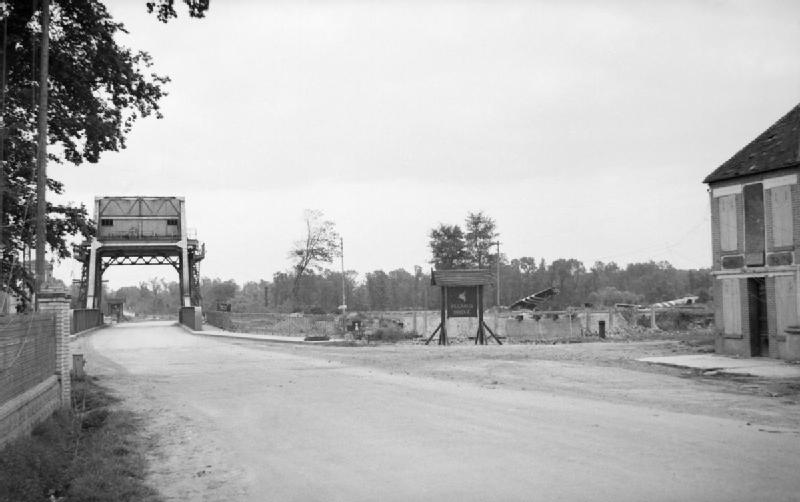
Pegasus Bridge over the Caen Canal at Bénouville on July 12, 1944, with two Horsa gliders in the background.
Alan S. Johnson / No. 5 Army Film and Photographic Unit / Imperial War Museums (B 7032) · Public domain · Original recordImage changes
Display copies resized; original downloaded JPEG preserved.
The words
Air Drops
Parachutists followed the first glider troops into Normandy. Scattered drops complicated assembly, but the 3rd and 5th Parachute Brigades helped secure the eastern flank.
Opening airborne-operation paragraphs, parachute brigades · British Army: the eastern airborne flank (opens a new tab)
Benouville
Bénouville stood by the canal crossing on the route inland from the beaches. Holding the crossings supported the airborne troops east of the Orne.
Ch. V, pp. 115–117, canal road and airborne flank · Canadian Army history: crossings and relief (opens a new tab)
Bridge
The canal bridge was seized intact for Allied use. It was a separate objective from the nearby bridge over the Orne.
Ch. V, pp. 91–93, two-bridge coup de main · Canadian Army history: crossings and relief (opens a new tab)
Caen
Caen was a major Second Army objective. The canal and river crossings near Bénouville helped protect the eastern flank of the invasion.
Ch. IV, pp. 71–72; Ch. V, pp. 115–117 · Canadian Army history: crossings and relief (opens a new tab)
Commandos
Brigadier Lord Lovat’s commandos reached the airborne troops during the afternoon after landing from the sea. Infantry and glider reinforcements followed.
Ch. V, p. 117, linkup and later reinforcements · Canadian Army history: crossings and relief (opens a new tab)
Coup de Main
A sudden attack intended to seize an objective intact.
Glider-borne infantry rushed the crossings before the beach landings. The objective was to take both bridges intact.
Ch. V, pp. 91–93, sudden bridge assault · Canadian Army history: crossings and relief (opens a new tab)
Glider Pilots
The Army Glider Pilot Regiment’s crews brought the force down in darkness. Five gliders landed close to the bridges; one landed far off course.
Memorial 92936, inscription, glider crews and landings · IWM: the glider-assault memorial (opens a new tab)
Horsa
Horsa gliders carried infantry close to the bridge objectives after being towed from England. They also transported equipment for the wider airborne operation.
Did you know?
The museum’s full-size Horsa replica was built for the sixtieth anniversary of D-Day in 2004.
Glider transport and the six bridge-assault aircraft · Mémorial Pegasus: Horsa gliders (opens a new tab)
Howard
Major John Howard planned the bridge assault. His force combined infantry with engineers and medical support for a rapid seizure of the crossings.
Memorial 92936, inscription, Howard and supporting personnel · IWM: the glider-assault memorial (opens a new tab)
Orne
The Orne bridge and canal bridge formed a pair of objectives. Capturing both preserved a route across the waterways on the invasion’s flank.
Ch. V, pp. 91–93 and 116–117, crossings and bridgehead · Canadian Army history: crossings and relief (opens a new tab)
Ox and Bucks
The 2nd Battalion, Oxfordshire and Buckinghamshire Light Infantry, supplied the assault troops. Engineers, medical personnel and a parachute liaison officer supported the force.
Memorial 92936, inscription, infantry and supporting services · IWM: the glider-assault memorial (opens a new tab)
Pathfinders
Troops sent ahead to mark airborne landing areas.
Men of the 22nd Independent Parachute Company marked drop zones with lights and homing beacons. Damaged equipment and misplaced markers complicated the night landings.
Company role; Normandy, marking failures and damaged equipment · Airborne Assault Museum: the pathfinders (opens a new tab)
Ranville
Airborne drop zones lay near Ranville, east of the bridges. Holding the crossings helped protect those zones and the landing beaches to the north.
Memorial 92936, inscription, protected beaches and drop zones · IWM: the glider-assault memorial (opens a new tab)
Second Army
Lieutenant-General Miles Dempsey commanded the British Second Army. The airborne bridgehead guarded the left flank of its seaborne assault.
Ch. IV, pp. 71–72; Ch. V, pp. 116–117 · Canadian Army history: crossings and relief (opens a new tab)
Tonga
Tonga was the 6th Airborne Division’s opening operation in Normandy. It combined bridge seizures with attacks on Merville and demolitions over the Dives.
Operation Tonga objectives paragraph · British Army: the eastern airborne flank (opens a new tab)
Sources
- Pegasus BridgeImperial War Museums, War Memorials Register 92936; National Memorial Arboretum sculpture and plaque transcription
- By air to battle on D-DayBritish Army; heritage account of 6th Airborne Division’s D-Day operations
- The Victory Campaign: The Operations in North-West Europe, 1944–1945Canadian Army official history, Volume III; Colonel C. P. Stacey; HyperWar transcription of the 1966 printing
- Horsa GliderMémorial Pegasus museum, Ranville; Horsa glider history and replica description
- 22nd Independent Parachute CompanyAirborne Assault Museum, ParaData; company history and Normandy operations