
World War II
Puzzle 54 · Overlord and the Assault Beaches · Page 81 in print
Pointe du Hoc
Lieutenant Colonel James Rudder’s Rangers scaled Pointe du Hoc’s cliffs under fire on 6 June 1944 and held out until relief on 8 June. Only about ninety of the original two hundred twenty-five attackers were still able to fight.
Jump to a word
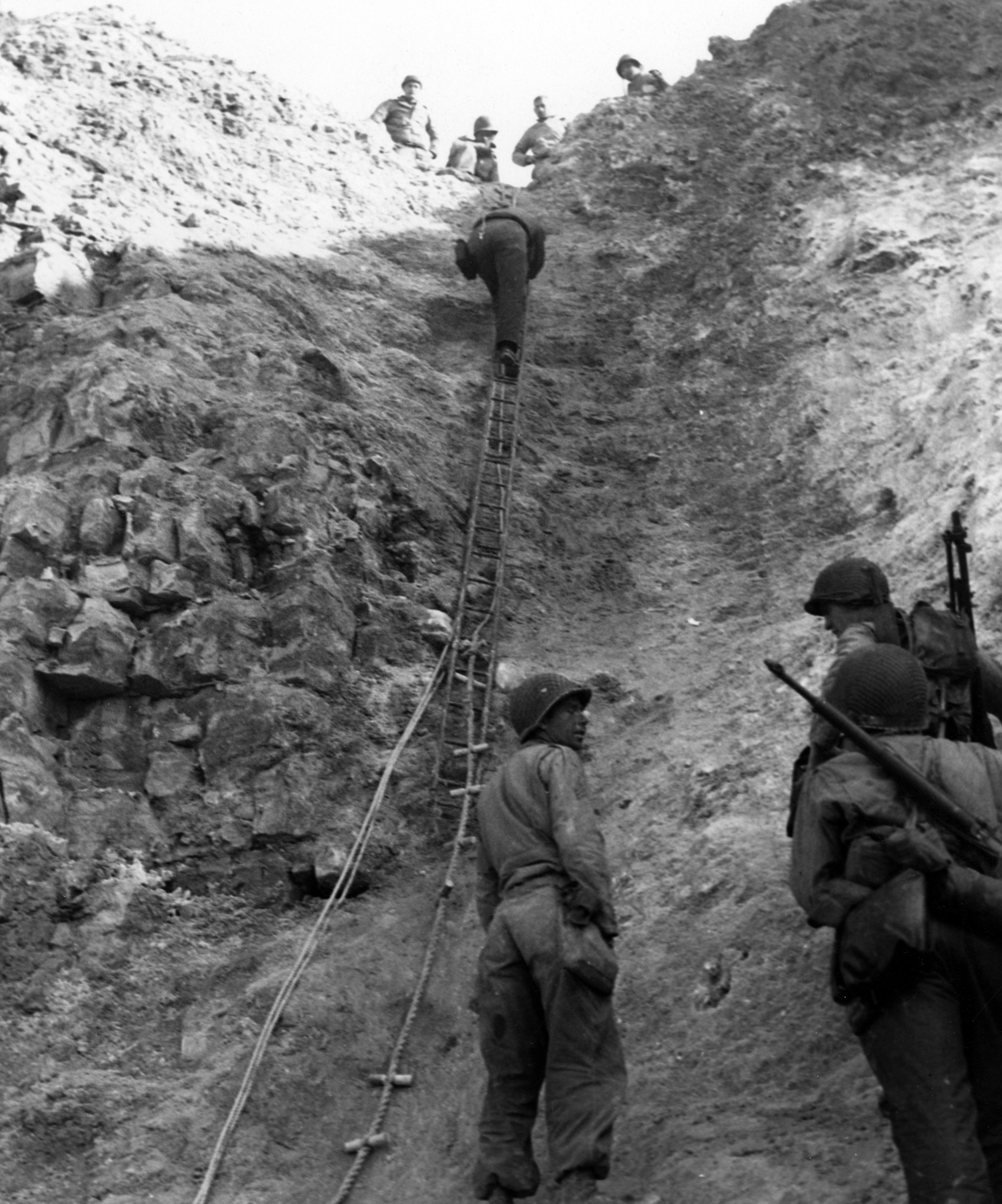
U.S. Army Rangers demonstrate the ladders used to scale the cliffs at Pointe du Hoc in June 1944.
U.S. Navy / National Archives (80-G-45716) · Public domain · Original recordImage changes
Display copies resized; original downloaded JPEG preserved.
The words
Air Attacks
Air bombardment helped turn the ground above the cliffs into a field of craters. Rangers crossed it in small groups after climbing.
Ch. VIII, p. 322, movement across the bombarded ground · U.S. Army history: the Ranger assault (opens a new tab)
Artillery Fire
German artillery and machine-gun fire struck Rangers advancing toward the coastal highway. Their move inland brought further casualties after the climb.
Point du Hoe, pp. 26–28, advance along the exit road · Army history: the Rangers’ boat teams (opens a new tab)
Atlantic Wall
At Pointe du Hoc, the German coastal defenses included gun emplacements, ammunition bunkers and observation positions. Rangers attacked this fortified site within the wider defense system.
PDF p. 2, features 5–7 and 13 · ABMC: cliffs, bunkers and gun positions (opens a new tab)
Big Guns
The guns were absent from the cliff-top emplacements. Rangers found them farther inland, camouflaged and unguarded, and put them out of action.
Ch. VIII, p. 322, the missing guns · U.S. Army history: the Ranger assault (opens a new tab)
Blockhouses
Fortified buildings protecting troops, weapons or observation posts.
Thick concrete walls protected German personnel and firing positions. At the observation bunker, defenders fired at advancing Rangers through narrow slits.
PDF p. 2, features 4, 13 and 20 · ABMC: cliffs, bunkers and gun positions (opens a new tab)
Bluffs
The ground above the cliffs was pitted by air and naval bombardment. The surviving craters remain part of the memorial landscape.
PDF p. 2, feature 2 and walking-path map · ABMC: cliffs, bunkers and gun positions (opens a new tab)
Cliff Assault
Lieutenant Colonel James Rudder’s three Ranger companies made the climb. Later German counterattacks left them holding an isolated position for two days.
Ch. VIII, p. 322, landing and subsequent counterattacks · U.S. Army history: the Ranger assault (opens a new tab)
Cliff Face
Bombardment broke chunks from the cliff, piling debris at its base. Some Rangers combined that rubble slope with extension ladders to get up.
Point du Hoe, pp. 9–10 and 14–15, debris and LCA 668 · Army history: the Rangers’ boat teams (opens a new tab)
Cliffs
Rangers used several methods to climb the cliffs under fire. Some used ropes and ladders; others also used bayonets or knives as climbing aids.
PDF p. 2, feature 12, the cliff line · ABMC: cliffs, bunkers and gun positions (opens a new tab)
Coastal Guns
The coastal battery was targeted as part of the invasion’s fire-support plan. Destroying its guns was the Rangers’ primary mission.
Ch. VIII, pp. 308 and 322, battery mission · U.S. Army history: the Ranger assault (opens a new tab)
Grappling
Catching and holding with hooks attached to ropes.
Rockets carried hooked ropes toward the cliff edge. Seawater made the ropes heavier, and some grapnels failed to gain a usable hold.
Point du Hoe, pp. 4, 7 and 11, rockets and soaked ropes · Army history: the Rangers’ boat teams (opens a new tab)
Gun Positions
The prepared emplacements on the Point were empty when searched. The actual guns had been moved to a hedgerow farther inland.
Did you know?
The guide identifies the gun displayed at the site as a similar recaptured piece, rather than one of the weapons destroyed by the Rangers.
PDF p. 2, feature 25, relocated guns · ABMC: cliffs, bunkers and gun positions (opens a new tab)
Lomell
First Sergeant Leonard Lomell was wounded while landing but continued inland. With Staff Sergeant Jack Kuhn, he found and helped disable the hidden guns.
Point du Hoe, pp. 14–15 and 30–31, landing and gun patrol · Army history: the Rangers’ boat teams (opens a new tab)
Rope Ladders
Rope ladders were one option among plain ropes, wooden-toggle ropes and extension ladders. Rangers used whichever equipment worked at their particular landing point.
Point du Hoe, pp. 4–5 and 11–15, equipment and boat teams · Army history: the Rangers’ boat teams (opens a new tab)
Satterlee
USS Satterlee fired close to shore to cover the Rangers’ climb. It continued supporting them through much of the day before other destroyers relieved it.
Ch. VIII, p. 322, destroyer support and relief · U.S. Army history: the Ranger assault (opens a new tab)
Sources
- Cross-Channel Attack, Chapter VIII: The Sixth of JuneU.S. Army Center of Military History; Gordon A. Harrison, official history, 1951; HyperWar transcription
- Small Unit Actions: Point du Hoe, 2d Ranger Battalion, 6 June 1944Historical Division, U.S. War Department; American Forces in Action series, 1946; HyperWar transcription
- Pointe du HocAmerican Battle Monuments Commission; English walking-path guide, February 2026