
World War II
Puzzle 53 · Overlord and the Assault Beaches · Page 80 in print
Juno Beach
Canadians landed at Juno on 6 June 1944 against Germany’s 716th Infantry Division.
Jump to a word
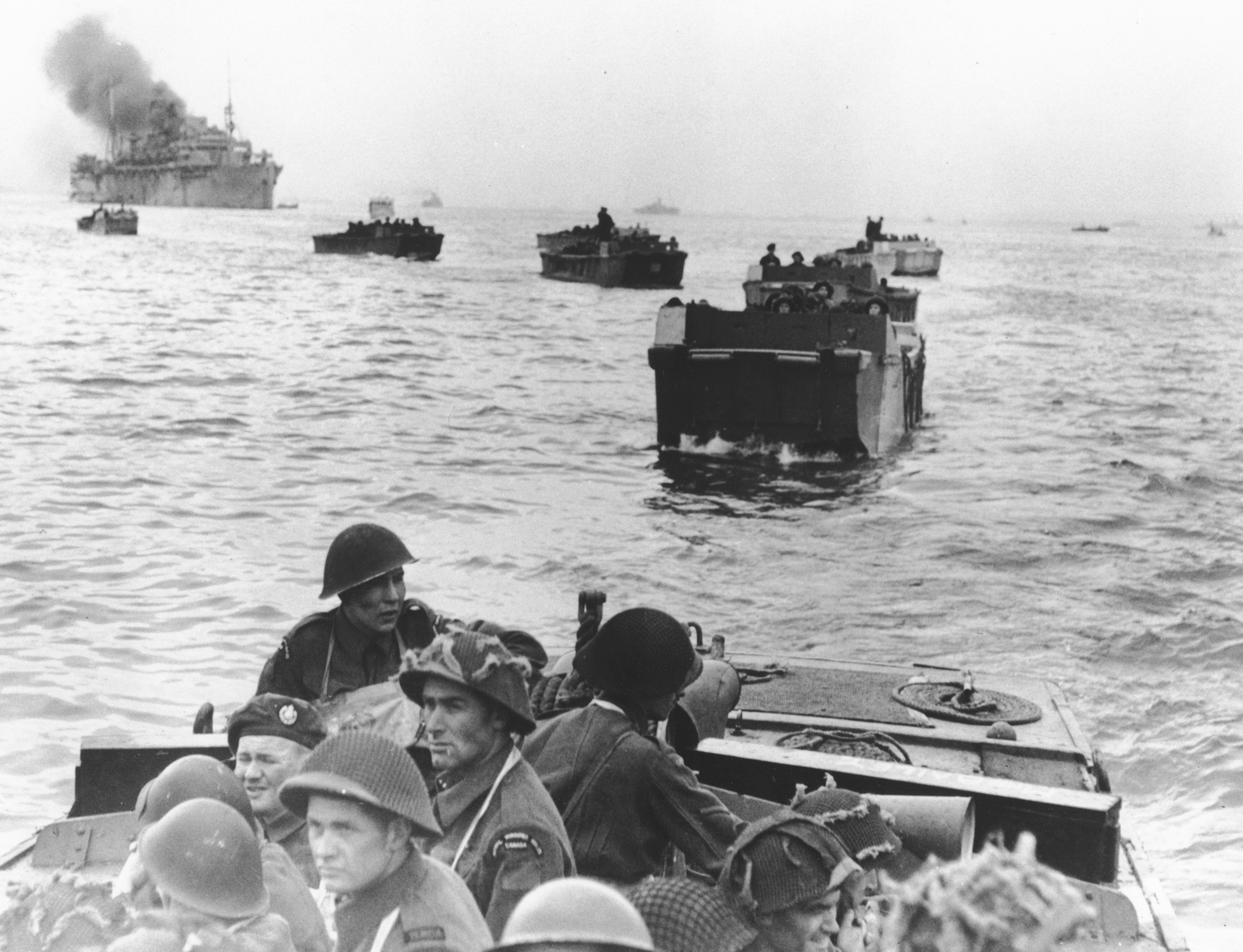
Royal Winnipeg Rifles infantrymen in landing craft heading toward Courseulles-sur-Mer at Juno Beach on June 6, 1944.
Canada. Dept. of National Defence / Library and Archives Canada / PA-132651 · Public domain · Original recordImage changes
Display copies resized; original downloaded JPEG preserved.
The words
Assault Beach
Two Canadian infantry brigades assaulted Juno. Taking the coastal villages and opening routes inland were the first stage of their advance.
Ch. IV, pp. 76–77, assault phases · Canadian Army history: the Juno assault (opens a new tab)
Assault Waves
The first assault was followed by reserve battalions and the 9th Brigade. These later arrivals were intended to carry the advance farther inland.
Canada’s role; Reserve units add support · Veterans Affairs Canada: Normandy landings (opens a new tab)
Beach Defenses
Concrete gun positions, mines, wire and obstacles protected Juno. The preliminary bombardment left many defenses intact, forcing infantry and tanks to fight through them.
The opponent; D-Day, surviving coastal positions · Veterans Affairs Canada: Normandy landings (opens a new tab)
Beach Landing
Landing craft brought troops through rough water to the shore. The rising tide concealed mined obstacles, damaging craft and causing casualties among later arrivals.
D-Day; Reserve units add support · Veterans Affairs Canada: Normandy landings (opens a new tab)
Beachmaster
A naval officer supervising operations on a beach sector.
Lieutenant Dudley Rayburn oversaw a sector of Juno as a naval beachmaster. His Beach Commando W reached France in early July 1944, after the initial assault.
Did you know?
Rayburn’s Combined Operations sleeve patch showed an anchor, a submachine gun and an eagle, representing the navy, army and air force.
Artifact CWM 20000131-001, Rayburn and Beach Commando W · War Museum: a Juno beachmaster’s blouse (opens a new tab)
Bernieres
The Queen’s Own Rifles landed at Bernières-sur-Mer. They suffered heavy casualties before overcoming the beach defenses and advancing through the village.
Ch. V, pp. 107–108, Queen’s Own Rifles · Canadian Army history: the Juno assault (opens a new tab)
Canadian Army
The army’s Juno force included infantry, tanks, artillery, engineers, signallers and medical personnel. Their different tasks supported the landing and sustained the advance inland.
Canada’s role, supporting arms and services · Veterans Affairs Canada: Normandy landings (opens a new tab)
Courseulles
Courseulles stood at the Seulles mouth. Canadians landed on both sides, with the Regina Rifles fighting through the town.
Ch. V, pp. 102–105, landings and town fighting · Canadian Army history: the Juno assault (opens a new tab)
Juno
Juno lay between Britain’s Gold and Sword beaches. The Canadian landing formed part of the British Second Army’s assault front.
Ch. IV, p. 76, neighboring assault divisions · Canadian Army history: the Juno assault (opens a new tab)
Keller
Major-General R. F. L. Keller commanded the 3rd Canadian Infantry Division. The 2nd Canadian Armoured Brigade was also under his command.
Ch. IV, p. 76, divisional command and attached armor · Canadian Army history: the Juno assault (opens a new tab)
Mike Sector
Mike lay west of the Seulles mouth. The Royal Winnipeg Rifles and an attached Canadian Scottish company assaulted its beaches.
Ch. V, p. 102, 7th Brigade landing sectors · Canadian Army history: the Juno assault (opens a new tab)
Nan Sector
Nan included the Regina Rifles’ landing east of the Seulles, as well as the 8th Brigade beaches farther east.
Ch. V, pp. 102 and 106–108, brigade beach fronts · Canadian Army history: the Juno assault (opens a new tab)
Regina Rifles
The Regina Rifle Regiment landed on Nan Green. Infantry and 1st Hussars tanks fought the surviving German positions in Courseulles.
Ch. V, pp. 102–105, landing sector and tank support · Canadian Army history: the Juno assault (opens a new tab)
Third Division
The 3rd Canadian Infantry Division supplied Juno’s main infantry force. Two brigades led the assault, with the third following to reinforce and extend the beachhead.
Canada’s role; Best laid plans, brigade sequence · Veterans Affairs Canada: Normandy landings (opens a new tab)
Winnipeg
The Royal Winnipeg Rifles assaulted west of Courseulles. Opposition varied: one company faced defenses missed by the bombardment and suffered severe losses coming ashore.
Hard earned victory, the Winnipeg assault companies · Veterans Affairs Canada: Normandy landings (opens a new tab)
Sources
- Royal Canadian Navy Beach Commando Battle Dress BlouseCanadian War Museum; artifact CWM 20000131-001, Lieutenant Dudley Rayburn’s battle dress blouse
- The Victory Campaign: The Operations in North-West Europe, 1944–1945Canadian Army official history, Volume III; Colonel C. P. Stacey; HyperWar transcription of the 1966 printing
- D-Day and the Battle of NormandyVeterans Affairs Canada; historical sheet