
World War II
Puzzle 52 · Overlord and the Assault Beaches · Page 79 in print
Utah Beach
Utah’s first troops landed about 2,000 yards south of their planned position on 6 June 1944.
Jump to a word
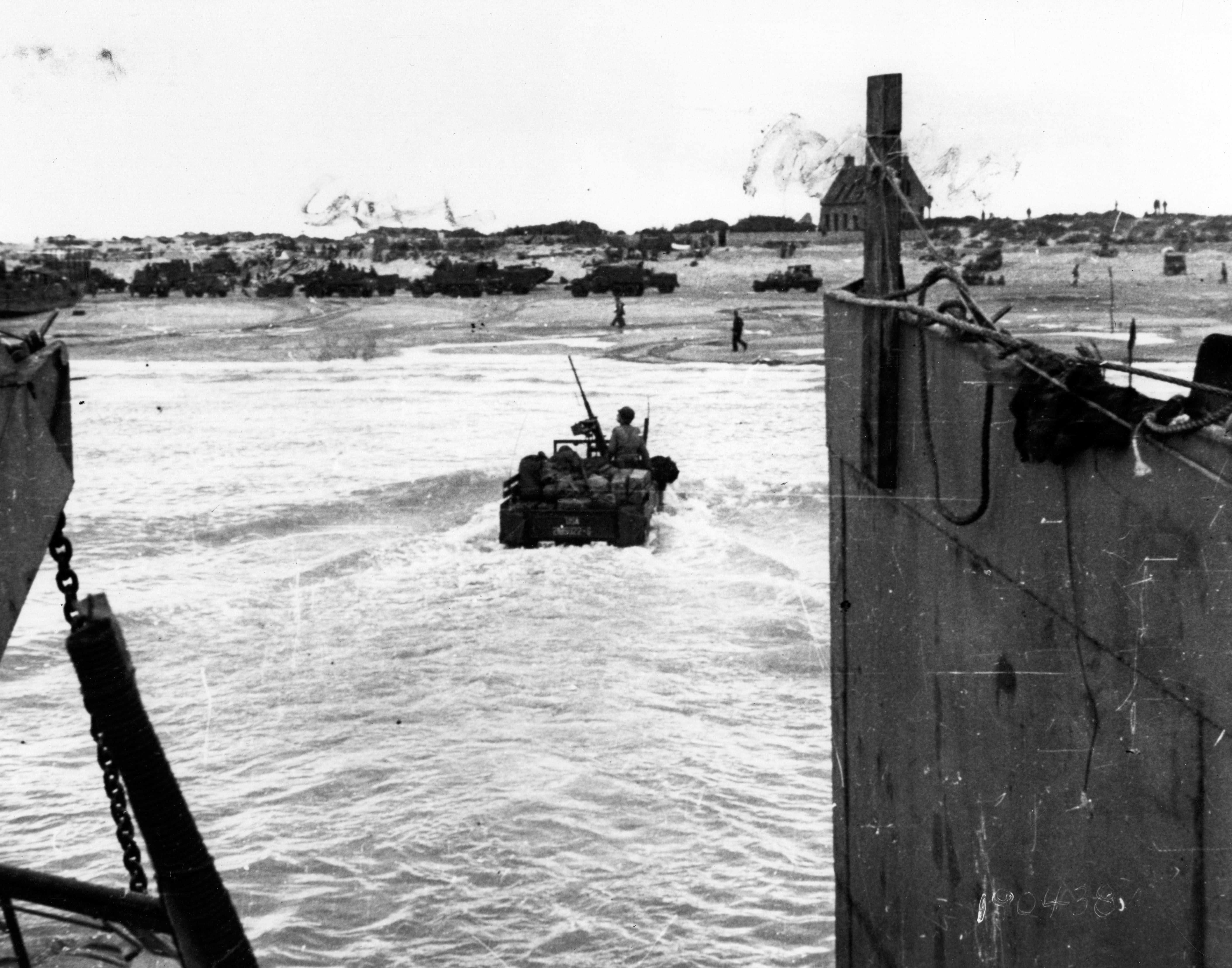
A U.S. Army weapons carrier drives through the surf toward Utah Beach on June 6, 1944.
U.S. Army Signal Corps / National Archives, courtesy National Museum of the U.S. Navy (SC 190438) · Public domain · Original recordImage changes
Display copies resized; original downloaded JPEG preserved.
The words
Barton
Raymond Barton commanded the 4th Infantry Division. Its 8th Infantry led the landing, followed by other regiments expanding the beachhead inland.
Ch. VIII, pp. 302–304, assault plan and advance · U.S. Army history: Utah and airborne troops (opens a new tab)
Causeways
Raised roads across wet or flooded ground.
Causeways crossed the flooded ground behind Utah. Airborne troops were tasked with securing their inland ends for the beach assault.
Launching the Invasion, pp. 1–3; The Airborne Assault, pp. 15–16 · Army history: Utah terrain and crossings (opens a new tab)
Cotentin
Utah’s position on the Cotentin brought troops nearer Cherbourg, whose port was a major objective for supplying the invasion.
Launching the Invasion, pp. 1–2, Cherbourg and port capacity · Army history: Utah terrain and crossings (opens a new tab)
Douve
Douve crossings and the la Barquette lock were airborne objectives, helping protect the beachhead’s southern flank.
The Airborne Assault, pp. 15–16, 101st Division missions · Army history: Utah terrain and crossings (opens a new tab)
La Fiere
Airborne troops suffered casualties fighting for the Merderet crossing at La Fière. German counterattacks drove troops from the western bridgehead.
The Airborne Assault, pp. 35–39, bridge attacks and counterattacks · Army history: Utah terrain and crossings (opens a new tab)
La Madeleine
Fortifications around La Madeleine confronted the first assault battalion. They covered the causeway routes inland from the actual landing area.
The Seaborne Assault, pp. 49–50, altered assault missions · Army history: Utah terrain and crossings (opens a new tab)
Merderet
The Merderet divided the 82nd’s landing area. Scattered drops on both banks complicated the effort to secure crossings.
The Airborne Assault, pp. 30–31 and 34–37, drops and crossings · Army history: Utah terrain and crossings (opens a new tab)
Moon
Rear Admiral Don Moon commanded Force U from Bayfield. The ship also housed VII Corps headquarters, bringing naval and army command aboard the same vessel.
Ch. VIII, p. 301, headquarters ships · U.S. Army history: Utah and airborne troops (opens a new tab)
Paratroop Drop
Paratroopers preceded the sea assault to secure exits and crossings. Scattered drops left mixed groups pursuing their missions.
The Airborne Assault, pp. 14–16 and 34–37 · Army history: Utah terrain and crossings (opens a new tab)
Pouppeville
After fighting at Pouppeville, the 101st’s troops met the 8th Infantry advancing from Utah, linking the airborne and seaborne assaults.
The Airborne Assault, pp. 21–22, Ewell and MacNeely · Army history: Utah terrain and crossings (opens a new tab)
Ridgway
Matthew Ridgway commanded the 82nd Airborne Division. Scattered landings left two of its regiments struggling to assemble and carry out their assigned missions.
Ch. VIII, p. 289, scattered 82nd Division drops · U.S. Army history: Utah and airborne troops (opens a new tab)
Ste-Mere-Eglise
The 505th Parachute Infantry captured Sainte-Mère-Église before dawn. Holding the town gave the scattered 82nd a defensive center inland while its river crossings remained insecure.
Ch. VIII, pp. 289–291, capture and defense of the town · U.S. Army history: Utah and airborne troops (opens a new tab)
Ted Roosevelt
Theodore Roosevelt Jr., the 4th Division’s assistant commander, insisted on accompanying the first wave. He went ashore after his initial request had been refused.
Did you know?
Roosevelt carried a walking cane with him onto Utah Beach.
D-Day paragraphs, first-wave role and written request · Army Museum: Roosevelt’s first-wave role (opens a new tab)
Utah
Utah’s first waves reached a less heavily defended stretch than planned. Troops reorganized and advanced inland while engineers cleared obstacles and opened routes.
Ch. VIII, pp. 303–304, mislanding and engineers · U.S. Army history: Utah and airborne troops (opens a new tab)
Van Fleet
James Van Fleet commanded the 8th Infantry, which made the opening assault. Its battalions then used the causeways to push toward the airborne troops.
Ch. VIII, pp. 302–304, 8th Infantry and beach exits · U.S. Army history: Utah and airborne troops (opens a new tab)
Sources
- Cross-Channel Attack, Chapter VIII: The Sixth of JuneU.S. Army Center of Military History; Gordon A. Harrison, official history, 1951; HyperWar transcription
- Utah Beach to Cherbourg, 6 June–27 June 1944Historical Division, U.S. War Department; American Forces in Action series; HyperWar transcription
- Theodore Roosevelt IIINational Museum of the United States Army; Delaney Brewer, Co-lead Education Specialist