
World War II
Puzzle 51 · Overlord and the Assault Beaches · Page 78 in print
Omaha Beach
Omaha’s assault troops fought up the bluffs on 6 June 1944.
Jump to a word
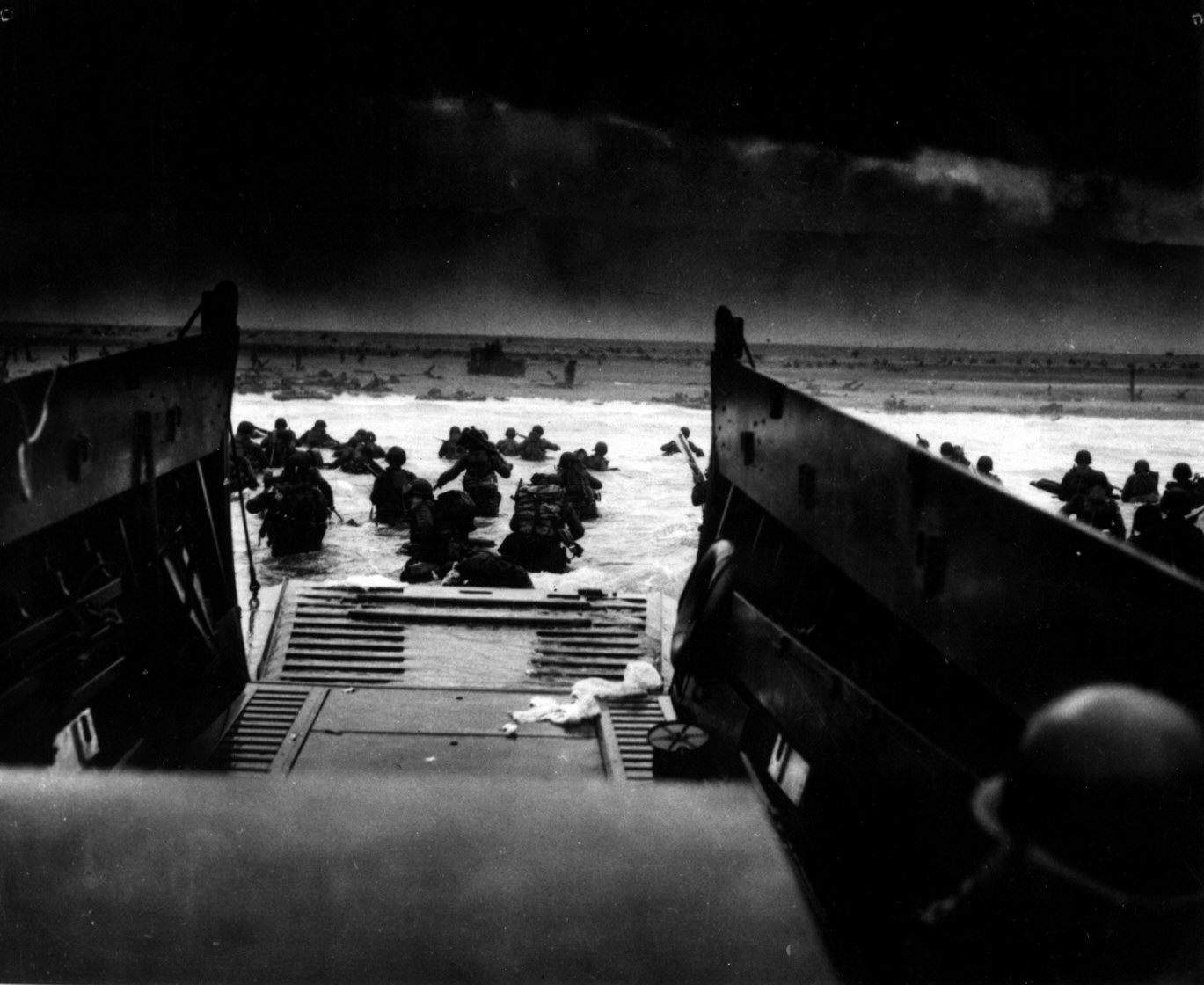
American soldiers leave a Coast Guard landing craft on the coast of France on June 6, 1944.
Robert F. Sargent / U.S. Coast Guard / National Archives (26-G-2343) · Public domain · Original recordImage changes
Display copies resized; original scan preserved.
The words
Bayeux
British troops entered and cleared Bayeux on June 7. Their advance east of Omaha brought the British and American beachheads closer to joining.
Ch. IX, p. 339, British advance and the beachhead junction · U.S. Army history: beyond the beaches (opens a new tab)
Big Red One
The U.S. 1st Infantry Division’s nickname.
At Omaha, the division brought experience from the North African and Sicilian landings. This was its third amphibious assault of the war.
Did you know?
The nickname comes from the red numeral on its shoulder patch, worn since 1918.
World War II section, North Africa, Sicily and Normandy · First Division Museum: the Big Red One (opens a new tab)
Colleville
The 16th Infantry pushed inland near Colleville after climbing the bluffs. Its attacks opened routes behind German positions guarding the beach.
Ch. VIII, pp. 324–327, 16th Infantry penetrations · U.S. Army history: Omaha’s troops and exits (opens a new tab)
Cota
Norman Cota helped urge soldiers off the exposed beach and up the bluffs. The 29th Division’s assistant commander worked alongside Colonel Canham.
Ch. VIII, p. 324, Canham and Cota urging the advance · U.S. Army history: Omaha’s troops and exits (opens a new tab)
Dog Green
Dog Green lay in front of the defenses of the Vierville draw. Company A, 116th Infantry, suffered devastating losses there in the first wave.
D Day: The Landings, pp. 45–47, Dog Green · Army history: Omaha terrain and landings (opens a new tab)
Draws
Valleys or depressions that provide routes through the bluffs.
Opening the draw roads was vital for bringing tanks, vehicles and supplies inland. Their defensive importance made them heavily protected routes.
Assault Plan, pp. 16 and 24–25, exit corridors and defenses · Army history: Omaha terrain and landings (opens a new tab)
Easy Red
Mislandings scattered the first-wave troops intended for Easy Red. Some men arrived between the E-1 and E-3 draws after struggling through deep water and currents.
D Day: The Landings, pp. 47–48, first-wave mislandings · Army history: Omaha terrain and landings (opens a new tab)
Frankford
USS Frankford was one of the destroyers supporting Omaha. The destroyers moved close in to fire on positions holding troops on the beach.
Ch. VIII, pp. 321–322 and note 80, destroyer support · U.S. Army history: Omaha’s troops and exits (opens a new tab)
Gerow
Leonard Gerow commanded V Corps at Omaha. The first assault paired the 16th Infantry with the 116th, attached from the 29th Division.
Ch. VIII, pp. 305–308, corps and assault regiments · U.S. Army history: Omaha’s troops and exits (opens a new tab)
Grandcamp
After relieving the Rangers at Pointe du Hoc, the 116th Infantry advanced to Grandcamp. Flooded ground channelled the approach and contributed to difficult fighting.
Ch. IX, p. 353, relief and advance to Grandcamp · U.S. Army history: beyond the beaches (opens a new tab)
Les Moulins
Les Moulins stood by the D-3 exit, where a road led inland. Smoke from burning grass temporarily screened some nearby landings from German fire.
Assault Plan, p. 13; D Day: The Landings, p. 45 · Army history: Omaha terrain and landings (opens a new tab)
Medical
Medical personnel brought wounded men back from the tidal flat under fire. The rising tide made delay deadly for soldiers unable to move.
D Day: The Landings, pp. 46–47, rescue and stranded wounded · Army history: Omaha terrain and landings (opens a new tab)
Minefield
German mines formed part of the defenses behind the beach. Engineers probed suspected mined ground to help infantry find a way inland.
Assault Plan, pp. 22–25; Assault of the Bluffs, p. 58 · Army history: Omaha terrain and landings (opens a new tab)
Omaha
Despite heavy losses and disorganization, small groups left cover and climbed the bluffs. Engineers, tanks and destroyers helped them overcome the beach defenses.
Assault of the Bluffs, p. 58, improvised penetrations · Army history: Omaha terrain and landings (opens a new tab)
Vierville
Troops captured Vierville before its beach exit was opened. The road through the defended draw remained blocked until engineers could clear a route that evening.
Ch. VIII, p. 326, village capture and the delayed exit · U.S. Army history: Omaha’s troops and exits (opens a new tab)
Sources
- Cross-Channel Attack, Chapter IX: The V Corps LodgmentU.S. Army Center of Military History; Gordon A. Harrison, official history, 1951; HyperWar transcription
- Cross-Channel Attack, Chapter VIII: The Sixth of JuneU.S. Army Center of Military History; Gordon A. Harrison, official history, 1951; HyperWar transcription
- Omaha Beachhead, 6 June–13 June 1944Historical Division, U.S. War Department; American Forces in Action series; HyperWar transcription
- About the First Infantry DivisionFirst Division Museum at Cantigny; The Fighting First and World War II sections