
World War II
Puzzle 50 · Overlord and the Assault Beaches · Page 77 in print
Bedell Smith at Southwick
At Southwick House, Eisenhower confirmed on 5 June 1944 that the invasion would proceed the next day.
Jump to a word
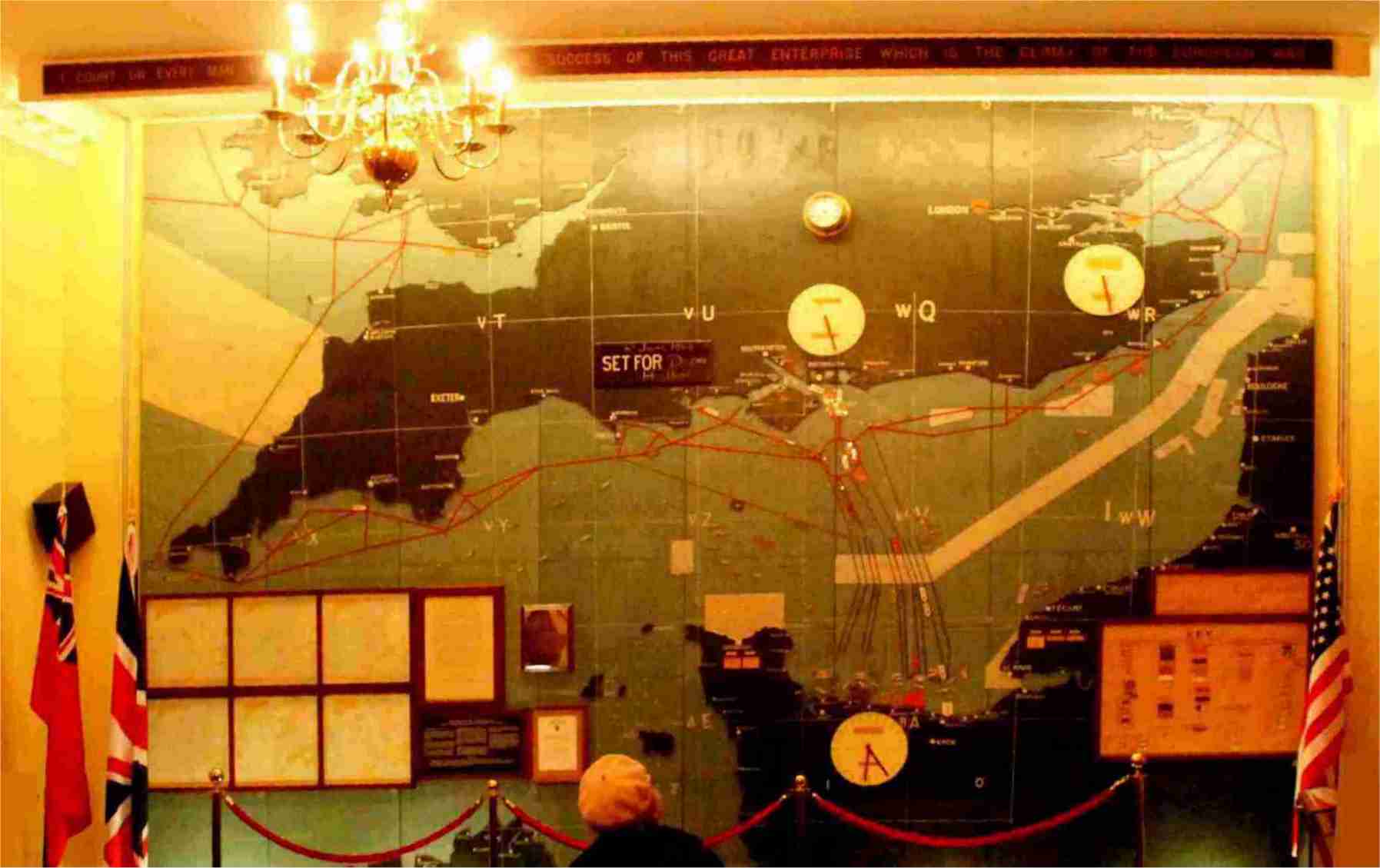
The D-Day map room at Southwick House, photographed on September 11, 2019.
A later photograph of the room used to plan the Normandy landings.
Ukiws / Wikimedia Commons · CC BY-SA 4.0 · Original recordImage changes
Display copies resized; original downloaded JPEG preserved.
The words
Allied Command
At Southwick, army, naval and air commanders weighed the weather together. Eisenhower heard their differing advice and made the final decision to proceed.
Ch. VIII, pp. 271–274, commanders’ discussions and decision · U.S. Army history: the weather decision (opens a new tab)
Army Group
Montgomery’s 21 Army Group controlled the invasion’s ground assault. Its staff included a temporary American element while U.S. troops remained under its command.
Ch. V, pp. 158–160, Montgomery and combined ground command · U.S. Army history: assault ground command (opens a new tab)
Bedell Smith
Walter Bedell Smith favored proceeding on June 6. He weighed uncertain naval gunfire spotting against the risks of a much longer delay.
Ch. VIII, p. 273, Smith’s assessment of the weather opening · U.S. Army history: the weather decision (opens a new tab)
Beetle
Beetle was Walter Bedell Smith’s nickname. The chief of staff later signed Germany’s surrender documents and served as ambassador to the Soviet Union.
Printed p. 48; PDF p. 6, opening paragraph of the Smith review · Peake review: Smith’s nickname and career (opens a new tab)
Chief of Staff
Smith screened staff studies before they reached Eisenhower. Coordinating correspondence and access to the commander helped turn many staff sections’ work into decisions.
Ch. III, pp. 62–63, correspondence and staff studies · U.S. Army history: how SHAEF worked (opens a new tab)
COSSAC
Chief of Staff to the Supreme Allied Commander (Designate).
COSSAC prepared the early invasion plan before a supreme commander was appointed. Its staff and studies became part of the developing SHAEF organization.
Ch. III, pp. 56–59, COSSAC’s contribution · U.S. Army history: how SHAEF worked (opens a new tab)
Map Room
The Southwick map tracked ships during the invasion. Keeping their positions current helped commanders follow the operation as reports arrived from across the Channel.
Did you know?
Wrens, members of the Women’s Royal Naval Service, updated the map as fresh reports arrived.
Object 6, Southwick map and incoming reports · Royal Navy Museum: keeping the map current (opens a new tab)
Morgan
Frederick Morgan led COSSAC’s planning staff. Under Eisenhower, he became a deputy chief of staff, helping preserve continuity with earlier planning.
Ch. III, pp. 57–59 and 63–64, Morgan’s changing role · U.S. Army history: how SHAEF worked (opens a new tab)
Norfolk House
Norfolk House in London’s St. James’s Square housed Morgan’s COSSAC staff. From there, officers selected personnel and outlined operations for the future supreme commander.
Ch. III, p. 58, Morgan’s London planning base · U.S. Army history: how SHAEF worked (opens a new tab)
Portsmouth
Portsmouth’s naval command had helped shape the invasion plan. Nearby Southwick House then became Ramsay’s headquarters as the date of the assault approached.
Early planning and Southwick Park: Nerve Centre of D-Day · Royal Navy Museum: Southwick and Ramsay (opens a new tab)
Postponement
Bad weather delayed the planned June 5 assault by twenty-four hours. Another postponement risked a much longer wait for suitable light and tides.
Ch. VIII, pp. 272–273, initial delay and next possible window · U.S. Army history: the weather decision (opens a new tab)
Ramsay
Admiral Bertram Ramsay directed the naval invasion forces. His planning coordinated landing craft, bombardment ships, minesweepers and the timing of the assault fleet.
Early planning, Planning Neptune and D-Day phases · Royal Navy Museum: Southwick and Ramsay (opens a new tab)
SHAEF
Supreme Headquarters Allied Expeditionary Force.
SHAEF brought British and American staff officers into one headquarters under Eisenhower. Its organization drew on COSSAC planning and experience from the Mediterranean.
Ch. III, pp. 56–59, integrated headquarters and predecessors · U.S. Army history: how SHAEF worked (opens a new tab)
Southwick
Southwick House became Ramsay’s naval headquarters near Portsmouth. Eisenhower and senior commanders met there to weigh the weather and decide whether the assault should proceed.
Royal Navy Museum: Southwick and Ramsay (opens a new tab) · U.S. Army history: the weather decision (opens a new tab)
Supreme HQ
Supreme Headquarters coordinated the work of the Allied commands. Its staff handled operations, intelligence, supply, civil affairs and other problems shared across the forces.
Ch. III, pp. 59–65, staff organization and coordination · U.S. Army history: how SHAEF worked (opens a new tab)
Sources
- Cross-Channel Attack, Chapter V: Overlord RevisedU.S. Army Center of Military History; Gordon A. Harrison, official history, 1951; HyperWar transcription
- Cross-Channel Attack, Chapter VIII: The Sixth of JuneU.S. Army Center of Military History; Gordon A. Harrison, official history, 1951; HyperWar transcription
- D-Day Map – Operation NeptuneNational Museum of the Royal Navy; original map and historical narrative
- The Supreme Command, Chapter III: The Nature of SHAEFU.S. Army Center of Military History; Forrest C. Pogue, official history, 1954; HyperWar transcription
- Intelligence Officer’s Bookshelf: Beetle, The Life of General Walter Bedell SmithHayden Peake; Studies in Intelligence, Vol. 55, No. 3, September 2011, p. 48; CIA-published book review
- 6 Objects that help bring the story of D-Day to life for D-Day 80Royal Navy Museums; National Museum of the Royal Navy, April 30, 2024