
World War II
Puzzle 49 · Overlord and the Assault Beaches · Page 76 in print
Operation Neptune
Neptune’s assault fleets crossed the Channel in radio silence on the night of 5-6 June 1944.
Jump to a word
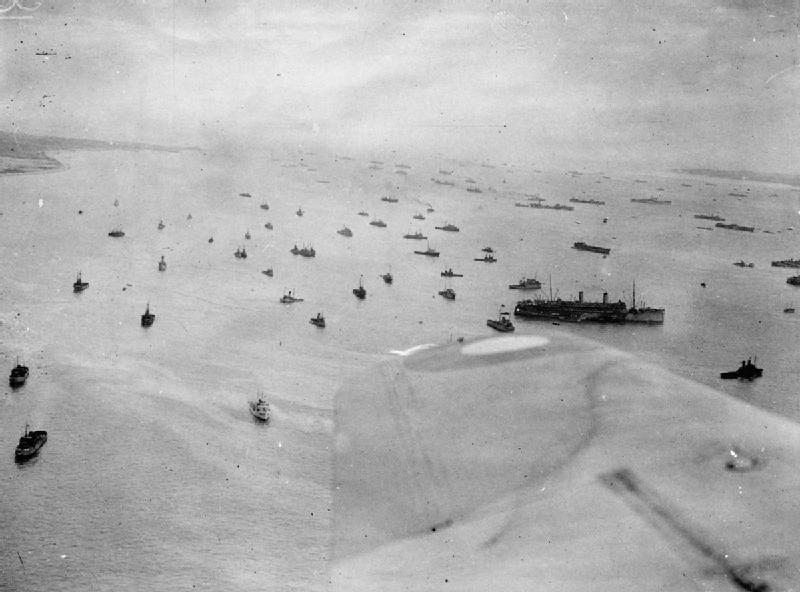
Royal Navy ships assemble off the Isle of Wight before sailing for the Normandy beaches in June 1944.
C. H. Parnall, Royal Navy official photographer / Imperial War Museums (A 23720A) · Public domain · Original recordImage changes
Display copies resized; original downloaded JPEG preserved.
The words
Admiralty
Britain’s wartime naval administration.
The Admiralty reported that Britain could not provide more bombardment ships. Ramsay requested American warships, increasing the force available to support the U.S. landings.
Ch. V, pp. 193–194, additional bombardment ships · U.S. Army history: naval fire planning (opens a new tab)
Assault Force
A beach’s landing force combined assault troops, support troops and reserves, with bombardment and minesweeping forces assigned to support it.
D-Day: The Assault, landing-force organization · Royal Navy Museum: Neptune’s naval forces (opens a new tab)
Coast Guard
Coast Guardsmen crewed assault vessels and rescue cutters. Their work included saving men from the water; ships such as LCI(L)-85 were lost under fire.
Rescue-cutter captions and account of LCI(L)-85 at Omaha · Coast Guard history: assault and rescue (opens a new tab)
Fleet Support
The naval fire plan aimed to suppress defenses during the landings, then support troops inland. Heavy shelling did not guarantee that fortified positions were destroyed.
Ch. V, pp. 193–194, neutralization and support ashore · U.S. Army history: naval fire planning (opens a new tab)
Force U
Rear Admiral Don Moon’s Force U carried the Utah assault. His headquarters ship, Bayfield, also carried VII Corps commander J. Lawton Collins.
Ch. VIII, pp. 301–302, Bayfield and the Utah assault · U.S. Army history: Utah and the Rangers (opens a new tab)
Gold
At Gold, rough seas changed the plan: landing craft brought the swimming tanks onto the beach behind the first infantry wave.
Gold Sector, weather and DD tank landing · Royal Navy Museum: Neptune’s naval forces (opens a new tab)
Kirk
Kirk’s Western Naval Task Force covered Utah and Omaha. Its ships carried and supported American assault troops.
D-Day: The Assault, western command and beaches · Royal Navy Museum: Neptune’s naval forces (opens a new tab)
Minesweepers
Minesweepers cleared and marked channels before the transports approached. They also swept the offshore areas where ships would anchor and lower landing craft.
Minesweeping, marked channels and offshore anchorages · Royal Navy Museum: Neptune’s naval forces (opens a new tab)
Neptune
Neptune was the invasion’s sea assault and immediate build-up. Convoys continued delivering troops and supplies after the first landings on June 6.
Did you know?
The original planning map survives in the Map Room at Southwick House.
D-Day: The Assault and The Follow Up · Royal Navy Museum: Neptune’s naval forces (opens a new tab)
Pointe du Hoc
Rangers scaled the cliffs under destroyer fire support. They found and disabled the guns farther inland, then faced counterattacks that kept them under siege for two days.
Ch. VIII, p. 322, naval support, guns and counterattacks · U.S. Army history: Utah and the Rangers (opens a new tab)
Spout
The Spout’s mineswept lanes ran south from Area Z toward Normandy. They channelled the assault fleet toward the landing areas.
D-Day: Early Phases and Minesweeping, Area Z and the Spout · Royal Navy Museum: Neptune’s naval forces (opens a new tab)
Sword
At Sword, rocky shoals and the Orne estuary restricted the landing frontage. Minesweeping and bombardment helped infantry and commandos come ashore.
Sword Sector, frontage and naval preparation · Royal Navy Museum: Neptune’s naval forces (opens a new tab)
Texas
USS Texas bombarded Pointe du Hoc and supported Omaha Beach on June 6. The next day it sent supplies ashore and received wounded Rangers.
The Liberation of France, June 6 and June 7 · Battleship Texas: bombardment and aid (opens a new tab)
Vian
Vian’s Eastern Naval Task Force covered Gold, Juno and Sword. It supported both British and Canadian landing sectors.
D-Day: The Assault, eastern command and beaches · Royal Navy Museum: Neptune’s naval forces (opens a new tab)
Warspite
HMS Warspite fired on shore batteries east of Ouistreham, near Sword. Her bombardment formed part of the naval gunfire supporting troops as they landed.
Object 2, a 15-inch semi armour-piercing shell · Royal Navy Museum: Warspite’s shore targets (opens a new tab)
Sources
- Cross-Channel Attack, Chapter V: Overlord RevisedU.S. Army Center of Military History; Gordon A. Harrison, official history, 1951; HyperWar transcription
- D-Day Map – Operation NeptuneNational Museum of the Royal Navy; interactive historical map and accompanying narrative
- D-Day: June 6, 1944, NormandyU.S. Coast Guard Historian’s Office; D-Day history and archival photograph captions
- Cross-Channel Attack, Chapter VIII: The Sixth of JuneU.S. Army Center of Military History; Gordon A. Harrison, official history, 1951; HyperWar transcription
- History – Battleship TexasBattleship Texas Foundation; operator of USS Texas, The Liberation of France section
- 6 Objects that help bring the story of D-Day to life for D-Day 80Royal Navy Museums; National Museum of the Royal Navy, April 30, 2024