
World War II
Puzzle 48 · Overlord and the Assault Beaches · Page 75 in print
Operation Overlord
Overlord’s Normandy invasion began on 6 June 1944.
Jump to a word
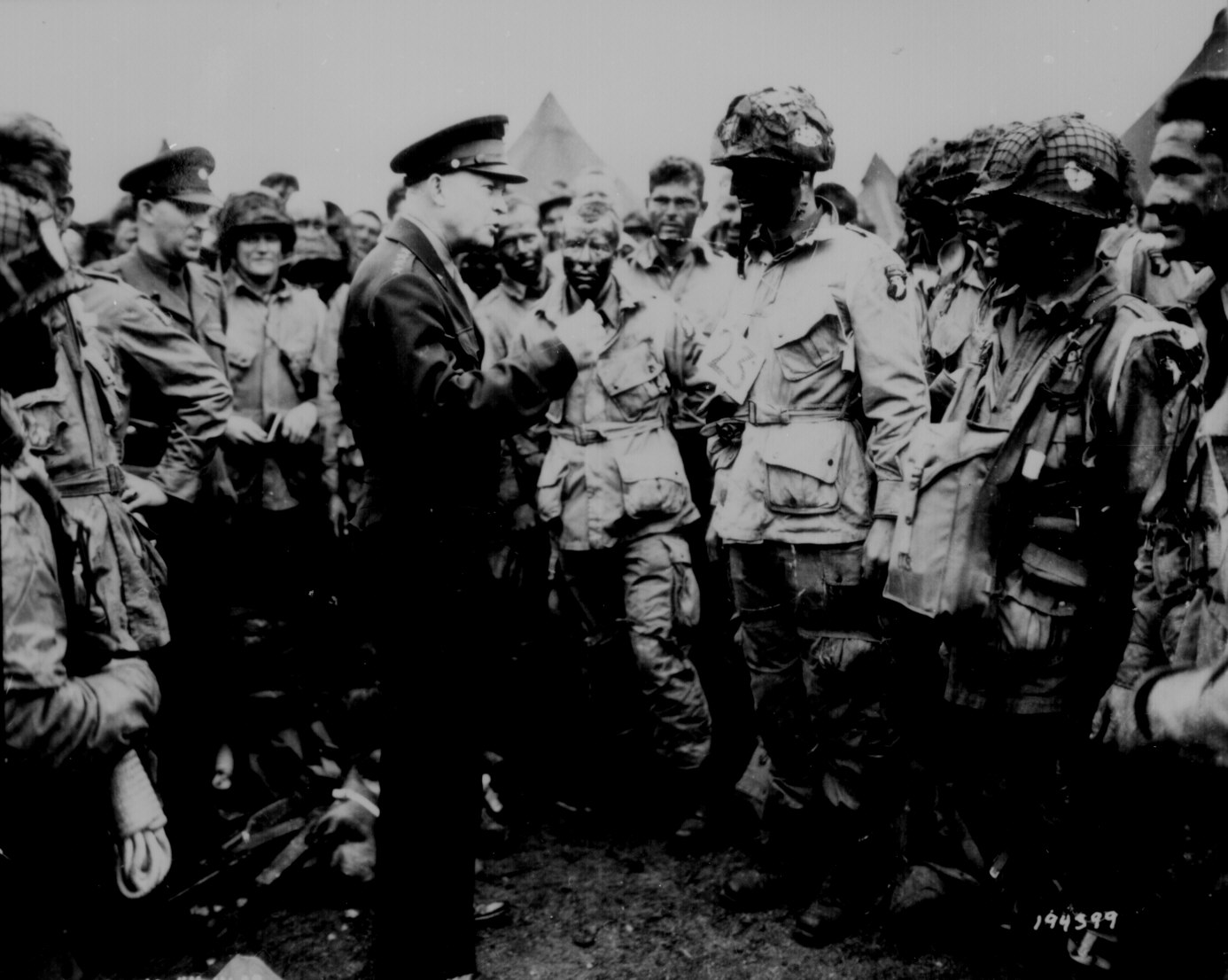
Dwight D. Eisenhower speaks with paratroopers in England before the Normandy invasion.
Moore / U.S. Army Signal Corps / National Archives (111-SC-194399) · Public domain · Original recordImage changes
Display copies resized; original scan preserved.
The words
Bodyguard
Bodyguard was the wider deception plan intended to conceal the invasion’s timing and location. Fortitude South formed one part of this coordinated effort.
D-Day’s Bodyguard section · English Heritage: Bodyguard and Fortitude (opens a new tab)
Calvados
Omaha Beach lies in Calvados, a department of Normandy. Nearby Colleville-sur-Mer contains the American cemetery above the coast where troops landed.
Catalogue summary and geographic subject headings · Calvados archives: Omaha and Colleville (opens a new tab)
Dempsey
Dempsey commanded the Second British Army on the eastern side of the assault. Its forces landed on Gold, Juno and Sword, including Canadian troops.
Printed p. 72; PDF p. 89, armies and assault sectors · Canadian Army history: invasion commanders (opens a new tab)
Exercise Tiger
Exercise Tiger rehearsed the Utah landings. On April 28, torpedo boats attacked tank landing ships, killing hundreds of American soldiers and sailors.
Ch. VII, pp. 251–258, Tiger plan and torpedo attack · U.S. Army history: invasion rehearsals (opens a new tab)
Floating Tanks
DD stood for Duplex Drive, referring to propulsion on land and in water.
DD tanks used canvas screens for buoyancy and propellers for movement through water. The screen could be lowered once the tank reached land.
M4A2 Tank Medium Duplex Drive section, screen and propulsion · Tank Museum: how the DD tank floated (opens a new tab)
Fortitude
Fortitude South encouraged German belief in a main invasion at the Pas-de-Calais. It also portrayed Normandy as a diversion, delaying German reinforcement decisions.
Did you know?
Dummy landing craft were built from scaffolding tubes, wood, canvas and empty barrels.
Operation Fortitude South and Success sections · English Heritage: Bodyguard and Fortitude (opens a new tab)
Glider Assault
Operation Deadstick sent glider-borne troops against the Orne River and Caen Canal bridges. Securing these crossings was vital to defending the landing area and drop zones.
Operation Deadstick plaque, bridge objectives and purpose · IWM: the bridge-assault memorial (opens a new tab)
Glider Force
At Brize Norton, Albemarle aircraft towed gliders carrying troops and Royal Engineers. Operation Mallard sent additional glider-borne reinforcements before dusk on June 6.
Operation Tonga phase 3 and Operation Mallard · RAF: glider tugs and reinforcements (opens a new tab)
Higgins Boat
LCVP meant Landing Craft, Vehicle, Personnel: a craft for troops and light vehicles.
Higgins’ LCVP let troops and jeeps move from ships directly onto beaches. Its bow ramp replaced the rounded bow of earlier Higgins craft.
LCVP evolution and the retractable bow ramp · WWII Museum: Higgins landing craft (opens a new tab)
Leigh-Mallory
Trafford Leigh-Mallory was appointed to head the Allied Expeditionary Air Force. Planning required coordination between British and American tactical air forces.
Ch. III, pp. 107–108, AEAF appointment and combined planning · U.S. Army history: air command planning (opens a new tab)
Mine Clearer
The Sherman Crab cleared routes by rotating chains against the ground to detonate mines. Crews advanced slowly through dust that restricted their view.
Opening explanation of the flail mechanism and crew risks · Tank Museum: the Crab mine flail (opens a new tab)
Sixth of June
Eisenhower postponed the planned June 5 assault because of bad weather. A forecast improvement opened the way for landings on June 6, 1944.
Ch. VIII, pp. 271–274, postponement and launch decision · U.S. Army history: the weather decision (opens a new tab)
Slapton
Slapton Sands in Devon hosted invasion rehearsals. For Exercise Tiger, Utah assault units practised embarkation, the sea crossing and beach landings.
Ch. VII, pp. 213 and 251–255, location and rehearsal phases · U.S. Army history: invasion rehearsals (opens a new tab)
Stagg
James Stagg was the senior meteorologist at Eisenhower’s headquarters. He reported the expected break in the weather that helped shape the decision to proceed.
Ch. VIII, pp. 271–273, Stagg’s forecasts · U.S. Army history: the weather decision (opens a new tab)
Tedder
Arthur Tedder served as Eisenhower’s deputy. Eisenhower also delegated general supervision of the Allied air forces to him, linking air planning to the overall invasion.
Printed pp. 20 and 23; PDF pp. 34 and 37, deputy and air supervision · Canadian Army history: invasion commanders (opens a new tab)
Sources
- D-Day Deception: Operation Fortitude SouthEnglish Heritage; Paul Pattison
- Omaha – La pointe du Hoc – Colleville, BH/BR/23888Archives du Calvados; departmental catalogue record for Rémy Desquesnes’s book, summary and geographic subject headings
- The Victory Campaign: The Operations in North-West Europe, 1944–1945Canadian Army; C. P. Stacey, official history, 1960
- RAF Brize Norton and Operation Overlord – D-DAYRoyal Air Force; RAF Brize Norton historical account
- Pegasus Bridge, War Memorials Register 92936Imperial War Museums; Operation Deadstick plaque transcription
- America Goes to WarThe National WWII Museum; Higgins landing craft educational history
- Cross-Channel Attack, Chapter III: Overlord in the BalanceU.S. Army Center of Military History; Gordon A. Harrison, official history, 1951; HyperWar transcription
- Sherman CrabThe Tank Museum; Sherman Crab collection record
- Cross-Channel Attack, Chapter VIII: The Sixth of JuneU.S. Army Center of Military History; Gordon A. Harrison, official history, 1951; HyperWar transcription
- M4 ShermanThe Tank Museum; M4A2 Tank Medium Duplex Drive section
- The Administrative and Logistical History of the ETO, Part VI: NEPTUNE, Chapter VII: ExercisesHistorical Division, United States Army Forces, European Theater; Lt. Clifford L. Jones, March 1946; HyperWar transcription