
World War II
Puzzle 47 · Bombers Over Europe · Page 71 in print
Ploesti Tidal Wave
The low-level Ploesti raid of 1 August 1943 cost over 50 B-24 bombers.
Jump to a word
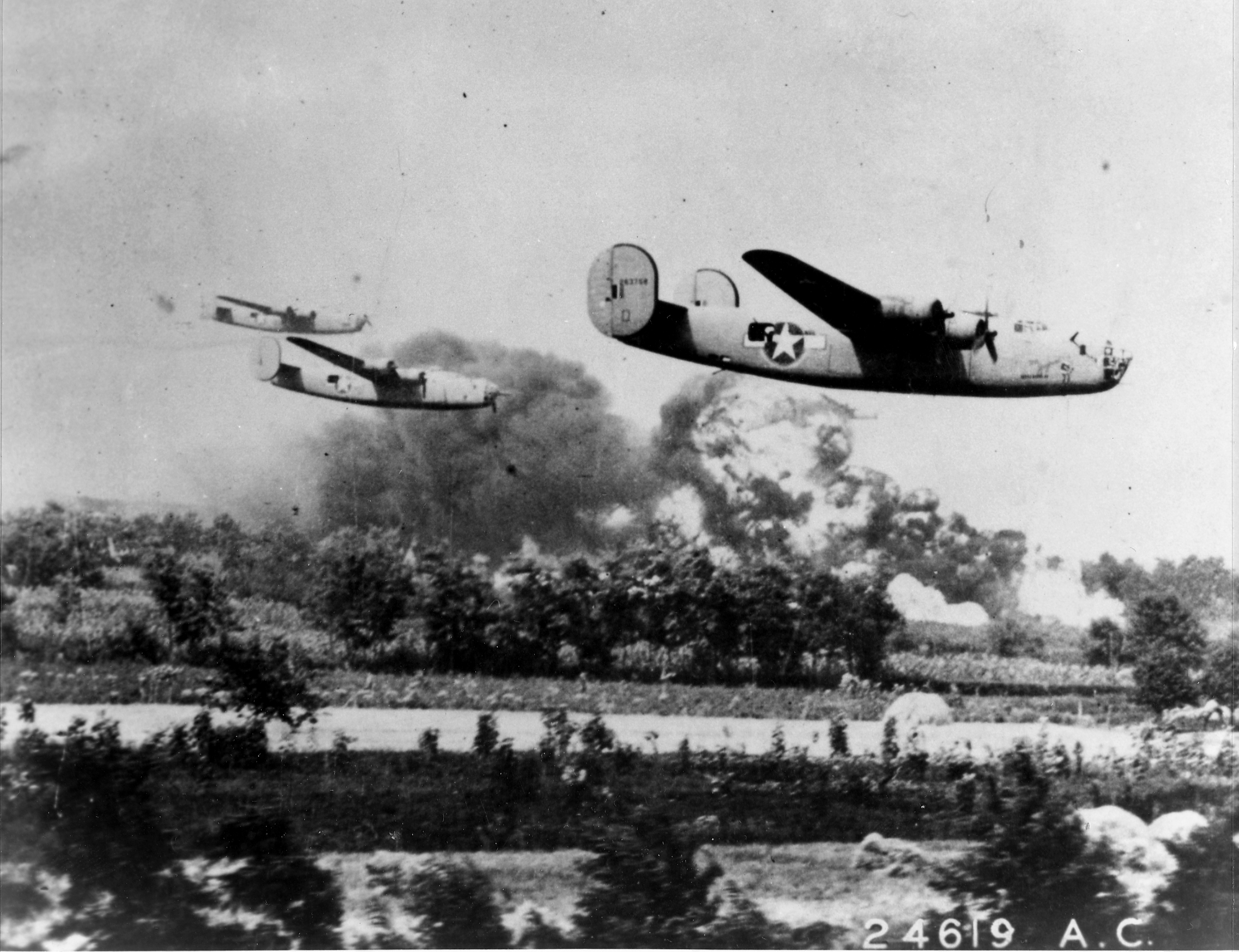
B-24s at low altitude during the Ploesti raid of August 1, 1943.
U.S. Air Force / National Museum of the U.S. Air Force (180422-F-FN604-026) · Public domain · Original recordImage changes
Display copies resized; original archive JPEG preserved.
The words
Astra Romana
Astra Romana formed part of Target White IV, assigned to the 98th Bombardment Group. The 93rd also struck it after the approach went wrong.
Ch. 14, pp. 479 and 482, target assignments and actual attacks · AAF history: Ploesti planning and execution (opens a new tab)
Baker
Addison Baker led the 93rd Bomb Group. After antiaircraft fire set his B-24 ablaze, he continued toward the target; he died when the aircraft crashed.
Group command, August 1 attack and posthumous award · Air Force history: Addison Baker (opens a new tab)
Benghazi
Five B-24 groups assembled near Benghazi in Libya. Three came from, or were intended for, Britain; two were already serving in the Mediterranean.
Did you know?
Crews repeatedly bombed a desert mock-up of the refinery targets before flying the mission.
Ch. 14, pp. 478–479, groups and preparations near Bengasi · AAF history: Ploesti planning and execution (opens a new tab)
Johnson
Leon Johnson commanded the 44th Bomb Group. He led its attack through burning targets, explosions and defenses already alerted by the earlier arrivals.
Leon Johnson photograph and flying-suit captions · USAF Museum: Tidalwave and its airmen (opens a new tab)
Kane
John Kane led the 98th Bomb Group through alerted defenses, smoke and flames. Delayed-action bombs from earlier attacks added to the danger.
John Kane photograph caption · USAF Museum: Tidalwave and its airmen (opens a new tab)
Low Level
The B-24s approached and bombed at very low altitude. Navigational errors and alerted defenses undermined the planned surprise, exposing the aircraft to intense ground fire.
Ch. 14, pp. 481–482, approach, wrong turn and defenses · AAF history: Ploesti planning and execution (opens a new tab)
Medal of Honor
Five participants received the Medal of Honor for actions during the raid. Baker, John Jerstad and Lloyd Hughes received their awards posthumously.
Third paragraph, five recipients and posthumous awards · USAF Museum: Tidalwave and its airmen (opens a new tab)
Mission
The plan divided key installations among seven target areas around Ploesti, Brazi and Campina. Several groups ultimately bombed refineries assigned to other units.
Ch. 14, pp. 478–479 and 481–482, planned and actual targets · AAF history: Ploesti planning and execution (opens a new tab)
Oil Fields
Ploesti’s oilfields were a source of crude oil for Germany. The August raid targeted the region’s refinery complex, where that crude oil was processed.
WWII Museum: Romania and the raid’s costs (opens a new tab) · EIA: crude oil and petroleum products (opens a new tab)
Oil Refinery
An industrial plant that processes crude oil into fuels and other products.
The raid damaged refineries, but repairs restored production. German authorities used forced laborers to repair the complex.
USAF Museum: Tidalwave and its airmen (opens a new tab) · EIA: how refineries process crude oil (opens a new tab) · WWII Museum: Romania and the raid’s costs (opens a new tab)
Petroleum
Naturally occurring oil from the earth.
Romanian petroleum supplied Germany’s war effort. The Allies hoped that attacking Ploesti would reduce that fuel supply, linking the raid to the wider war.
WWII Museum: Romania and the raid’s costs (opens a new tab) · EIA: crude oil and petroleum products (opens a new tab)
Ploesti
Ploesti lay north of Bucharest. The raid killed airmen and people on the ground; Romanian civilians and officials buried American dead at Bolovan Cemetery.
Location, human losses and burial paragraphs · WWII Museum: Romania and the raid’s costs (opens a new tab)
Romania
Romania joined the Axis in November 1940 under Ion Antonescu. Its oil industry was a major economic contribution to Germany’s war effort.
Romania’s Axis alignment and economic contribution · WWII Museum: Romania and the raid’s costs (opens a new tab)
Soapsuds
Soapsuds was an earlier name for the operation, after Statesman and before Tidalwave. Planning brought together five groups for the low-level attack.
Ch. 14, p. 478, operation names and assigned groups · AAF history: Ploesti planning and execution (opens a new tab)
Tidal Wave
The August 1, 1943 attack lost 54 B-24s. Airmen were killed or captured, and damaged facilities soon returned to production.
Mission losses and concluding account of repairs · USAF Museum: Tidalwave and its airmen (opens a new tab)
Sources
- The Army Air Forces in World War II, Volume II, Chapter 14: Conquest of Sicily, Ploesti sectionU.S. Air Historical Group; Craven and Cate, editors; HyperWar transcription
- Baker — Lt Col Addison Earl BakerAir Force Historical Support Division
- OPERATION TIDALWAVE: Ploesti, August 1, 1943National Museum of the United States Air Force
- Over the Cauldron of Ploesti: The American Air War in RomaniaThe National WWII Museum; Jason Dawsey, PhD, August 12, 2019
- Oil and petroleum products explainedU.S. Energy Information Administration
- Refining crude oil — the refining processU.S. Energy Information Administration