
World War II
Puzzle 46 · Bombers Over Europe · Page 70 in print
Operation Argument
Big Week, 20-25 February 1944, targeted German aircraft production.
Jump to a word
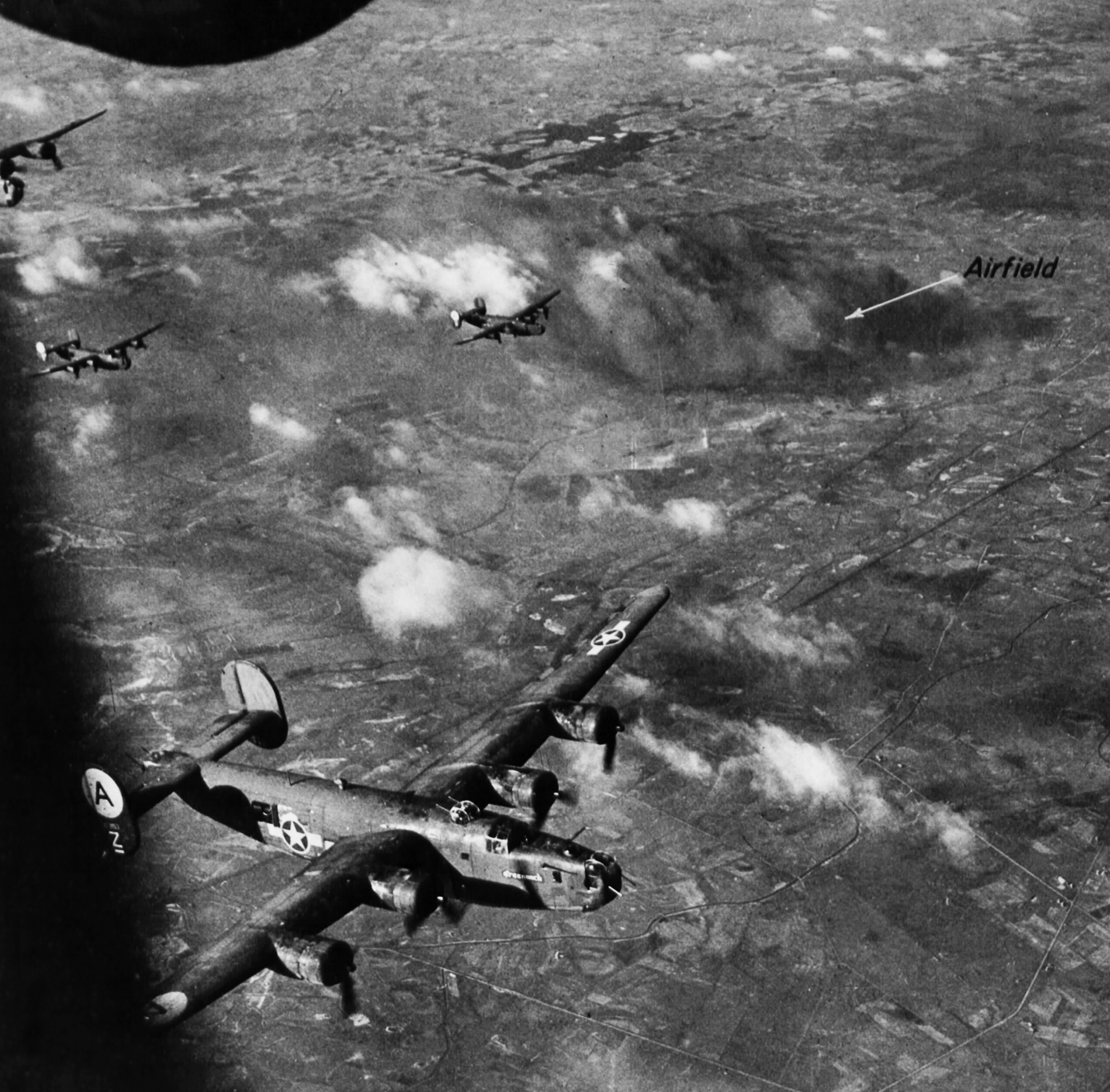
B-24s bombing Diepholz airfield in Germany.
U.S. Air Force / National Museum of the U.S. Air Force (180422-F-FN604-033) · Public domain · Original recordImage changes
Display copies resized; original archive JPEG preserved.
The words
Argument
Operation Argument was the code name for the offensive against German aviation industry and the Luftwaffe. It became better known as Big Week.
Opening paragraph, operation name and purpose · USAF Museum: the February offensive (opens a new tab)
Augsburg
The Messerschmitt parent plant at Augsburg was bombed on February 25. Despite extensive damage, the factory returned to full production in little over a month.
Ch. 2, pp. 40–42, February 25 targets and recovery · AAF history: Big Week and its effects (opens a new tab)
Ball Bearing
A machine support that uses rolling metal balls to reduce friction.
Bearing plants were targeted as suppliers to aircraft manufacture. Large stocks and dispersal limited the attacks’ effects on finished aircraft production.
AAF history: Big Week and its effects (opens a new tab) · Collins: ball bearings (opens a new tab)
Big Week
The February 20–25 campaign combined American daylight raids with RAF night attacks. The attacks damaged factories and caused heavy bomber losses and aircrew casualties.
Title and first two paragraphs, timing and human losses · USAF Museum: the February offensive (opens a new tab)
Bombing
Factory destruction did not end German aircraft production. Salvaged machinery and dispersed workshops helped output recover; Allied intelligence overestimated the lasting damage.
Ch. 2, pp. 43–45, damage, dispersal and production recovery · AAF history: Big Week and its effects (opens a new tab)
Brunswick
Brunswick lay within the central target area, where planned attacks covered major aircraft assembly and component plants during Big Week.
Ch. 2, p. 33, assembly and component targets · AAF history: Big Week and its effects (opens a new tab)
De Havilland
De Havilland’s Mosquito was designed as an unarmed bomber, relying on speed to evade fighters. The aircraft family later served in many different roles.
Did you know?
The Mosquito was built largely from wood, earning it the nickname “The Wooden Wonder.”
Mosquito family design and versatility paragraphs · RAF Museum: Mosquito roles and design (opens a new tab)
Escort
Longer-range American fighters could accompany bombers deeper into Germany. They fought the Luftwaffe aircraft defending the industrial targets.
Second paragraph, fighter range and escort · USAF Museum: the February offensive (opens a new tab)
February
Weather repeatedly postponed the operation. A forecast improvement prompted the February 20 launch despite disagreement over cloud and icing risks at the bases.
Ch. 2, pp. 31–33, forecasts and launch decision · AAF history: Big Week and its effects (opens a new tab)
Fifteenth
The Italy-based Fifteenth Air Force joined the campaign. Weather and demands at Anzio complicated its commitment; on February 25 its deepest penetration lacked full escort.
Ch. 2, pp. 31–32 and 40–41, Anzio and escort limits · AAF history: Big Week and its effects (opens a new tab)
Fighter
The offensive attacked fighter production and drew Luftwaffe fighters into combat. Losing experienced pilots damaged German air power as well as losing aircraft.
Second and third paragraphs, air battles and veteran pilots · USAF Museum: the February offensive (opens a new tab)
Gotha
B-24s attacked the Gotha aircraft factory on February 24. The museum’s photograph shows the factory burning and fragmentation bombs striking completed aircraft on its airfield.
Gotha attack photograph caption · USAF Museum: the February offensive (opens a new tab)
Leipzig
Leipzig’s Erla aircraft works included component and assembly plants. The February 20 bombing also killed workers in trenches and inadequate shelters at Heiterblick.
Ch. 2, pp. 30 and 34, Erla works and workers killed · AAF history: Big Week and its effects (opens a new tab)
Mosquito
Mosquitos joined the RAF’s Pathfinder Force as the night offensive expanded. The versatile aircraft family also flew as night fighters and photographic reconnaissance aircraft.
Family night roles and the B35 service distinction · RAF Museum: Mosquito roles and design (opens a new tab)
Night Flying
RAF bombers attacked after dark while American heavy bombers operated by day. These complementary operations formed part of the same concentrated offensive.
Opening paragraph, day and night attacks · USAF Museum: the February offensive (opens a new tab)
Sources
- The Army Air Forces in World War II, Volume III, Chapter 2: Big WeekU.S. Air Historical Group; Craven and Cate, editors; HyperWar transcription
- de Havilland Mosquito B35Royal Air Force Museum; Mosquito family history and later B35 collection record
- “Big Week”: February 20–25, 1944National Museum of the United States Air Force
- Ball bearingCollins dictionaries, HarperCollins; mechanical senses