
World War II
Puzzle 45 · Bombers Over Europe · Page 69 in print
Regensburg Schweinfurt Raid
The Regensburg-Schweinfurt raid of 17 August 1943 cost 60 B-17 bombers.
Jump to a word
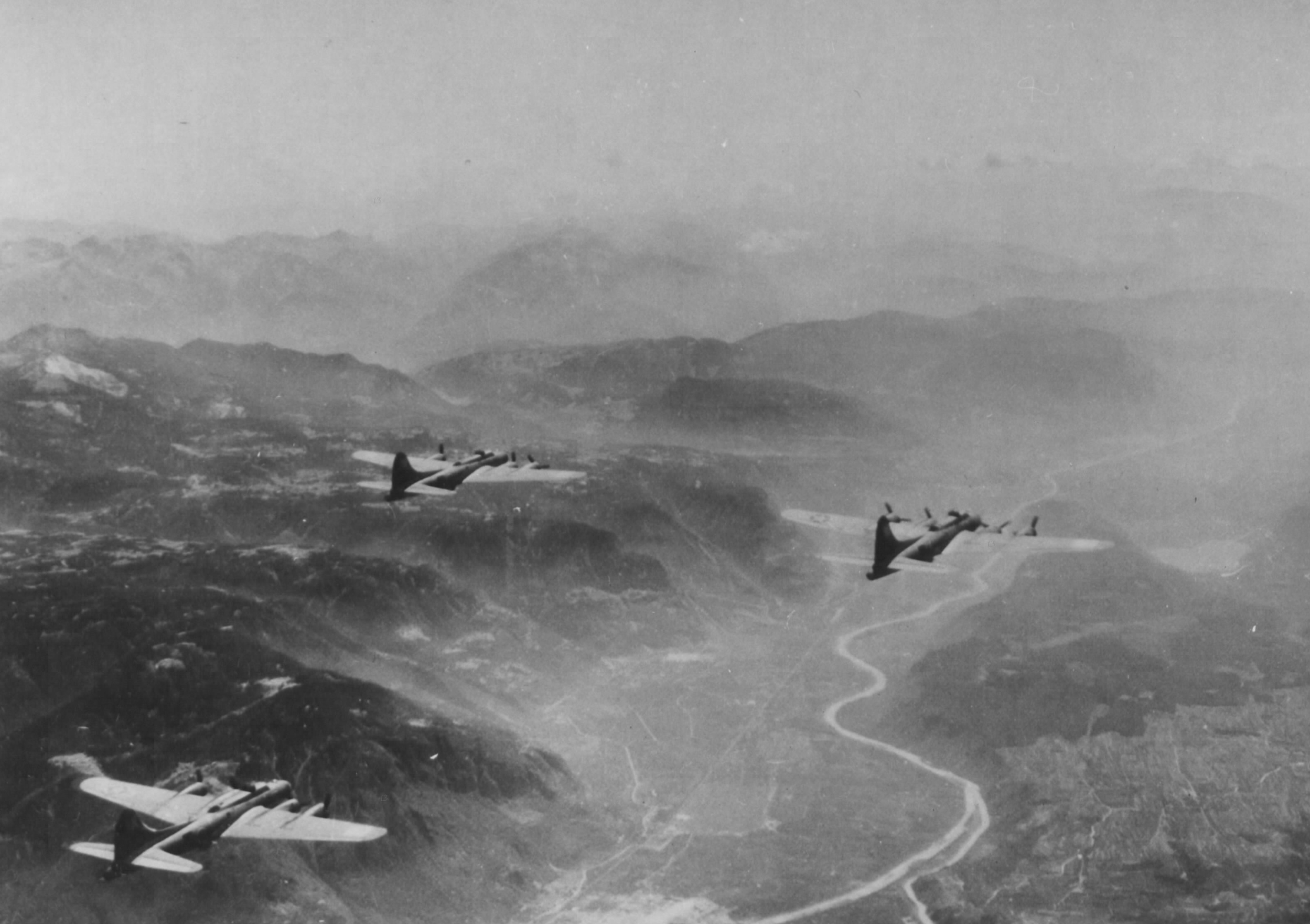
B-17s cross the Alps toward North Africa after the Regensburg raid.
U.S. Air Force / National Museum of the U.S. Air Force (180422-F-FN604-027) · Public domain · Original recordImage changes
Display copies resized; original archive JPEG preserved.
The words
Air Force
The Eighth Air Force organized the paired attack on Regensburg and Schweinfurt. The 306th Bombardment Group’s surviving track chart records its Schweinfurt mission.
Description and 306th Bombardment Group record citation · Archives: the August 17 mission chart (opens a new tab)
August
Fog delayed the Schweinfurt force on August 17, 1943. Regensburg bombers departed first, breaking the intended timing of the paired attacks.
Fog and the separation of the two forces · USAF Museum: the August paired raid (opens a new tab)
Bearings
Machine parts that support other moving parts.
Schweinfurt’s concentrated bearing industry made it a strategic target. The Americans hoped that damaging these factories would disrupt Germany’s wider war production.
AAF history: planning and industrial effects (opens a new tab) · Collins: mechanical bearings (opens a new tab)
Double Strike
The two-pronged plan targeted aircraft production at Regensburg and bearing plants at Schweinfurt. Closely timed attacks were intended to divide the German fighter defense.
Paired industrial targets and the planned timing · USAF Museum: the August paired raid (opens a new tab)
Flight
The Regensburg force faced a long flight to Germany and onward to North Africa. Extra fuel and arrival before dusk were essential to the plan.
Did you know?
Crews bound for North Africa were told to pack toothbrushes and a change of underwear.
Ch. 20, pp. 683–685, fuel, range and arrival deadline · AAF history: planning and industrial effects (opens a new tab)
Fourth Wing
The Fourth Bombardment Wing flew the Regensburg part of the operation. Its units included the 100th Bomb Group, which continued to North Africa after the attack.
August 17 shuttle mission and the 100th Bomb Group · WWII Museum: the Fourth Wing’s shuttle (opens a new tab)
Munitions
Military weapons, ammunition, equipment and supplies.
These targets supplied Germany’s war industries: Regensburg built fighter aircraft, and Schweinfurt made bearings used in machinery.
AAF history: planning and industrial effects (opens a new tab) · Collins: munitions (opens a new tab)
North Africa
The shuttle force landed at African bases with inadequate maintenance facilities. Operating far from its ground crews strained aircraft support and combat crews.
Ch. 20, p. 686, LeMay’s assessment of support problems · AAF history: planning and industrial effects (opens a new tab)
Raid
The paired raid struck two industrial targets on August 17. The Eighth Air Force lost 60 of the 376 aircraft it dispatched.
Mission description, dispatched aircraft and losses · Archives: the August 17 mission chart (opens a new tab)
Regensburg
Regensburg’s Messerschmitt works were a fighter-production target. The August 17 attack also killed and injured people on the ground, as the Bavarian history atlas records.
Angriffe; Tote und Verletzte, August 17, 1943 · Bavarian history: the raid on Regensburg (opens a new tab)
Sacrifice
The operation cost aircrew lives and left others missing or captured. Aircraft losses involved different human outcomes; they are not a count of deaths.
Aircraft losses and killed, missing or captured airmen · USAF Museum: the August paired raid (opens a new tab)
Schweinfurt
Bombs damaged Schweinfurt’s bearing plants. German responses included substituting bearing types and importing stocks, softening the effects on war production.
Ch. 20, pp. 685–686, factory damage and German responses · AAF history: planning and industrial effects (opens a new tab)
Shuttle
A shuttle mission ended at a different base region after bombing. The Regensburg force continued to North Africa; Schweinfurt’s bombers returned to Britain.
Ch. 20, pp. 683–684, the two routes · AAF history: planning and industrial effects (opens a new tab)
Unescorted
P-47 fighters could protect the bombers only within their range. Much of the deep flight into Germany continued beyond that escort’s reach.
Summer 1943 operations and limited fighter range · USAF Museum: limits of the P-47 escort (opens a new tab)
Vulnerable
The delayed timetable gave German fighters time to land, rearm and refuel between attacks. They could then engage the second bomber force as it approached.
German fighters rearming between the two attacks · USAF Museum: the August paired raid (opens a new tab)
Sources
- The Army Air Forces in World War II, Volume II, Chapter 20: PointblankU.S. Air Historical Group; Craven and Cate, editors; HyperWar transcription
- Regensburg/Schweinfurt, August 17, 1943National Museum of the United States Air Force
- Track Chart of Bombing Mission to SchweinfurtNational Archives Foundation, DocsTeach; National Archives Identifier 596346, 306th Bombardment Group operations, August 17, 1943
- The Bloody 100th Bomb GroupThe National WWII Museum
- MunitionsCollins dictionaries, HarperCollins
- BearingCollins dictionaries, HarperCollins; mechanical senses
- Regensburg – Atlas zum WiederaufbauHaus der Bayerischen Geschichte; Bavarian state history institution, reconstruction atlas
- Heavy BombersNational Museum of the United States Air Force