
World War II
Puzzle 44 · Bombers Over Europe · Page 68 in print
P-51 Mustang
Drop tanks let Merlin-powered Mustangs escort bombers to Berlin and back.
Jump to a word
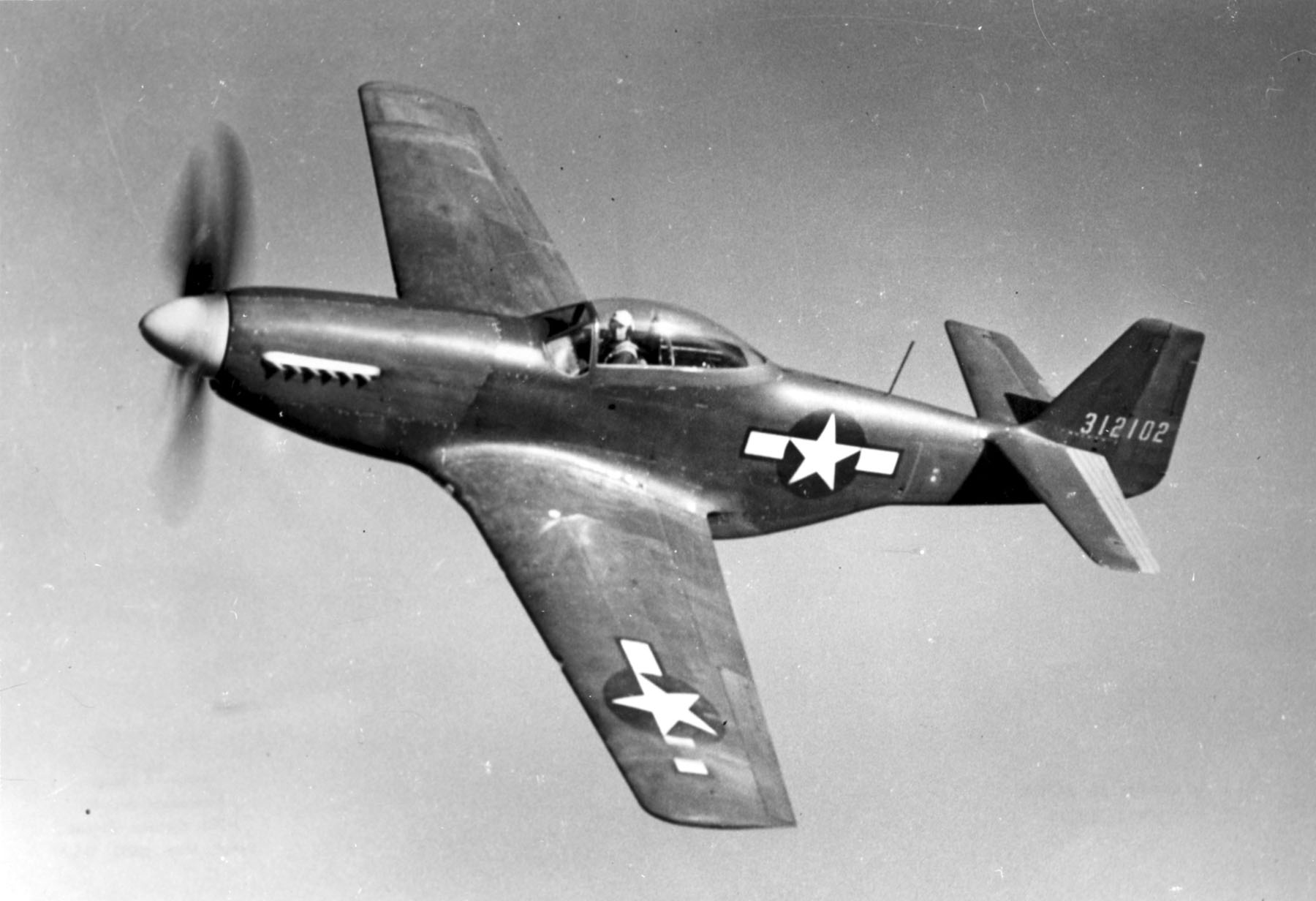
The P-51D prototype, serial 43-12102, a modified P-51B, in flight.
U.S. Air Force / National Museum of the U.S. Air Force (061023-F-1234P-021) · Public domain · Original recordImage changes
Display copies resized; original archive JPEG preserved.
The words
Air Combat
In March 1944, Allied planners used raids on Berlin partly to draw German fighters into battle. Mustang escorts engaged the interceptors defending the capital.
Ch. 2, pp. 47–51, Berlin and the fighter battle · AAF history: fighters, escort and Berlin (opens a new tab)
Airframe
Airframe means the aircraft’s structure. The P-51D added a bubble canopy, giving the pilot a clearer view than earlier Mustang versions.
Bubble-top Mustang, changes in the P-51D · USAF Museum: Mustang models and engines (opens a new tab)
Big Friend
In TIME’s July 1944 account, a fighter pilot called a damaged B-17 Big Friend. The crew bailed out before the burning bomber fell.
Chancy’s account, the bomber crew’s bailout · TIME, 1944: bomber and escort nicknames (opens a new tab)
Fighter Ace
A fighter ace was credited with at least five aerial victories. Mustang pilot Chuck Yeager was among the American pilots who achieved that distinction.
Fighter Aces Association: the five victories (opens a new tab) · USAF: Yeager’s Mustang combat service (opens a new tab)
Fighter Cover
Fighter cover could involve relays of different units. On the March 6 Berlin raid, successive Eighth and Ninth Air Force fighter groups covered the bombers.
Ch. 2, p. 51, successive escort relays · AAF history: fighters, escort and Berlin (opens a new tab)
Fighter Escort
Merlin-powered P-51B and P-51C fighters entered European combat in December 1943. They helped provide the long-range escort needed for the March 1944 Berlin missions.
A Winning Combination, European service and Berlin · USAF Museum: Mustang models and engines (opens a new tab)
Fighter Sweep
By March 1944, American escorts were increasingly released from close protection duties. They sought out German aircraft, taking the fight beyond the bomber formations.
Ch. 2, pp. 46–47, offensive fighter employment · AAF history: fighters, escort and Berlin (opens a new tab)
Laminar Flow
The Mustang’s wing was designed to reduce drag through laminar flow. NASA researchers doubted that its wartime surfaces were smooth enough to achieve much of it.
Printed p. 64 (PDF p. 8), Mustang and surface quality · NASA: laminar flow and surface quality (opens a new tab)
Little Friend
Little Friend meant the fighter escort in TIME’s wartime report. The damaged bomber’s pilot used the name when calling for help from nearby P-51s.
Opening of Chancy’s account and the bomber’s radio call · TIME, 1944: bomber and escort nicknames (opens a new tab)
Long Range
Auxiliary fuel tanks extended the Mustang’s escort reach. By March 1944, P-51s could accompany American bombers deep into Germany, including to Berlin.
Ch. 2, pp. 47–49, extended range and auxiliary tanks · AAF history: fighters, escort and Berlin (opens a new tab)
Luftwaffe
The Luftwaffe was Germany’s air force. Its fighters defended bombing targets, while Allied escorts sought to weaken their ability to intercept the bomber formations.
Ch. 2, pp. 30–33 and 46–51, German fighter resistance · AAF history: fighters, escort and Berlin (opens a new tab)
Mustang
Early Mustangs used Allison engines. Fitting Merlin engines improved high-altitude performance and led to the P-51B and P-51C versions used for long-range escort.
Early Allison models and A Winning Combination · USAF Museum: Mustang models and engines (opens a new tab)
North American
North American Aviation designed the Mustang for Britain after being asked to build P-40s under license in 1940. Its NA-73X prototype flew that October.
Did you know?
North American built the nearly identical P-51B in Inglewood, California, and the P-51C in Dallas, Texas.
Origins, British order and prototype · USAF Museum: Mustang models and engines (opens a new tab)
Packard
Packard built the V-1650 engine in the United States under license. It was an American-produced version of the Rolls-Royce Merlin used in Mustangs.
Biographical / Historical, licensed engine and P-51 use · Smithsonian archives: Packard’s Merlin (opens a new tab)
Yeager
Chuck Yeager flew Mustangs over Europe in 1944. Shot down over occupied France in March, he evaded capture with help from the French Resistance.
Wartime Mustang service, March 5 loss and evasion · USAF: Yeager’s Mustang combat service (opens a new tab)
Sources
- The Army Air Forces in World War II, Volume III, Chapter 2: Big WeekU.S. Air Historical Group; Craven and Cate, editors; HyperWar transcription
- North American P-51D MustangNational Museum of the United States Air Force
- World Battlefronts: Little Friend, Big FriendTIME, July 10, 1944; Captain James B. Chancy’s account as reported to CBS correspondent Bill Shadell
- Renowned test pilot Chuck Yeager dies412th Test Wing Public Affairs; United States Air Force, December 9, 2020
- The American Fighter AceAmerican Fighter Aces Association; definition of an American fighter ace
- Laminar-Flow Flight ExperimentsR. D. Wagner, D. V. Maddalon, D. W. Bartlett, F. S. Collier Jr. and A. L. Braslow; NASA Langley and collaborators
- Packard V-1650 Merlin 12-Cylinder V Reports CollectionNational Air and Space Museum Archives, Smithsonian Institution; NASM.2013.0036