
World War II
Puzzle 43 · Bombers Over Europe · Page 67 in print
Norden Bombsight
Norden’s secret bombsight equipped B-17 and B-24 bombers in the U.S. daylight campaign.
Jump to a word
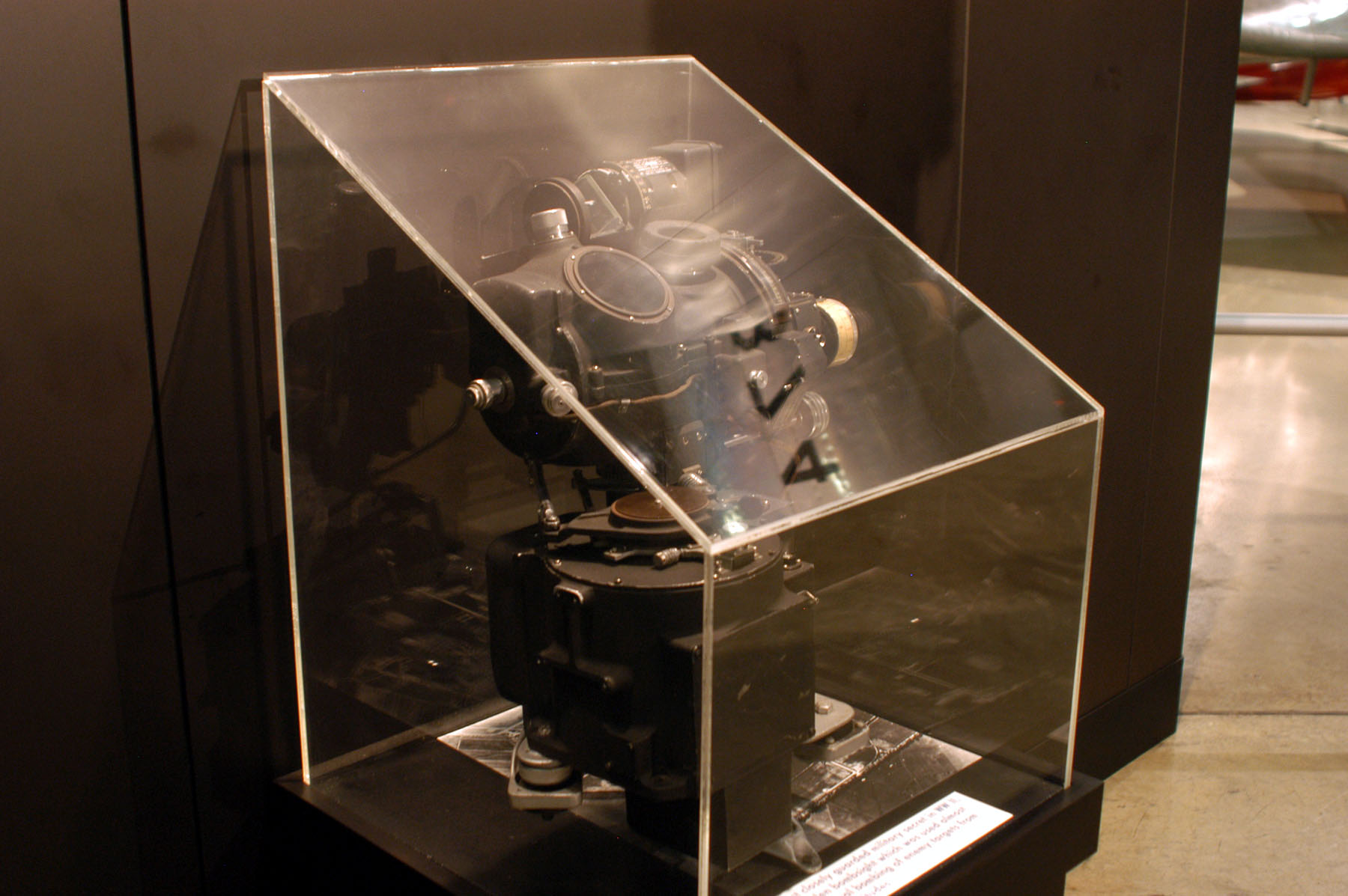
A Norden bombsight displayed at the National Museum of the U.S. Air Force in Dayton, Ohio.
U.S. Air Force / National Museum of the U.S. Air Force (051019-F-1234P-045) · Public domain · Original recordImage changes
Display copies resized; original archive JPEG preserved.
The words
Accuracy
Accuracy depended on stable flight conditions. Last-second changes in altitude during combat could move bombs away from their intended aiming point.
Quoted operating account, optimal conditions and altitude changes · NPS: Norden operation and secure storage (opens a new tab)
Autopilot
The Honeywell C-1 autopilot helped hold the bomber steady. Linked with the Norden, it let the bombardier make course corrections during the final approach.
Autopilot operation and pilot/bombardier control · USAF Museum: the C-1 autopilot (opens a new tab)
Bomb Aimer
In the RAF’s bombing campaign, the bomb aimer guided the pilot on the final approach and released the bombs.
Crew roles, the bomb aimer · War Memorial: the bomb aimer’s role (opens a new tab)
Bombardier
The American bombardier operated the sight and directed the bombing run. His work depended on cooperation with the pilot to maintain the required flight conditions.
Bombardier responsibilities and pilot teamwork · B-17 manual: bombardier and navigator (opens a new tab)
Bombing Run
The bombing run was the final approach to release. A straight, level course gave the bombardier a steady platform for aiming through the sight.
Quoted operating account, steady bombing platform · NPS: Norden operation and secure storage (opens a new tab)
Bombsight
The Norden combined a telescopic sight with an analog computer. Wind, airspeed and altitude data helped it calculate an aiming point for the falling bombs.
Bombsight system and analog computation · USAF Museum: the Norden’s working parts (opens a new tab)
Gyroscopic
An internal gyroscope stabilized the Norden’s telescopic sight. This helped the bombardier keep a usable view of the target while the aircraft was in flight.
Internal gyroscope and telescopic sight · USAF Museum: the Norden’s working parts (opens a new tab)
Norden
Carl L. Norden developed the bombsight for the U.S. Navy. Testing at the Naval Proving Ground at Dahlgren helped refine the instrument before its wartime use.
Did you know?
McCook Army Air Base in Nebraska stored its bombsights in concrete vaults while crews trained at the airfield.
Navy historian: Norden’s naval origins (opens a new tab) · NPS: Norden operation and secure storage (opens a new tab)
Optical
An optical bombsight used a telescope with crosshairs to view the target. It needed stabilization because aircraft turbulence could disrupt the view.
Telescope, crosshairs and aircraft movement · USAF Museum: the technical problems (opens a new tab)
Pickle Barrel
Claims that the Norden could drop a bomb into a pickle barrel exaggerated its accuracy. In practice, aiming at large factory complexes was more realistic.
Norden accuracy claim and factory-complex targets · USAF Museum: accuracy and its limits (opens a new tab)
Precision
Precision meant trying to hit selected targets. During Big Week, bombs aimed at aircraft production killed workers sheltering at Heiterblick.
Ch. 2, pp. 30 and 33–34, precision targets and worker deaths · AAF history: factory targets and victims (opens a new tab)
Sperry
Sperry’s S-1 was another American bombsight. It equipped some Army Air Forces bombers early in the war, but its production contracts were canceled in late 1943.
S-1 service and late-1943 contract cancellation · USAF Museum: the competing Sperry sight (opens a new tab)
Target
The target was the intended aiming point. The bombardier entered flight data so the Norden could account for wind drift and calculate the correct aim.
Target approach, input data and wind drift · USAF Museum: the Norden’s working parts (opens a new tab)
USAAF
USAAF stood for United States Army Air Forces. It integrated the Norden into bomber flight controls for the daylight campaign, including on B-17s and B-24s.
USAAF doctrine and bomber flight-control integration · USAF Museum: the technical problems (opens a new tab)
Sources
- The Norden Bombsight and the U.S. Naval Proving GroundRobert V. Gates; Naval Surface Warfare Center Dahlgren Division
- Second-Generation Norden Bombsight VaultNational Park Service, Aviation: From Sand Dunes to Sonic Booms; August 29, 2017
- Honeywell C-1 AutopilotNational Museum of the United States Air Force
- Striking by Night – CrewAustralian War Memorial
- Duties and Responsibilities of the B-17 CrewmenB-17 Pilot Training Manual, 1943; 303rd Bomb Group Association transcription
- Norden M-9 BombsightNational Museum of the United States Air Force
- Bombing as a Technical ProblemNational Museum of the United States Air Force
- Enabling TechnologiesNational Museum of the United States Air Force
- The Army Air Forces in World War II, Volume III, Chapter 2: Big WeekU.S. Air Historical Group; Craven and Cate, editors; HyperWar transcription
- Sperry S-1 BombsightNational Museum of the United States Air Force