
World War II
Puzzle 42 · Bombers Over Europe · Page 66 in print
Doolittle and the Eighth
Doolittle took command of the U.S. Eighth Air Force in January 1944.
Jump to a word
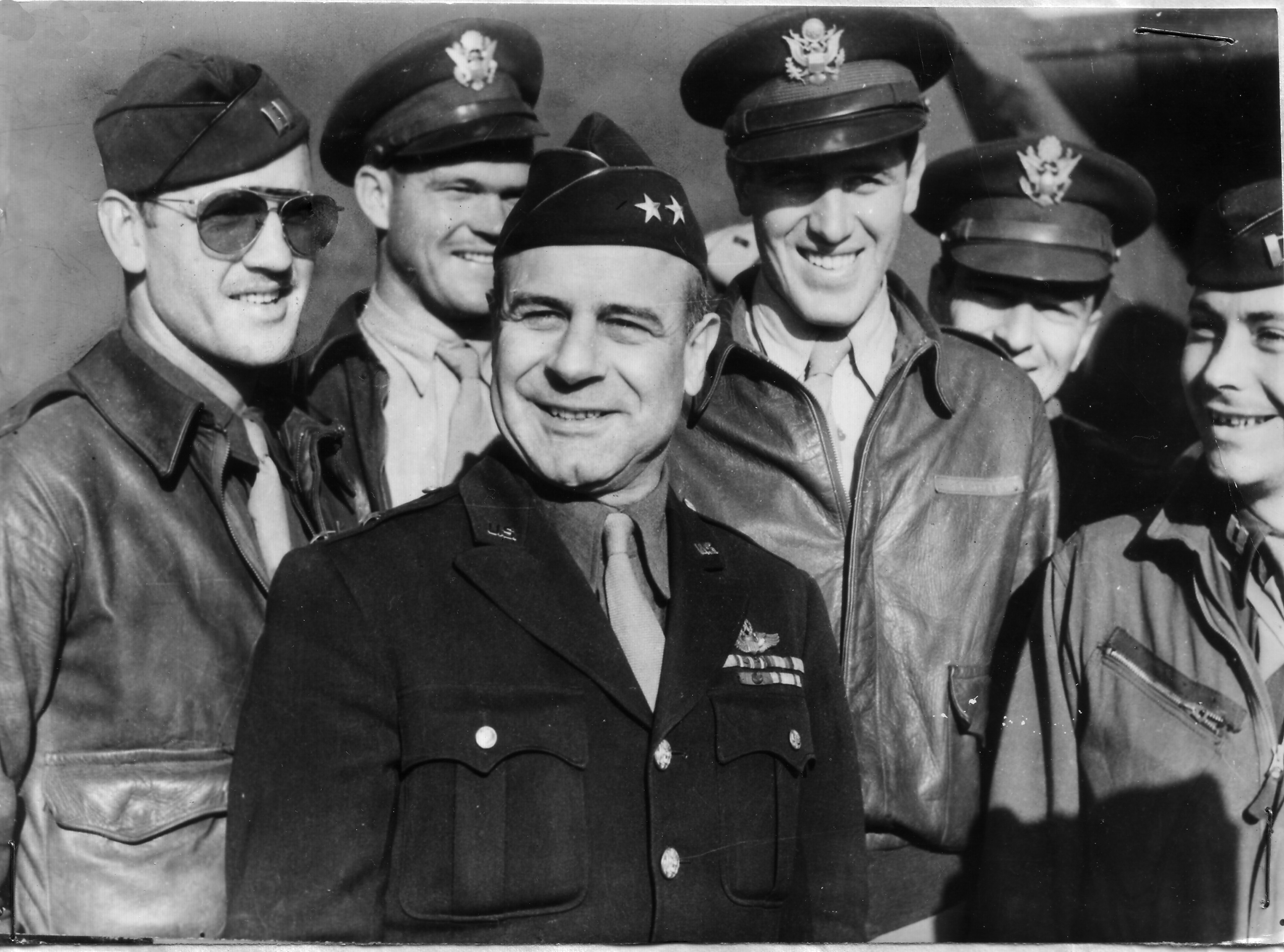
James H. Doolittle with a group of American airmen.
U.S. Air Force / Joint Base San Antonio (060415-F-0000G-002) · Public domain · Original recordImage changes
Display copies resized; original archive JPEG preserved.
The words
Air Corps
The Air Corps handled training and equipment. In June 1941, the Army Air Forces was created to unite it with the operational Air Force Combat Command.
Air Corps functions and June 20, 1941 organization · USAF Museum: establishing the AAF (opens a new tab)
Air Supremacy
Doolittle’s command sought control of the air. Fighter escorts increasingly left close defensive positions to seek and attack German aircraft.
Ch. 2, pp. 46–47, offensive escort tactics · AAF history: escort tactics and Berlin (opens a new tab)
Berlin
The Eighth’s bombers reached Berlin in March 1944 with P-51 escorts. Clouds disrupted aiming, and bombs on the March 6 raid scattered across the city.
Ch. 2, pp. 49–51, March 4 and 6 missions · AAF history: escort tactics and Berlin (opens a new tab)
Bomb Group
The 305th Bombardment Group flew B-17s from Chelveston. Its work depended on maintainers, armourers, refuellers, medics and other ground personnel.
Chelveston operations and the group’s supporting personnel · USAF historian: the 305th at Chelveston (opens a new tab)
Bomber Crew
A B-17 usually carried ten specialists, including pilots, a navigator, bombardier and gunners. Combat brought deaths, injuries and captivity to bomber crews.
B-17 manual: crew responsibilities (opens a new tab) · USAF historian: the 305th at Chelveston (opens a new tab)
Combat Box
Combat boxes arranged B-17s for mutual protection by concentrating defensive gunfire. LeMay’s 305th helped develop these formation tactics before Doolittle’s 1944 command.
LeMay and development of the combat box · USAF historian: the 305th at Chelveston (opens a new tab)
Crewman
At high altitude, a crewman relied on the bomber’s oxygen equipment. The 303rd’s October 1944 orders assigned regular crew oxygen checks to the bombardier.
October 15, 1944 orders, Oxygen, General · 303rd orders: crew oxygen checks (opens a new tab)
Doolittle
James “Jimmy” Doolittle took over the Eighth Air Force in January 1944. He had previously commanded the Fifteenth Air Force in the Mediterranean.
Biography, Fifteenth and Eighth commands · USAF: Doolittle’s wartime commands (opens a new tab)
Drop Tanks
Drop tanks carried extra fuel outside the fighter. Auxiliary wing tanks extended P-51 escort range, helping American bombers reach targets deep inside Germany.
Ch. 2, p. 49, auxiliary tanks and escort range · AAF history: escort tactics and Berlin (opens a new tab)
Eighth
The Eighth Air Force’s bombers operated from Britain. Spaatz’s USSTAF coordinated their strategic operations with those of the Italy-based Fifteenth Air Force.
Ch. 1, p. 6, coordinating the two bomber forces · AAF history: the Eighth and USSTAF (opens a new tab)
Formation
In October 1944, the 303rd Bombardment Group prescribed a twelve-aircraft squadron formation: four flights of three, arranged in high and low positions.
October 15, 1944 orders, 12-aircraft formation · 303rd orders: bomber formations (opens a new tab)
Fortresses
Fortresses were Boeing B-17 Flying Fortress bombers. Four engines, high-altitude performance and heavy defensive armament supported their role in the American bombing campaign over Europe.
Aircraft design, European service and technical notes · USAF Museum: the Flying Fortress (opens a new tab)
LeMay
Colonel Curtis LeMay led the 305th at Chelveston. Its lead crews helped coordinate bomb-release timing, developing techniques adopted across the Eighth Air Force.
305th leadership and the lead-crew system · USAF historian: the 305th at Chelveston (opens a new tab)
Pinetree
Pinetree was the wartime code name for VIII Bomber Command’s headquarters at Wycombe Abbey, where American officers directed the bomber campaign from England.
VIII Bomber Command’s school headquarters and code name · Eighth Air Force: the Pinetree headquarters (opens a new tab)
Wycombe Abbey
The Air Ministry requisitioned Wycombe Abbey in 1942, and its pupils relocated to other schools. American officers worked from the former headmistress’s offices.
Did you know?
During the wartime occupation, the school’s chapel became a cinema.
School requisition, pupil relocation and offices · Wycombe Abbey: the school in wartime (opens a new tab)
Sources
- 75 years of American Airmen: Past, present, futureSenior Airman Erin Trower, 8th Air Force Public Affairs, February 1, 2017; includes historian Lane Callaway
- The Army Air Forces in World War II, Volume III, Chapter 2: Big WeekU.S. Air Historical Group; Craven and Cate, editors; HyperWar transcription
- General James Harold DoolittleUnited States Air Force; official biography
- AAF EstablishedNational Museum of the United States Air Force
- Chelveston in context – 305th Air Mobility Wing heritageStuart Lockhart, 305th Air Mobility Wing History Office, April 30, 2020
- Duties and Responsibilities of the B-17 CrewmenB-17 Pilot Training Manual, 1943; transcription hosted by the 303rd Bomb Group Association
- Standard Operating Procedure: Oxygen and EquipmentHeadquarters 303rd Bombardment Group (H), October 15, 1944; 303rd Bomb Group Association transcription
- The Army Air Forces in World War II, Volume III, Chapter 1: Winter BombingU.S. Air Historical Group; Craven and Cate, editors; HyperWar transcription
- Standard Operating Procedure: Formation Technique, 12 and 18 AircraftHeadquarters 303rd Bombardment Group (H), October 15, 1944; 303rd Bomb Group Association transcription
- Boeing B-17F Memphis BelleNational Museum of the United States Air Force
- Pinetree to Pine TreesWycombe Abbey; school’s account of its wartime occupation and May 2022 commemoration