
World War II
Puzzle 41 · Bombers Over Europe · Page 65 in print
Carl Spaatz
Spaatz led U.S. strategic bombing in Europe from January 1944.
Jump to a word
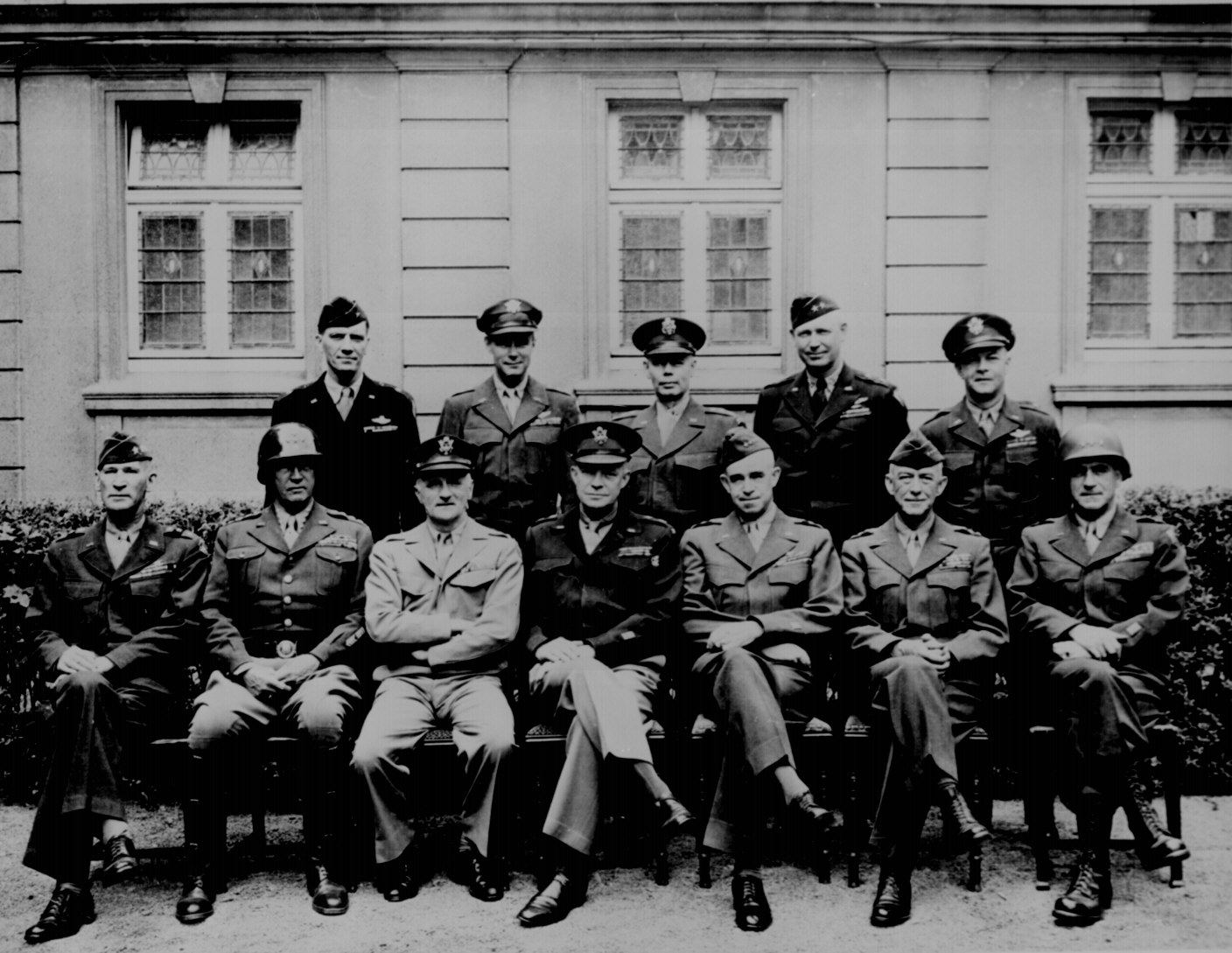
Carl Spaatz, seated third from the left, with other American generals in about 1945.
Office of War Information / National Archives (208-YE-182) · Public domain · Original recordImage changes
Display copies resized; original scan preserved.
The words
Air Campaign
The combined bomber campaign paired American daylight raids with British night attacks. Its objectives included German industry and the morale of the civilian population.
Ch. 9, pp. 298–305, combined offensive and directive · AAF history: Casablanca and daylight raids (opens a new tab)
Air Command
USSTAF supervised its bomber forces and set policy. Coordinated operations such as Big Week could come under its operations deputy’s direct control.
Ch. 2, p. 30, headquarters responsibilities · AAF history: Big Week and its costs (opens a new tab)
Air Offensive
Big Week in February 1944 struck German aircraft production. Bombs killed workers sheltering at Heiterblick, showing the human cost of factory attacks.
Ch. 2, pp. 33–34, the Heiterblick attack · AAF history: Big Week and its costs (opens a new tab)
Air Warfare
Bombers and escort fighters worked together during Big Week. American P-47s, P-38s and P-51s helped protect the force attacking aircraft factories.
Ch. 2, pp. 32–33, bomber forces and fighter escorts · AAF history: Big Week and its costs (opens a new tab)
Casablanca
At Casablanca in January 1943, Allied leaders agreed on a combined bomber offensive. Its directive listed aircraft production, transport and oil among the targets.
Ch. 9, pp. 300–305, conference and directive · AAF history: Casablanca and daylight raids (opens a new tab)
Commander
Lieutenant General Carl Spaatz took command of U.S. Strategic Air Forces in Europe in January 1944, overseeing the American strategic bombing campaign.
Biography, lieutenant-general promotion and return to England · USAF: Carl Spaatz’s commands (opens a new tab)
Daylight
Daylight helped American crews identify individual targets visually. Cloud, winter weather and German defenses limited the missions they could fly and increased the dangers.
Ch. 9, pp. 299–302, weather, defenses and visual targets · AAF history: Casablanca and daylight raids (opens a new tab)
Doctrine
American bombing doctrine guided training, equipment and tactics toward striking specific industrial targets in daylight. This was the intended method; its effectiveness remained contested.
Ch. 9, pp. 298–299, policy and disputed methods · AAF history: Casablanca and daylight raids (opens a new tab)
Eaker
General Ira Eaker defended daylight bombing at Casablanca. He argued that American day raids and British night attacks could maintain continuous pressure on Germany.
Did you know?
Spaatz and Eaker flew together in a 1929 endurance flight that kept an aircraft aloft for 150 hours and 40 minutes.
AAF history: Casablanca and daylight raids (opens a new tab) · Air Force foundation: the Spaatz award (opens a new tab)
Oil Plan
Spaatz made denying oil to German forces the primary strategic aim in June 1944. Refineries and synthetic-fuel plants became priority targets.
Ch. 9, p. 280, June 8 order and targets · AAF history: the oil campaign (opens a new tab)
Pointblank
Pointblank covered the combined bomber offensive. Defeating German fighter strength became its urgent priority as the Allies prepared to invade France.
Ch. 1, pp. 7–8, campaign scope and fighter priority · AAF history: USSTAF and Pointblank (opens a new tab)
Spaatz
Spaatz commanded the Eighth Air Force in 1942. After service in North Africa and the Mediterranean, he returned to England to lead USSTAF.
Biography, successive wartime commands · USAF: Carl Spaatz’s commands (opens a new tab)
Strategic
Strategic attacks sought to weaken Germany’s ability to sustain the war. The oil campaign targeted the fuel needed by its armed forces.
Ch. 9, pp. 278–280, strategic role and oil priority · AAF history: the oil campaign (opens a new tab)
Tooey
Tooey was Spaatz’s nickname. The Air Force Historical Foundation, which he helped found in 1953, named an award for him.
Award title and foundation history · Air Force foundation: the Spaatz award (opens a new tab)
USSTAF
USSTAF meant United States Strategic Air Forces in Europe. Its headquarters coordinated the Eighth Air Force in Britain and Fifteenth in the Mediterranean.
Ch. 1, p. 6, formation and coordination · AAF history: USSTAF and Pointblank (opens a new tab)
Sources
- The Army Air Forces in World War II, Volume II, Chapter 9: The Casablanca DirectiveU.S. Air Historical Group; Wesley Frank Craven and James Lea Cate, editors; HyperWar transcription
- The Army Air Forces in World War II, Volume III, Chapter 2: Big WeekU.S. Air Historical Group; Craven and Cate, editors; HyperWar transcription
- General Carl A. SpaatzUnited States Air Force; official biography
- The Army Air Forces in World War II, Volume III, Chapter 9: The Strategic Bomber Strikes AheadU.S. Air Historical Group; Craven and Cate, editors; HyperWar transcription
- Lifetime Achievement Award for Impacting Airpower History: General Carl Tooey Spaatz AwardAir Force Historical Foundation
- The Army Air Forces in World War II, Volume III, Chapter 1: Winter BombingU.S. Air Historical Group; Craven and Cate, editors; HyperWar transcription