
World War II
Puzzle 40 · Bombers Over Europe · Page 64 in print
Avro Lancaster
The four-engine Avro Lancaster was RAF Bomber Command’s principal heavy bomber. Nineteen specially modified Lancasters of 617 Squadron set out to attack German dams with bouncing bombs on the night of 16-17 May 1943.
Jump to a word
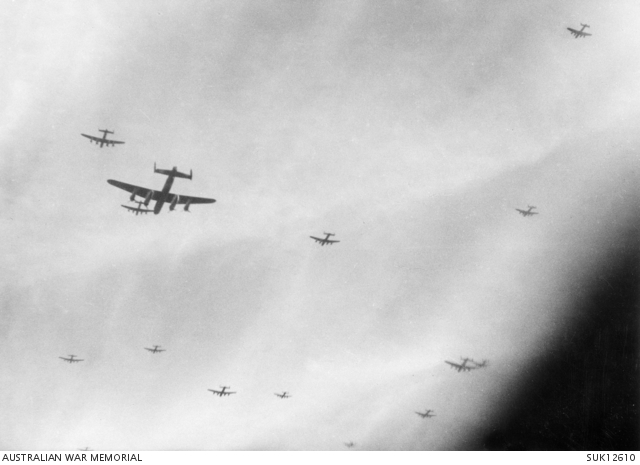
RAF Lancasters returning to England after an attack on targets in the Pas-de-Calais around August 1944.
Australian War Memorial (SUK12610) · Public domain · Original recordImage changes
Display copies resized; original downloaded JPEG preserved.
The words
Aircraft
The Lancaster entered Bomber Command service in 1942. Its wings and fuselage were built in separate sections, equipped before being transported for final assembly.
Design and wartime production · BAE Heritage: Lancaster design and engines (opens a new tab)
Aircrew
A Lancaster normally carried seven: pilot, flight engineer, navigator, bomb aimer, wireless operator, mid-upper gunner and rear gunner. Each position served a different flying or combat task.
Did you know?
G for George flew with 27 different crews during its operational service.
Description, normal crew complement · War Memorial: G for George (opens a new tab)
Avro
A.V. Roe and Company designed the Lancaster, but other firms also built it. Production spread across factories in Britain and Canada.
Manufacturer and production network · BAE Heritage: Lancaster design and engines (opens a new tab)
Dam Raid
Operation Chastise breached the Möhne and Eder dams in May 1943. The flooding killed civilians, foreign prisoners of war and forced labourers downstream.
MOD: the Dams Raid and its human cost (opens a new tab) · RAF Museum: casualties below the dams (opens a new tab)
Dambusters
The Dambusters name became associated with 617 Squadron after its dams attack. Eight Lancasters were lost; 53 airmen died and three became prisoners of war.
Squadron name and aircrew losses · MOD: the Dams Raid and its human cost (opens a new tab)
Four Engine
Four engines distinguished the Lancaster from its twin-engine Manchester predecessor. Most used Merlins, but the Lancaster B.II had Bristol Hercules radial engines.
Manchester development and B.II variant · BAE Heritage: Lancaster design and engines (opens a new tab)
Gunner
Rear and mid-upper gunners watched for enemy fighters, nearby aircraft and falling bombs. Their warning role complemented their defensive machine guns.
Rear and mid-upper gunners · War Memorial: bomber crew roles (opens a new tab)
Heavy Bomber
The Lancaster’s long bomb bay accommodated large bomb loads. Special adaptations enabled some aircraft to carry Tallboy and Grand Slam bombs.
Bomb bay and special bomb adaptations · BAE Heritage: Lancaster design and engines (opens a new tab)
Lancaster
The Lancaster grew out of efforts to improve the Manchester bomber. Its prototype first flew in January 1941, before it became Bomber Command’s principal heavy bomber.
Development and operational role · RAF Museum: the Lancaster’s development (opens a new tab)
Merlin
The Merlin was a liquid-cooled, twelve-cylinder piston engine. Four Merlin XX engines originally powered G for George; Merlin 22 engines were fitted later in Australia.
Description, original and replacement engines · War Memorial: G for George (opens a new tab)
Pilot
The pilot flew the Lancaster and captained its crew. The navigator guided the route, the engineer monitored the engines, and the bomb aimer directed the final bombing run.
Pilot, navigator, flight engineer and bomb aimer · War Memorial: bomber crew roles (opens a new tab)
Rolls-Royce
Rolls-Royce developed the Merlin engines used in the Lancaster. The four-engine design replaced the Manchester’s troublesome Vulture installation with more reliable powerplants.
Manchester and Lancaster engine installations · BAE Heritage: Lancaster design and engines (opens a new tab)
Roy Chadwick
Roy Chadwick led Avro’s team in redesigning the Manchester bomber. Fitting four Merlin engines on larger wings produced the aircraft that became the Lancaster.
Chief designer and the larger-wing redesign · BAE Heritage: Lancaster design and engines (opens a new tab)
Scampton
RAF Scampton was 617 Squadron’s home station for the Dams Raid. Nineteen Lancasters departed on May 16, 1943; eleven returned after the operation.
Departure and surviving aircraft returning to Scampton · MOD: the Dams Raid and its human cost (opens a new tab)
Upkeep
Upkeep was Barnes Wallis’s cylindrical bouncing mine. Released at low level with backspin, it skipped over defensive netting toward the dam wall before exploding underwater.
Transcript p. 3, mine shape and delivery · RAF Museum: how Upkeep worked (opens a new tab)
Sources
- Avro LancasterBAE Systems Heritage; manufacturer successor’s aircraft record
- Dambusters raid rememberedUK Ministry of Defence, May 16–17, 2013
- Avro Lancaster 1Royal Air Force Museum; R5868 collection record
- Avro Lancaster Mk I Bomber G for George: 460 Squadron, RAAFAustralian War Memorial; RELAWM31788 collection record
- Striking by Night – CrewAustralian War Memorial
- The Dams RaidRoyal Air Force Museum, 2013; podcast transcript
- Casualties of the Dams RaidRoyal Air Force Museum; archival exhibition