
World War II
Puzzle 38 · Anzio to the Gothic Line · Page 59 in print
Bologna Offensive
Lt. Gen. Lucian K. Truscott, commanding Fifth Army, directed the western envelopment in the Bologna Offensive, coordinating with Eighth Army’s eastern thrust in spring 1945.
Jump to a word
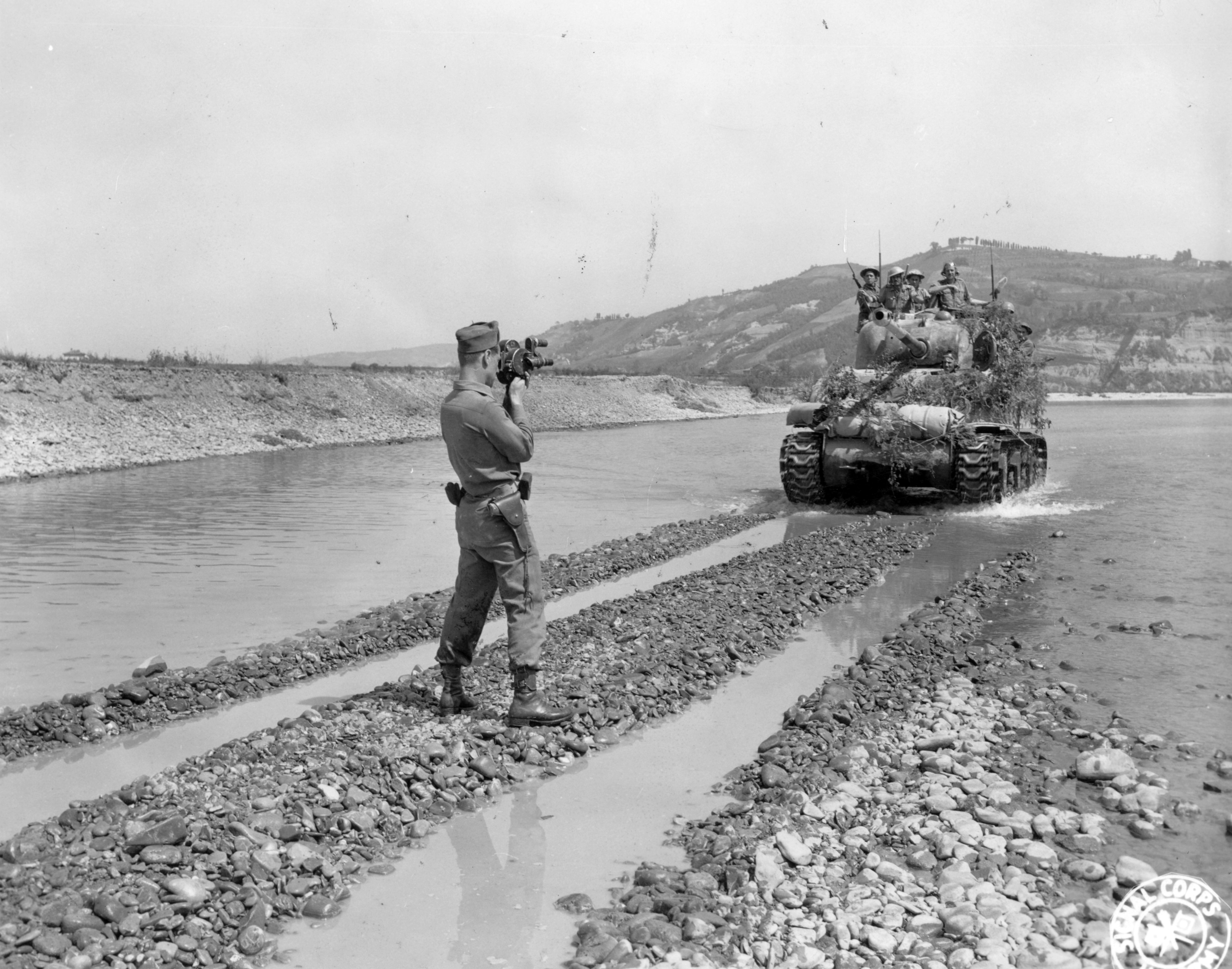
Army cameraman John Pitts films a South African tank crossing the Reno River on the way to Bologna on April 20, 1945.
Schmidt, 196th Signal Photo Company / U.S. Army Signal Corps / Signal Corps Archive (SC 329872) · Public domain · Original recordImage changes
Display copies resized; original downloaded JPEG preserved.
The words
Argenta Gap
German-blown dikes and dismantled pumping stations had flooded all but a narrow corridor, the Argenta Gap. Britain’s 78th Division seized its key, the Bastia Bridge, on April 14, 1945, and was through Argenta by April 18.
Did you know?
The British called their LVTs (Landing Vehicles, Tracked) “Fantails” or “Buffaloes.” In mid-April 1945, British troops rode them over flooded land “hitherto regarded impassable,” the US Army history says, to outflank the Bastia Bridge.
Fisher, Cassino to the Alps, ch. 25 (opens a new tab) · Fisher, Cassino to the Alps, ch. 26 (opens a new tab) · National Army Museum, April 1945 (opens a new tab)
Armor
Lieutenant General Lucian K. Truscott paired the US 1st Armored and South African 6th Armoured divisions for a concentrated thrust. When German resistance broke at Monte San Michele on April 19, 1945, every available tank was called forward.
Did you know?
On April 23, 1945, Britain’s 6th Armoured Division met the South African 6th Armoured at the village of Finale, trapping thousands of Germans. For many of them, the US Army history remarks, the name “signified their fate.”
Fisher, Cassino to the Alps, ch. 25 (opens a new tab) · Fisher, Cassino to the Alps, ch. 27 (opens a new tab) · Fisher, Cassino to the Alps, ch. 28 (opens a new tab) · 15th Army Group, Finito! (1945) (opens a new tab)
Bologna
Polish, American and Italian troops entered Bologna on April 21, 1945, “simultaneously,” about dawn, says the 15th Army Group’s 1945 history. Poland’s Institute of National Remembrance puts the 9th Carpathian Rifle Battalion first, at 6:05 a.m.
Did you know?
Bologna made 17 Polish commanders honorary citizens, and its city council gave Polish soldiers commemorative medals inscribed, in Italian, to the liberators who first entered the city on April 21, 1945.
Fisher, Cassino to the Alps, ch. 27 (opens a new tab) · IPN Trails of Hope: Bologna (opens a new tab) · 15th Army Group, Finito! (1945) (opens a new tab) · Storia e Memoria di Bologna: Polish Corps (opens a new tab)
Brazilian
On February 21, 1945, the 1st Regiment of the Brazilian Expeditionary Force took Monte Castello, covering the US 10th Mountain Division’s flank. In mid-April, as Fifth Army’s offensive opened, the Brazilian division occupied Montese.
Did you know?
A popular Brazilian saying held that a snake would sooner smoke a pipe than the expeditionary force reach the front. The soldiers made it their badge, calling themselves the Smoking Snakes and wearing a shoulder patch of a snake with a pipe.
Fisher, Cassino to the Alps, ch. 24 (opens a new tab) · Fisher, Cassino to the Alps, ch. 27 (opens a new tab) · Wikipedia: Brazilian Expeditionary Force (opens a new tab) · Mariners' Museum: The Smoking Snakes (opens a new tab)
Collapse
By April 21, 1945, Fifth Army intelligence noted “no front line in the formal sense.” On April 23 General der Panzertruppe (lieutenant general) Fridolin von Senger und Etterlin, lacking signal equipment to control XIV Panzer Corps, fled across the Po.
Did you know?
Generalmajor (brigadier general) Friedrich von Schellwitz of the German 305th Infantry Division and his staff surrendered to the US 88th Division at the Po in late April 1945. The US Army history calls him the first German division commander captured in the campaign.
Fisher, Cassino to the Alps, ch. 28 (opens a new tab) · Fisher, Cassino to the Alps, ch. 29 (opens a new tab) · Fisher, Cassino to the Alps, ch. 2 (opens a new tab) · 15th Army Group, Finito! (1945) (opens a new tab) · Lexikon der Wehrmacht: Senger und Etterlin (opens a new tab) · Neue Deutsche Biographie: Senger (opens a new tab) · Fisher, Cassino to the Alps, ranks table (opens a new tab) · Lexikon der Wehrmacht: 305th Infantry Div. (opens a new tab)
Comacchio
In Operation Roast, tracked amphibians (LVTs) carried Britain’s 2nd Commando Brigade into the shallow Comacchio Lagoon on the night of April 1, 1945. They stuck in the mud; the men switched to storm boats and waded ashore.
Did you know?
Eighth Army engineers had long wanted to cross the lagoon but lacked data on its depth and bottom. Friendly Italian fishermen slipping through the British lines, it turned out, could supply it.
Fisher, Cassino to the Alps, ch. 25 (opens a new tab) · Fisher, Cassino to the Alps, ch. 26 (opens a new tab) · National Army Museum, April 1945 (opens a new tab)
Defeat
At Caserta’s Royal Palace shortly after 2 p.m. on April 29, 1945, Oberstleutnant (lieutenant colonel) Victor von Schweinitz and SS-Sturmbannführer (major) Eugen Wenner signed the unconditional surrender of German forces in Italy, effective at noon GMT on May 2.
Did you know?
Late on the afternoon of May 2, 1945, 10th Mountain Division radios near Lake Garda picked up a BBC broadcast announcing the unconditional surrender of the German armies in Italy, after more than a week of rumors.
Fisher, Cassino to the Alps, ch. 30 (opens a new tab) · Fisher, Cassino to the Alps, ch. 29 (opens a new tab) · National Army Museum, April 1945 (opens a new tab) · Caserta surrender instrument (Avalon) (opens a new tab) · Fisher, Cassino to the Alps, ranks table (opens a new tab)
Ferrara
Eighth Army drove northwest from Argenta toward Ferrara. Indian troops reached the Po 3 miles (5 km) north of it on April 23, 1945; the next day the 1st Battalion, Argyll and Sutherland Highlanders, cleared the city.
Did you know?
Ferrara’s 2024 Liberation Day program featured the Colonna della Libertà, or Freedom Column, a reenactment of the British entry, with World War II military vehicles in the historic center and bagpipers in the cathedral square.
Fisher, Cassino to the Alps, ch. 28 (opens a new tab) · Ferrara: Liberation Day program 2024 (opens a new tab) · 15th Army Group, Finito! (1945) (opens a new tab)
Final Push
The US Army’s official history calls it “The Last Offensive.” Two days after the cease-fire, on May 4, 1945, Fifth Army scouts met US Seventh Army troops at Vipiteno, 9 miles (14 km) south of the Brenner Pass.
Did you know?
General Mark W. Clark insisted on an early-April start partly for fear the Red Army or US Seventh Army would reach Austria’s Alpine frontier first. He was, the US Army history says, “determined to be in on the kill.”
Fisher, Cassino to the Alps, ch. 25 (opens a new tab) · National Army Museum, April 1945 (opens a new tab) · Fisher, Cassino to the Alps, ch. 30 (opens a new tab) · 15th Army Group, Finito! (1945) (opens a new tab)
Grapeshot
Britain’s National Army Museum dates Operation Grapeshot from April 6 to May 2, 1945, when the German surrender in Italy took effect. Within it, Eighth Army’s opening attack across the Senio carried its own code name, Buckland.
Did you know?
Fifth Army’s part began as Operation Pianoro, sharing its name with a town on Highway 65, the road to Bologna that Clark long favored. Greatly modified, it became Operation Craftsman.
National Army Museum, April 1945 (opens a new tab) · Wikipedia: Spring 1945 offensive in Italy (opens a new tab) · Kay, Cassino to Trieste, ch. 9.I (opens a new tab) · Fisher, Cassino to the Alps, ch. 25 (opens a new tab) · Fisher, Cassino to the Alps, ch. 27 (opens a new tab)
Offensive
The 15th Army Group struck in two blows, giving each army the full weight of Allied air power: 1,673 heavy bombers backed Eighth Army from April 9, 1945, and some 2,052 backed Fifth Army from April 14.
Did you know?
Fifth Army’s planners stocked reserve rations enough to feed 400,000 prisoners for 30 days, though captured German stocks were to be used first.
Fisher, Cassino to the Alps, ch. 25 (opens a new tab) · Fisher, Cassino to the Alps, ch. 26 (opens a new tab) · Fisher, Cassino to the Alps, ch. 27 (opens a new tab)
Po Valley
On April 20, 1945, the 86th Mountain Infantry crossed Highway 9 northwest of Bologna. US troops “swept almost unimpeded” over the plain, and the 10th Mountain Division reached the Po at San Benedetto on April 22.
Did you know?
In spring 1945 the Po ran at its lowest level in half a century. The water was too shallow for the big ferries the Germans had counted on, forcing them to abandon much heavy equipment south of the river.
Fisher, Cassino to the Alps, ch. 27 (opens a new tab) · Fisher, Cassino to the Alps, ch. 28 (opens a new tab)
Senio River
Eighth Army wintered facing the Senio’s floodbanks. At 7:20 p.m. on April 9, 1945, after hours of bombing and shelling, flamethrowers hosed the far bank and New Zealand and Indian infantry crossed by boat and kapok bridge.
Did you know?
Moving up to the Senio in late March 1945, New Zealanders, Māori soldiers among them, sewed on the British 78th Division’s yellow battleaxe badges to pass as Englishmen. Italians along the road greeted them as “kiwis” anyway.
Fisher, Cassino to the Alps, ch. 24 (opens a new tab) · Fisher, Cassino to the Alps, ch. 26 (opens a new tab) · National Army Museum, April 1945 (opens a new tab) · Kay, Cassino to Trieste, ch. 8.II (opens a new tab) · Kay, Cassino to Trieste, ch. 9.II (opens a new tab) · Kay, Cassino to Trieste, ch. 9.III (opens a new tab)
Snow
In winter 1944–45 most of the front “lay dormant beneath a coat of snow and ice.” On the Senio about 6 inches (15 cm) fell on January 6–7, 1945, then froze so hard silent movement became almost impossible.
Did you know?
The US 10th Mountain Division, new to Italy that winter, had many college-trained men, including skiers and climbers, most of them volunteers recruited by the civilian National Ski Patrol System. Its arrival was not announced to the press until February 23, 1945.
Fisher, Cassino to the Alps, ch. 24 (opens a new tab) · Fisher, Cassino to the Alps, ch. 25 (opens a new tab) · Kay, Cassino to Trieste, ch. 8.II (opens a new tab)
Spring
April 9, 1945, the day Eighth Army attacked, dawned “bright and almost cloudless,” the ground “dry and firm after weeks unusually free from rain.” Fog over the airfields held Fifth Army back from April 12 until April 14.
Did you know?
Racing for the Po on April 24, 1945, New Zealanders drove through countryside “lovely in the first spring clothing” of wheat and alfalfa, the 21st Battalion’s history recalls, past ditches of buttercups and daisies, as villagers crowded around with flowers and wine.
Kay, Cassino to Trieste, ch. 9.III (opens a new tab) · Fisher, Cassino to the Alps, ch. 27 (opens a new tab) · National Army Museum, April 1945 (opens a new tab) · Kay, Cassino to Trieste, ch. 11.II (opens a new tab)
Sources
- Cassino to the Alps, Chapter XXIV: Through the WinterU.S. Army Center of Military History (HyperWar transcription)
- Cassino to the Alps, Part Seven: The Last Offensive, Chapter XXV: Strategies and PlansU.S. Army Center of Military History (HyperWar transcription)
- Cassino to the Alps, Chapter XXVI: Breakthrough on the Eighth Army FrontU.S. Army Center of Military History (HyperWar transcription)
- Cassino to the Alps, Chapter XXVII: Breakthrough on the Fifth Army's FrontU.S. Army Center of Military History (HyperWar transcription)
- Cassino to the Alps, Part Eight: Pursuit to the Alps, Chapter XXVIII: Race for the PoU.S. Army Center of Military History (HyperWar transcription)
- Cassino to the Alps, Chapter XXIX: To the AlpsU.S. Army Center of Military History (HyperWar transcription)
- Cassino to the Alps, Chapter XXX: The CapitulationU.S. Army Center of Military History (HyperWar transcription)
- On This Day: April 1945National Army Museum (UK)
- Italy Volume II: From Cassino to Trieste, Chapter 8 (The Winter Line), II: Offensive DefenceHistorical Publications Branch, Wellington (NZETC, Internet Archive copy)
- Italy Volume II: From Cassino to Trieste, Chapter 9 (The Spring Offensive), I: The PlanHistorical Publications Branch, Wellington (NZETC, Internet Archive copy)
- Italy Volume II: From Cassino to Trieste, Chapter 9, II: The Senio StopbankHistorical Publications Branch, Wellington (NZETC, Internet Archive copy)
- Italy Volume II: From Cassino to Trieste, Chapter 9, III: The Assault on the Senio LineHistorical Publications Branch, Wellington (NZETC, Internet Archive copy)
- Italy Volume II: From Cassino to Trieste, Chapter 11 (The Race to Trieste), II: Crossing the River PoHistorical Publications Branch, Wellington (NZETC, Internet Archive copy)
- Bologna - PlacesInstitute of National Remembrance (IPN), Poland: Trails of Hope
- Brazilian Expeditionary ForceWikipedia
- Spring 1945 offensive in ItalyWikipedia
- Ferrara, Festa della Liberazione 2024: Programma Attività CulturaliComune di Ferrara (Cronaca Comune); program by the Istituto di Storia Contemporanea di Ferrara
- Cassino to the Alps, Chapter II: Preparing for a New OffensiveU.S. Army Center of Military History (HyperWar transcription)
- Finito! The Po Valley Campaign, 1945 (full text)Headquarters, 15th Army Group, Italy (Milan: Rizzoli, 1945; Internet Archive full text)
- Instrument of Local Surrender of German and Other Forces Under the Command or Control of the German Commander-In-Chief Southwest; April 29, 1945Avalon Project, Yale Law School (from US Department of State publication 2669, 1946)
- Il 2° Corpo d’Armata Polacco e la liberazione dell’Emilia Romagna (Polish War Cemetery panel text)Storia e Memoria di Bologna (Museo civico del Risorgimento, Comune di Bologna)
- The Smoking SnakesThe Mariners' Museum and Park
- Cassino to the Alps, Appendix A: Table of Equivalent RanksU.S. Army Center of Military History (HyperWar mirror, ibiblio.org)
- Fridolin von Senger und EtterlinLexikon der Wehrmacht
- Senger und Etterlin, Fridolin vonNeue Deutsche Biographie 24 (2010), Deutsche Biographie online
- 305. Infanterie-DivisionLexikon der Wehrmacht