
World War II
Puzzle 37 · Anzio to the Gothic Line · Page 58 in print
Operation Olive
Eighth Army attacked the Adriatic end of the Gothic Line on 25 August 1944.
Jump to a word
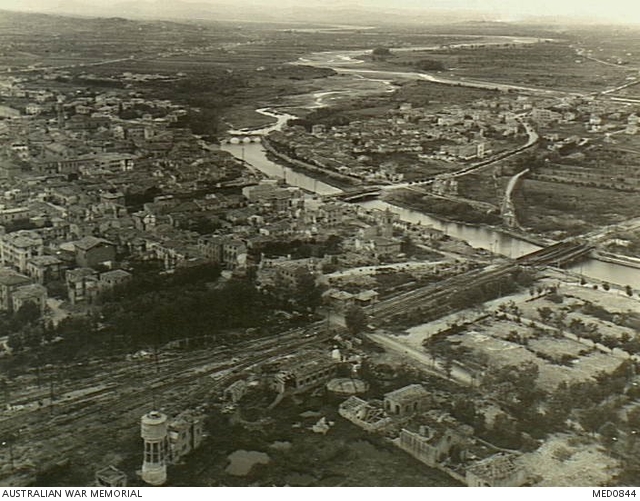
Rimini and the Marecchia River on October 7, 1944, after the town's capture during the Gothic Line offensive.
Australian War Memorial (MED0844) · Public domain · Original recordImage changes
Display copies resized; original downloaded JPEG preserved.
The words
Adriatic
Eighth Army’s commander counted on the Adriatic coast itself to guard his right flank, with a small fleet of destroyers and gunboats. On August 26, 1944, two gunboats opened fire on German flank positions with 6-inch (152 mm) guns.
Did you know?
By late August 1944, says New Zealand’s official history, kiosks along the Adriatic beaches that had once sold ice cream were hiding German machine guns and antitank guns.
Fisher, Cassino to the Alps, ch. 17 (opens a new tab) · Stacey, Canadian Army 1939-1945, ch. 10 (opens a new tab) · Fisher, Cassino to the Alps, ch. 18 (opens a new tab) · Kay, Cassino to Trieste, ch. 5.IV (opens a new tab)
Air Support
Though air priority had shifted to Fifth Army, the Desert Air Force still gave Eighth Army full support. On September 13, 1944, as Canadians fought onto Coriano Ridge, it flew 900 sorties, 700 in close support of ground troops.
Did you know?
On August 24, 1944, the Germans heard of an Allied landing near Ravenna. It was really, says the US Army history, an “exceptionally heavy air attack on Ravenna,” but they had already stopped a division leaving for France.
Fisher, Cassino to the Alps, ch. 18 (opens a new tab) · Fisher, Cassino to the Alps, ch. 20 (opens a new tab)
Apennines
Olive struck where the Apennines, says New Zealand’s official history, “spread their tapering fingers towards the Adriatic.” The Allies hoped to reach the plain beyond them “before the rains came.”
Did you know?
To launch Olive, Eighth Army moved east across the Apennines in eight days. Driving by night on twisting, dimly lit roads, says New Zealand’s official history, it sent about 11,000 vehicles a day over the mountain divide.
Fisher, Cassino to the Alps, ch. 17 (opens a new tab) · Stacey, Canadian Army 1939-1945, ch. 10 (opens a new tab) · Kay, Cassino to Trieste, ch. 5.IV (opens a new tab)
British Army
For Olive, Eighth Army fielded the 2nd Polish Corps, the brigade-sized Italian Corps of Liberation, 1st Canadian Corps and British 5 and 10 Corps. British 5 Corps, including 4th Indian Division, fought through the roughest ground inland.
Did you know?
Replacements ran short first in Eighth Army. In autumn 1944, the US Army history says, the British 1st Armoured Division, which had attacked Coriano Ridge, was reduced to “nonoperational status” and its infantry sent to the 56th Division.
Fisher, Cassino to the Alps, ch. 18 (opens a new tab) · Stacey, Canadian Army 1939-1945, ch. 10 (opens a new tab) · Fisher, Cassino to the Alps, ch. 17 (opens a new tab) · Fisher, Cassino to the Alps, ch. 21 (opens a new tab)
Coriano
Coriano Ridge, the key to Rimini, stopped British armor on September 4, 1944. Canadian and British troops took it on September 13. Its war cemetery holds 1,940 graves, mostly British, Canadian and New Zealand, Veterans Affairs Canada said in 2026.
Did you know?
Four days after its capture, the ridge lit a second Canadian attack on San Martino. On the night of September 17, 1944, searchlights on its reverse slope shone against low clouds, helping commanders keep control. The attack still failed.
Fisher, Cassino to the Alps, ch. 20 (opens a new tab) · VAC, Coriano Ridge War Cemetery (opens a new tab) · Fisher, Cassino to the Alps, ch. 18 (opens a new tab) · Stacey, Canadian Army 1939-1945, ch. 10 (opens a new tab)
Forli
The Romagna city Eighth Army entered on November 9, 1944, weeks after Operation Olive ended.
Did you know?
Forlì was seen as the cradle of fascism, says Italy’s AGI news agency, and the British reserved the honor of entering first. Polish troops took Benito Mussolini’s birthplace, Predappio, 9 miles (14 km) south, on October 27, 1944.
Fisher, Cassino to the Alps, ch. 23 (opens a new tab) · Fisher, Cassino to the Alps, ch. 22 (opens a new tab) · AGI: Predappio honors General Anders (opens a new tab)
Gemmano
The ridge British divisions attacked eleven times before 4th Indian Division finally took it on September 15.
Did you know?
The twelfth assault went in behind 260 guns. Forty minutes before it, says the Indian divisions’ 1946 history, Bofors guns began laying “deception lines of tracer” to the west of where the attack would go in.
Leese
Lieutenant General Sir Oliver Leese commanded Eighth Army in Olive, an attack he had proposed. For surprise, his guns stayed silent until assault troops had crossed the Metauro River. On October 1, 1944, he left Eighth Army for Burma.
Did you know?
He won his case on August 4, 1944, at Orvieto airfield, talking with General Sir Harold Alexander as they sheltered from the sun under the wing of a Dakota transport plane.
Stacey, Canadian Army 1939-1945, ch. 10 (opens a new tab) · Fisher, Cassino to the Alps, ch. 1 (opens a new tab) · Fisher, Cassino to the Alps, ch. 17 (opens a new tab) · Fisher, Cassino to the Alps, ch. 18 (opens a new tab) · Fisher, Cassino to the Alps, ch. 21 (opens a new tab) · Kay, Cassino to Trieste, ch. 5.IV (opens a new tab)
Mountain
The original plan went through the central mountains. In August 1944, with the French mountain troops gone, Lieutenant General Sir Oliver Leese doubted Eighth Army could break through; New Zealand’s official history calls it “untrained and ill-equipped for mountain warfare.”
Did you know?
Mountain troops did fight in Olive, just not in the mountains. “By a perversity of fortune,” New Zealand’s official history says, the 3rd Greek Mountain Brigade was committed on the coastal flats inland from Riccione.
Fisher, Cassino to the Alps, ch. 17 (opens a new tab) · Stacey, Canadian Army 1939-1945, ch. 10 (opens a new tab) · Fisher, Cassino to the Alps, ch. 1 (opens a new tab) · Kay, Cassino to Trieste, ch. 5.IV (opens a new tab)
Olive
Olive was the first blow of General Sir Harold Alexander’s “one-two punch”: once Eighth Army had drawn German reserves to the coast, Fifth Army struck north of Florence. Olive ended at Rimini on September 21, 1944, far behind schedule.
Did you know?
Not until late on August 28, 1944, says New Zealand’s official history, did the Germans wake to Eighth Army’s secret concentration, after a copy of Lieutenant General Sir Oliver Leese’s message to his troops fell into their hands.
Stacey, Canadian Army 1939-1945, ch. 10 (opens a new tab) · Fisher, Cassino to the Alps, ch. 20 (opens a new tab) · Fisher, Cassino to the Alps, ch. 17 (opens a new tab) · Fisher, Cassino to the Alps, ch. 18 (opens a new tab) · Fisher, Cassino to the Alps, ch. 1 (opens a new tab) · Kay, Cassino to Trieste, ch. 5.IV (opens a new tab)
Outflank
By outflanking Pesaro, the Gothic Line’s eastern anchor, the Polish Corps made the Germans in the town withdraw on September 2, 1944. Next day Canadians advanced 10 miles (16 km) and “pinched out” the Poles against the coast.
Did you know?
The US Army’s official history opens its Gothic Line chapters with a line from French Colonel Charles Ardant du Picq: in ancient combat, “it was almost always an attack from the flank or rear, a surprise action, that won battles.”
Fisher, Cassino to the Alps, ch. 18 (opens a new tab) · Stacey, Canadian Army 1939-1945, ch. 10 (opens a new tab) · Fisher, Cassino to the Alps, ch. 17 (opens a new tab) · Wikipedia: Charles Ardant du Picq (opens a new tab)
Ridge
San Fortunato Ridge, the last spur before Rimini, carried the Germans’ Rimini Line, with dug-in tank turrets. The 1st Canadian Infantry Division cleared it in a full-scale assault on the night of September 19–20, 1944.
Did you know?
Between the Metauro River and the Romagna plain lay ridge after ridge. Allied infantrymen and tankers, says the US Army history, became “obsessed with a kind of bitter refrain: ‘one more river, one more ridge.’”
Fisher, Cassino to the Alps, ch. 20 (opens a new tab) · Fisher, Cassino to the Alps, ch. 18 (opens a new tab) · Stacey, Canadian Army 1939-1945, ch. 10 (opens a new tab) · Kay, Cassino to Trieste, ch. 5.IV (opens a new tab)
Rimini
The 3rd Greek Mountain Brigade entered Rimini on September 21, 1944. Seventy-five percent of the city lay in ruins, says the US Army history; New Zealand’s official history records Allied bombing since late 1943, Allied shelling and German demolitions.
Did you know?
At about 7 a.m., New Zealand tanks supporting the Greeks clattered into the main square. A civilian calling himself Rimini’s mayor produced a document in English, Greek and Italian, ready to hand over his city, says New Zealand’s official history.
Stacey, Canadian Army 1939-1945, ch. 10 (opens a new tab) · VAC, Coriano Ridge War Cemetery (opens a new tab) · Fisher, Cassino to the Alps, ch. 20 (opens a new tab) · Kay, Cassino to Trieste, ch. 5.V (opens a new tab)
San Marino
On June 26, 1944, Allied bombs caused “more than sixty deaths” among neutral San Marino’s citizens and refugees, a 2026 History of San Marino says. In September, 4th Indian Division drove the Germans from its heights, the division’s history says.
Did you know?
Among the refugees from Rimini who found shelter in San Marino were the parents and sister of film director Federico Fellini, notes a 2026 History of San Marino.
Stacey, Canadian Army 1939-1945, ch. 10 (opens a new tab) · The Tiger Triumphs, ch. 13 (opens a new tab) · History of San Marino (2026), ch. 6 (opens a new tab) · UK Treaty Series No. 115 (1961) (opens a new tab)
Weather
Rain began on September 3, 1944, as British armor moved up toward Coriano Ridge, and fell off and on for a week. Flash floods washed out inland bridges, and operations on Eighth Army’s front “sloshed to a halt.”
Did you know?
By late September 1944, Canadians had reached the Fiumicino, which, Canada’s official history says, “disputes with the Uso the honour of being Caesar’s Rubicon.” Then 10 days of heavy rain held them on its south bank.
Fisher, Cassino to the Alps, ch. 18 (opens a new tab) · Stacey, Canadian Army 1939-1945, ch. 10 (opens a new tab)
Sources
- Cassino to the Alps, Chapter XVII: Planning for the OffensiveU.S. Army Center of Military History (HyperWar mirror, ibiblio.org)
- Cassino to the Alps, Chapter XVIII: The Gothic Line Offensive BeginsU.S. Army Center of Military History (HyperWar mirror, ibiblio.org)
- Cassino to the Alps, Chapter XX: A Diversionary OperationU.S. Army Center of Military History (HyperWar mirror, ibiblio.org)
- Cassino to the Alps, Chapter XXIII: Stalemate in the Mountains and on the PlainU.S. Army Center of Military History (HyperWar mirror, ibiblio.org)
- The Canadian Army 1939-1945: An Official Historical Summary, Chapter X: The Italian Campaign: Through the Gothic Line to the Lombard Plain, July 1944-February 1945Historical Section, General Staff, Canadian Army / Department of National Defence (HyperWar mirror, ibiblio.org)
- The Tiger Triumphs: The Story of Three Great Divisions in Italy, Chapter 13 – Fourth Division Opens the BattleHis Majesty's Stationery Office for the Government of India, 1946 (transcription hosted on ibiblio.org)
- Coriano Ridge War CemeteryVeterans Affairs Canada
- Cassino to the Alps, Chapter I: Spring in Italy--1944U.S. Army Center of Military History (HyperWar mirror, ibiblio.org)
- Cassino to the Alps, Chapter XXI: From Ridge to RidgeU.S. Army Center of Military History (HyperWar mirror, ibiblio.org)
- Cassino to the Alps, Chapter XXII: Toward a Winter StalemateU.S. Army Center of Military History (HyperWar mirror, ibiblio.org)
- Italy Volume II: From Cassino to Trieste, Chapter 5 (The Gothic Line), IV: The Rimini CorridorHistorical Publications Branch, Wellington (NZETC, Internet Archive copy)
- Italy Volume II: From Cassino to Trieste, Chapter 5 (The Gothic Line), V: The Capture of RiminiHistorical Publications Branch, Wellington (NZETC, Internet Archive copy)
- History of San Marino (2026), Chapter 6: Displacement during the Second World War, pp. 123–129History of San Marino, eds. L. Gorgolini and S. Pivato (Rimini, 2026), via the University of the Republic of San Marino IRIS repository
- Treaty Series No. 115 (1961): Exchange of Notes between the United Kingdom and the Republic of San Marino concerning a Payment made to San Marino in respect of War Damage (Cmnd. 1571)Her Majesty's Stationery Office, 1961 (UK Foreign, Commonwealth & Development Office treaty archive)
- La Predappio dove nacque Mussolini celebra il generale Anders che la liberò nel '44AGI Agenzia Italia
- Charles Ardant du PicqWikipedia