
World War II
Puzzle 36 · Anzio to the Gothic Line · Page 57 in print
Gothic Line
Canadian I Corps crossed the Foglia River during the Gothic Line offensive on 30 August 1944.
Jump to a word
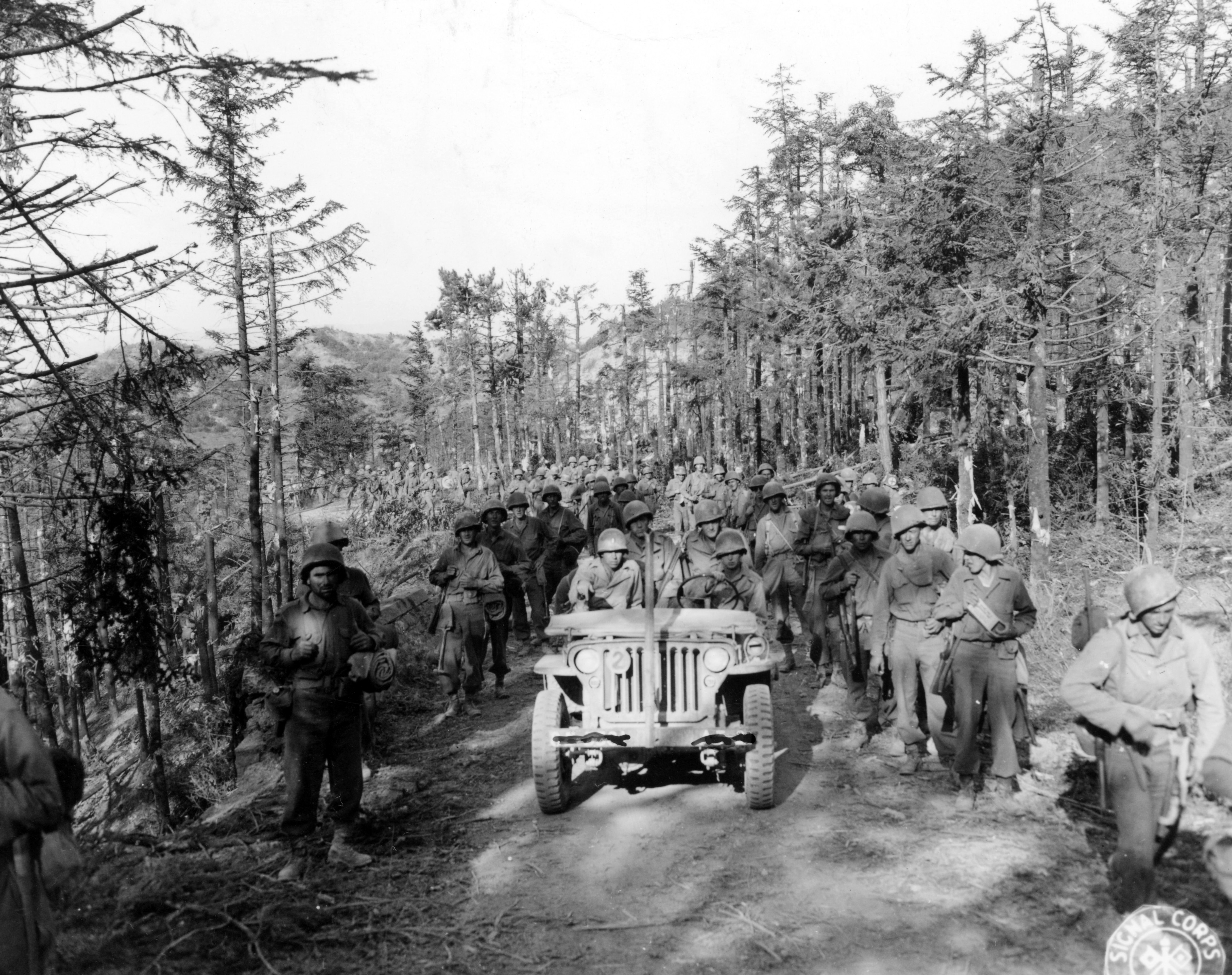
Troops of the 338th Infantry Regiment, 85th Infantry Division, march toward a newly won position in the Gothic Line on September 19, 1944.
Schmidt, 3131st Signal Service Company / U.S. Army Signal Corps / Signal Corps Archive (SC 195655) · Public domain · Original recordImage changes
Display copies resized; original downloaded JPEG preserved.
The words
Arno River
Lieutenant General Mark W. Clark’s Fifth Army reached the Arno in July 1944 and paused there for weeks to rest before the Gothic Line offensive. When the Germans pulled back, its IV Corps crossed almost unopposed on September 1, 1944.
Did you know?
To rest its divisions, Fifth Army handed a 10-mile (16 km) stretch of the Arno line to four antiaircraft battalions converted into infantry: Task Force 45. When the army crossed, they occupied the part of Pisa north of the river.
Fisher, Cassino to the Alps, ch. 16 (opens a new tab) · Fisher, Cassino to the Alps, ch. 17 (opens a new tab) · Fisher, Cassino to the Alps, ch. 18 (opens a new tab) · Mathews, Three Battles: Altuzzo, ch. 1 (opens a new tab)
Firenzuola
Reaching Firenzuola, a road junction 5 miles (8 km) beyond Il Giogo Pass, gave Fifth Army a second road toward the Po Valley, down the Santerno valley to Imola. After the breakthrough, the 88th Division was sent that way.
Did you know?
From fall 1943, two related Firenzuola families, the Matti and the Angeli, hid the five members of the Jewish Smulevich family until the Allies came in September 1944. In November 2021 four rescuers were honored as Righteous Among the Nations.
Fisher, Cassino to the Alps, ch. 17 (opens a new tab) · Fisher, Cassino to the Alps, ch. 18 (opens a new tab) · Fisher, Cassino to the Alps, ch. 20 (opens a new tab) · Gariwo: the Angeli and Matti families (opens a new tab) · La Nazione: Firenzuola's Righteous (2021) (opens a new tab)
Florence
The city on the Arno, on the Allied approach to the line.
Did you know?
As the Germans readied Florence’s bridges for demolition, they spared the Ponte Vecchio alone, “for its artistic value,” their Fourteenth Army’s war diary says. The US Army history notes art historians rank it below some of the bridges they destroyed.
Fisher, Cassino to the Alps, ch. 16 (opens a new tab) · Fisher, Cassino to the Alps, ch. 17 (opens a new tab) · Kay, Cassino to Trieste, ch. 4.VI (opens a new tab)
Futa Pass
The Florence–Bologna highway crossed the Apennines at the Futa Pass, the weakest natural point in Fifth Army’s zone, so the Germans built their strongest defenses there. Outflanked from Il Giogo Pass, it fell without heavy fighting on September 22, 1944.
Did you know?
To hold German eyes on the Futa Pass, the Americans massed armor and air strikes. The 34th Division’s holding attack pressed so hard, the US Army history says, that German commanders never divined the main effort was at Il Giogo.
Fisher, Cassino to the Alps, ch. 17 (opens a new tab) · Mathews, Three Battles: Altuzzo, ch. 1 (opens a new tab) · Fisher, Cassino to the Alps, ch. 18 (opens a new tab) · Fisher, Cassino to the Alps, ch. 19 (opens a new tab) · Mathews, Three Battles: Altuzzo, ch. 5 (opens a new tab)
German Army
In early September 1944, The Stars and Stripes announced that the German Army in Italy was finished. But on September 13, the Germans facing US II Corps showed they would not leave the Gothic Line without a struggle.
Did you know?
Not all of Germany’s army in Italy was German. The 162d Turkomen Division, in reserve near Rimini in August 1944, was made up of former Soviet prisoners of war from Turkestan, led by German officers and noncommissioned officers.
Fisher, Cassino to the Alps, ch. 17 (opens a new tab) · Mathews, Three Battles: Altuzzo, ch. 1 (opens a new tab) · Fisher, Cassino to the Alps, ch. 12 (opens a new tab)
Gothic
The Germans’ Gotenstellung, or Gothic Line, ran some 180 miles (290 km) in all along the Northern Apennines from Massa to Pesaro. On Hitler’s June 1944 order, Generalfeldmarschall (general of the army) Albert Kesselring renamed it the Green Line.
Did you know?
The name looked back to Italy’s past: the US Army history says it would evoke the Gothic kingdoms that Germanic tribes established in Italy.
Mathews, Three Battles: Altuzzo, ch. 1 (opens a new tab) · Fisher, Cassino to the Alps, ch. 12 (opens a new tab) · Fisher, Cassino to the Alps, ch. 17 (opens a new tab) · Fisher, Cassino to the Alps, ch. 13 (opens a new tab) · Fisher, Cassino to the Alps, ranks table (opens a new tab)
Green Line
Green Line was the name Generalfeldmarschall (general of the army) Albert Kesselring gave the Gothic Line on Hitler’s June 1944 order. If the Allies broke through, Hitler reasoned, they would seize on the grander name to magnify their victory claims.
Did you know?
The Allies never adopted the new name. The Germans also scouted a fallback switch position, Green Line II, about 8 to 10 miles (13–16 km) behind the line, but by late August 1944 little work had been done on it.
Mathews, Three Battles: Altuzzo, ch. 1 (opens a new tab) · Fisher, Cassino to the Alps, ch. 13 (opens a new tab) · Fisher, Cassino to the Alps, ch. 17 (opens a new tab) · Fisher, Cassino to the Alps, ranks table (opens a new tab)
Il Giogo Pass
British Intelligence told Lieutenant General Mark W. Clark that the boundary between the German Tenth and Fourteenth Armies, generally their weakest point, lay at Il Giogo Pass. So Fifth Army made its main effort there, not at the Futa Pass.
Did you know?
On September 12, 1944, Clark told officers of the 338th Infantry: “I’m going to throw you a long forward pass into the Po Valley, and I want you to go get it.”
Mathews, Three Battles: Altuzzo, ch. 1 (opens a new tab) · Fisher, Cassino to the Alps, ch. 19 (opens a new tab) · Fisher, Cassino to the Alps, ch. 18 (opens a new tab)
Lemelsen
General der Panzertruppe (lieutenant general) Joachim Lemelsen’s Fourteenth Army held Florence, then the Gothic Line’s Futa and Il Giogo passes. As fighting neared Florence in July 1944, the US Army history says, he once authorized “reprisal by executing twenty-six civilians.”
Did you know?
Lemelsen had led this puzzle’s Tenth Army before. When Generalfeldmarschall (general of the army) Albert Kesselring questioned Generaloberst (general) Heinrich von Vietinghoff’s handling of it, Vietinghoff took umbrage and requested sick leave, and Lemelsen commanded it from November 5 to December 28, 1943.
Fisher, Cassino to the Alps, ch. 18 (opens a new tab) · Fisher, Cassino to the Alps, ch. 19 (opens a new tab) · Fisher, Cassino to the Alps, ch. 17 (opens a new tab) · Fisher, Cassino to the Alps, ch. 12 (opens a new tab) · Fisher, Cassino to the Alps, ch. 16 (opens a new tab) · Blumenson, Salerno to Cassino, ch. 13 (opens a new tab) · Fisher, Cassino to the Alps, ch. 1 (opens a new tab) · Fisher, Cassino to the Alps, ranks table (opens a new tab) · Fisher, Cassino to the Alps, ch. 10 (opens a new tab)
Monte Altuzzo
Monte Altuzzo, the 3,037-foot (926 m) peak east of Il Giogo Pass, was the 85th Division’s main objective. It fell on September 18, 1944, after five days; the US Army’s 1952 history counts 290 casualties in the division’s 338th Infantry.
Did you know?
Of a Fifth Army of 262,000 troops, the Army historian Sidney T. Mathews reckoned, fewer than 1,000 men, one third of 1 percent, made the principal attack here. At the critical point, the assault force was sometimes a single platoon.
Mathews, Three Battles: Altuzzo, ch. 1 (opens a new tab) · Fisher, Cassino to the Alps, ch. 19 (opens a new tab) · Mathews, Three Battles: Altuzzo, ch. 5 (opens a new tab)
Monticelli
The Monticelli ridge, west of Il Giogo Pass, drew in all the 363d Infantry’s rifle companies. Captain William B. Fulton’s company reached the summit on September 17, 1944; Private First Class Oscar G. Johnson’s stand won the Medal of Honor.
Did you know?
On September 17, 1944, a German paratrooper commander on Monticelli came forward under a white flag to ask for a truce to evacuate both sides’ wounded. Before an answer came, two dozen of his men surrendered, and so did he.
Mathews, Three Battles: Altuzzo, ch. 1 (opens a new tab) · Fisher, Cassino to the Alps, ch. 19 (opens a new tab)
Paula Line
German Fourteenth Army meant to hold the Paula Line, in hills about 5 miles (8 km) south of Florence. In late July–early August 1944 New Zealanders and South Africans made the main assault, Canadian tanks supporting Indians on their left.
Did you know?
The Germans’ phase lines for withdrawing to the Arno had girls’ names, among them Irmgard, Karin, Maedchen, Nora, Olga and Paula. They were not connected defenses, New Zealand’s official history says, but “merely lines of withdrawal marked on the map.”
DND Canada, Advance to Florence honour (opens a new tab) · Kay, Cassino to Trieste, ch. 4.I (opens a new tab) · Kay, Cassino to Trieste, ch. 4.VI (opens a new tab)
Tenth Army
On August 25, 1944, Eighth Army struck Tenth Army’s Adriatic wing. Generalfeldmarschall (general of the army) Albert Kesselring shifted divisions there, one from the Fourteenth Army, leaving only the 4th Parachute Division to cover the Futa and Il Giogo passes.
Did you know?
On September 2, 1944, the Tenth Army’s chief of staff found its Adriatic wing in worse shape than headquarters realized. Unable to reach headquarters for approval, he sent a reserve division into a gap on his own authority.
Mathews, Three Battles: Altuzzo, ch. 1 (opens a new tab) · Fisher, Cassino to the Alps, ch. 17 (opens a new tab) · Fisher, Cassino to the Alps, ch. 18 (opens a new tab) · Fisher, Cassino to the Alps, ranks table (opens a new tab)
Vietinghoff
On August 26, 1944, Generaloberst (general) Heinrich von Vietinghoff judged Eighth Army’s Adriatic attack the long-awaited Allied offensive. Generalfeldmarschall (general of the army) Albert Kesselring waited until August 28 before letting him pull a corps back into the Gothic Line.
Did you know?
Inspecting the line in August 1944, Kesselring told Vietinghoff that the antitank ditches and wire, mostly built far in front of the main line, would have been worth more inside it, where they could surprise attackers.
Fisher, Cassino to the Alps, ch. 18 (opens a new tab) · Fisher, Cassino to the Alps, ch. 1 (opens a new tab) · Fisher, Cassino to the Alps, ch. 17 (opens a new tab) · Fisher, Cassino to the Alps, ranks table (opens a new tab)
Winter Line
In fall 1943 Fifth Army fought into “what was then somewhat vaguely called the German Winter Line south of Cassino”: the Barbara, Bernhard and Gustav lines. Generalfeldmarschall (general of the army) Albert Kesselring planned another stand on the Gothic Line.
Did you know?
In early November 1943, as Fifth Army’s Winter Line attacks neared stalemate, Major General John P. Lucas of VI Corps gave his verdict on the terrain in his diary: “Wars,” he wrote, “should be fought in better country than this.”
Blumenson, Salerno to Cassino, ch. 13 (opens a new tab) · Fisher, Cassino to the Alps, ch. 12 (opens a new tab) · Blumenson, Salerno to Cassino, ch. 10 (opens a new tab) · Fisher, Cassino to the Alps, ch. 1 (opens a new tab) · Fisher, Cassino to the Alps, ranks table (opens a new tab)
Sources
- Cassino to the Alps, Chapter XVI: Along the ArnoU.S. Army Center of Military History (HyperWar mirror, ibiblio.org)
- Cassino to the Alps, Chapter XVII: Planning for the OffensiveU.S. Army Center of Military History (HyperWar mirror, ibiblio.org)
- Cassino to the Alps, Chapter XVIII: The Gothic Line Offensive BeginsU.S. Army Center of Military History (HyperWar mirror, ibiblio.org)
- Cassino to the Alps, Chapter XIX: Battle for the PassU.S. Army Center of Military History (HyperWar mirror, ibiblio.org)
- Cassino to the Alps, Chapter XII: Interlude in RomeU.S. Army Center of Military History (HyperWar mirror, ibiblio.org)
- Cassino to the Alps, Chapter I: Spring in Italy--1944U.S. Army Center of Military History (HyperWar mirror, ibiblio.org)
- Three Battles: Arnaville, Altuzzo, and Schmidt. Break-Through at Monte Altuzzo: Developing the Gothic Line (10-13 September)U.S. Army Center of Military History (HyperWar mirror, ibiblio.org)
- Salerno to Cassino, Chapter XIII: Into the Winter LineU.S. Army Center of Military History (HyperWar mirror, ibiblio.org)
- Advance to Florence (WW2 battle honour)Government of Canada, Department of National Defence (Canada.ca)
- Cassino to the Alps, Chapter XIII: Pursuit North of RomeU.S. Army Center of Military History (HyperWar mirror, ibiblio.org)
- Cassino to the Alps, Chapter XX: A Diversionary OperationU.S. Army Center of Military History (HyperWar mirror, ibiblio.org)
- Three Battles: Arnaville, Altuzzo, and Schmidt. Break-Through at Monte Altuzzo: Counterattacks (17 September)U.S. Army Center of Military History (HyperWar mirror, ibiblio.org)
- Salerno to Cassino, Chapter X: Beyond SalernoU.S. Army Center of Military History (HyperWar mirror, ibiblio.org)
- Italy Volume II: From Cassino to Trieste, Chapter 4 (The Advance to Florence), I: A Change in PlanHistorical Publications Branch, Wellington (NZETC, Internet Archive copy)
- Italy Volume II: From Cassino to Trieste, Chapter 4 (The Advance to Florence), VI: Breaking the Paula LineHistorical Publications Branch, Wellington (NZETC, Internet Archive copy)
- Famiglia Angeli e Matti: quattro cittadini di Firenzuola che salvarono la famiglia Smulevich dai nazistiGariwo (Gardens of the Righteous Worldwide)
- Salvarono una famiglia di ebrei dai nazisti. Quattro firenzuolini Giusti fra le NazioniLa Nazione
- Cassino to the Alps, Appendix A: Table of Equivalent RanksU.S. Army Center of Military History (HyperWar mirror, ibiblio.org)
- Cassino to the Alps, Chapter X: Breaking the StalemateU.S. Army Center of Military History (HyperWar Foundation transcription)