
World War II
Puzzle 35 · Anzio to the Gothic Line · Page 56 in print
Truscott to Rome
VI Corps entered Rome on 4 June 1944, making it the first Axis capital captured by the Allies.
Jump to a word
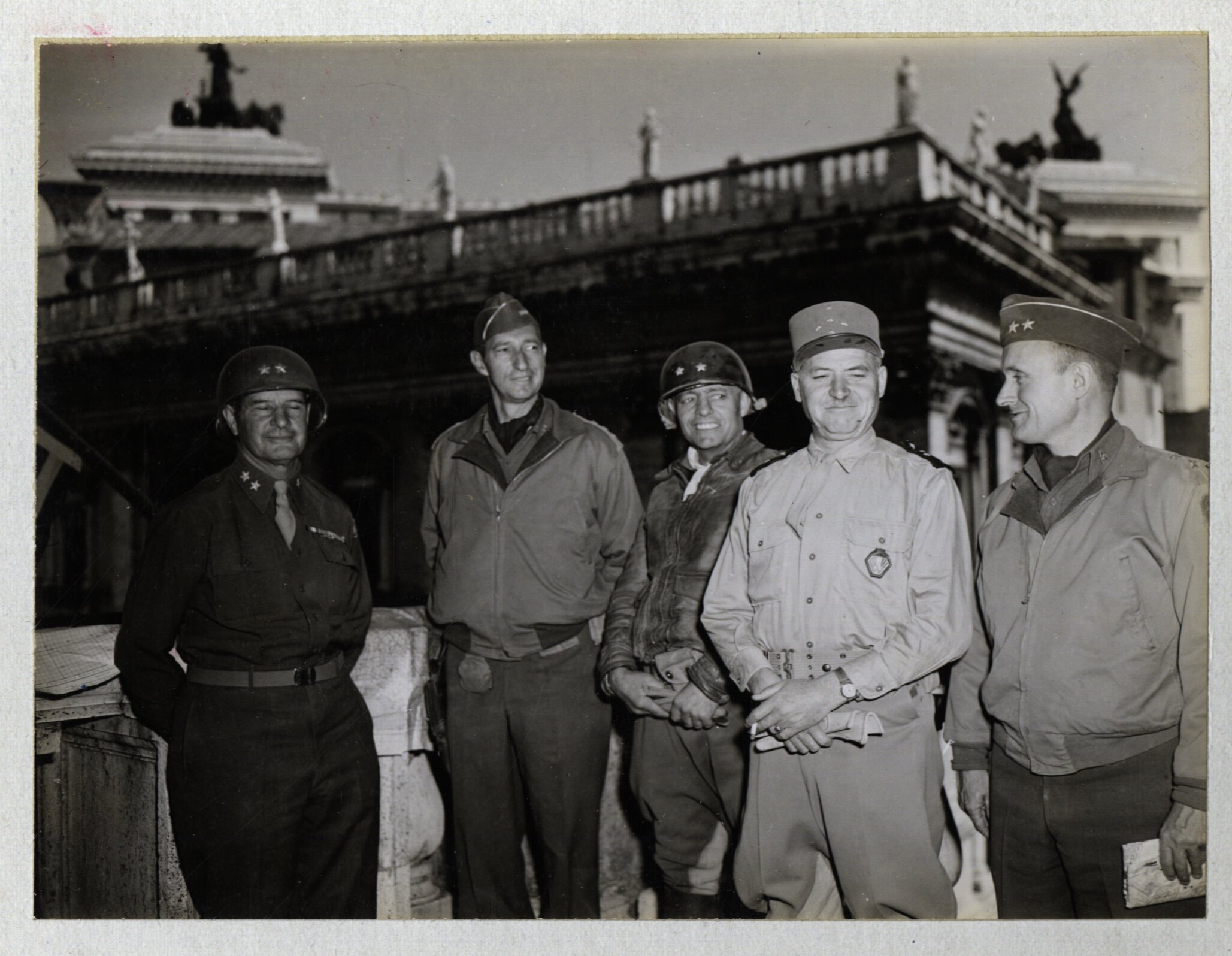
Geoffrey Keyes, Mark Clark, Lucian Truscott, Alphonse Juin and Alfred Gruenther at Rome City Hall on June 5, 1944.
U.S. Fifth Army / National Archives · Public domain · Original recordImage changes
Display copies resized; original downloaded JPEG preserved.
The words
Alexander
General Sir Harold Alexander, the Allied ground commander in Italy, declared a drive on Valmontone the only plan likely to produce “worthwhile results.” Lieutenant General Mark W. Clark’s turn toward Rome reached him as a fait accompli.
Did you know?
Prime Minister Winston Churchill cabled him on May 28, 1944: “it is the cop that counts,” cop being schoolboy slang for a catch. On June 4, Alexander reported there was not much doubt “that we have got a fair cop.”
Fisher, Cassino to the Alps, ch. 1 (opens a new tab) · Fisher, Cassino to the Alps, ch. 6 (opens a new tab) · Fisher, Cassino to the Alps, ch. 9 (opens a new tab) · Fisher, Cassino to the Alps, ch. 11 (opens a new tab)
Axis Retreat
Late on June 2, 1944, Germany’s Tenth Army was ordered to disengage and retreat through the mountains east of Rome. Next day the High Command let Generalfeldmarschall (general of the army) Albert Kesselring withdraw the Fourteenth Army beyond the Tiber.
Did you know?
Clark had his corps form mobile task forces to dash into Rome and seize the Tiber bridges before the Germans could destroy them. He need not have worried: Hitler had ordered the bridges left intact as his troops withdrew.
Fisher, Cassino to the Alps, ch. 11 (opens a new tab) · WWII Museum, Liberation of Rome 1944 (opens a new tab) · Fisher, Cassino to the Alps, ch. 10 (opens a new tab) · Fisher, Cassino to the Alps, ch. 1 (opens a new tab) · Fisher, Cassino to the Alps, ranks table (opens a new tab)
Buffalo
Operation Buffalo, VI Corps’ breakout from Anzio, began at 6:30 a.m. on May 23, 1944. It aimed northeast through Cisterna, Cori and Artena to Valmontone, to block Highway 6 and cut off the German Tenth Army’s right wing.
Did you know?
Buffalo had company. VI Corps drew up four breakout plans, Grasshopper, Buffalo, Turtle and Crawdad, and kept Turtle, a drive straight toward Rome, up to date in case the Germans shifted strength from the Alban Hills.
Fisher, Cassino to the Alps, ch. 6 (opens a new tab) · Anzio Beachhead, The Breakthrough (opens a new tab) · Fisher, Cassino to the Alps, ch. 9 (opens a new tab)
Caesar C Line
Begun in April 1944, the Caesar Line was finished only from the coast north of Anzio to Highway 6; farther east it was “a penciled line.” West of the Alban Hills, VI Corps gained little from May 26, 1944.
Did you know?
The “C” came first. German records call it the C-Stellung, or C-Position; Allied staffs simply assumed the C stood for Caesar, “a logical deduction considering its location,” says the US Army history.
Fisher, Cassino to the Alps, ch. 8 (opens a new tab) · WWII Museum, Liberation of Rome 1944 (opens a new tab) · Fisher, Cassino to the Alps, ch. 10 (opens a new tab) · Fisher, Cassino to the Alps, ch. 9 (opens a new tab)
Frosinone
The Highway 6 road junction southeast of Rome that Canadian infantry entered on May 31, 1944.
Did you know?
On the road to Frosinone, a 120-foot (37 m) bridge near Ceprano collapsed on May 28, 1944, just as engineers were about to declare it ready. The 5th Canadian Armoured Division waited a day for a new one.
Fisher, Cassino to the Alps, ch. 10 (opens a new tab) · Veterans Affairs Canada, Liri Valley (opens a new tab) · Fisher, Cassino to the Alps, ch. 9 (opens a new tab)
Highway Six
Highway 6 was the German Tenth Army’s “main supply route” and Buffalo’s target. Alexander wanted it kept clear for Eighth Army’s Canadians, then at the end of May 1944 gave Fifth Army sole use from Valmontone to Rome.
Did you know?
Fuel followed the troops up the highway. By June 5, 1944, US engineers had laid a 6-inch (15 cm) pipeline along Highway 6 at 2 miles (3 km) a day, reaching Ceprano, 54 miles (87 km) from Rome.
Fisher, Cassino to the Alps, ch. 6 (opens a new tab) · Anzio Beachhead, The Breakthrough (opens a new tab) · Fisher, Cassino to the Alps, ch. 9 (opens a new tab) · Fisher, Cassino to the Alps, ch. 10 (opens a new tab) · Fisher, Cassino to the Alps, ch. 12 (opens a new tab)
Liberated
Rome was liberated over two days. Fifth Army troops fought their way in on June 4, 1944, and on June 5, the US Army history says, Romans gave the columns a “tumultuous, almost hysterical welcome.”
Did you know?
The men who actually captured Rome, says the US Army history, “passed through in darkness and near silence.” The 36th Division’s commander, Major General Fred L. Walker, wrote in his diary of Romans at the windows “clapping their hands.”
Fisher, Cassino to the Alps, ch. 12 (opens a new tab) · WWII Museum, Liberation of Rome 1944 (opens a new tab) · Fisher, Cassino to the Alps, ch. 11 (opens a new tab) · Fisher, Cassino to the Alps, ch. 6 (opens a new tab)
Mark Clark
On May 25, 1944, Fifth Army’s Lieutenant General Mark W. Clark turned most of VI Corps from Valmontone toward Rome, a long-debated choice. Alexander later could “only assume” the “lure of Rome” swayed him; Clark doubted any trap would work.
Did you know?
The day before his order, on May 24, 1944, Clark asked his VI Corps commander, Major General Lucian K. Truscott Jr., “Have you considered changing the direction of your attack to the northwest—toward Rome?”
Fisher, Cassino to the Alps, ch. 9 (opens a new tab) · WWII Museum, Liberation of Rome 1944 (opens a new tab) · Fisher, Cassino to the Alps, ch. 11 (opens a new tab) · Fisher, Cassino to the Alps, ch. 1 (opens a new tab) · Fisher, Cassino to the Alps, ch. 6 (opens a new tab) · Fisher, Cassino to the Alps, ch. 2 (opens a new tab)
Occupation
German troops held Rome for nine months from September 1943. On October 16, 1943, the SS began rounding up Rome’s Jews; the US Holocaust Memorial Museum says more than 1,000 were deported to the Auschwitz-Birkenau killing center.
Did you know?
King Victor Emmanuel III fled Rome in September 1943. He wanted to return as king, but the Allies held him to his promise: on June 5, 1944, far from Rome, he signed his royal powers over to the crown prince.
Fisher, Cassino to the Alps, ch. 1 (opens a new tab) · Fisher, Cassino to the Alps, ch. 12 (opens a new tab) · USHMM Holocaust Encyclopedia: Rome (opens a new tab) · Primo Levi Center: Rome roundup, 1943 (opens a new tab)
Open City
In wartime, a city declared demilitarized and left undefended, open to occupation, to spare it under international law from attack.
Italy declared Rome an open city on August 14, 1943. The US Army history says President Franklin D. Roosevelt’s April 1944 reply left its status “still in doubt,” and calls the Germans’ declaration of June 3, 1944, an “anticipatory surrender.”
Did you know?
Roberto Rossellini began shooting his film Rome, Open City on the capital’s streets just months after its liberation. In 1946 it shared the Grand Prix, forerunner of the Palme d’Or, at the first Cannes festival.
Fisher, Cassino to the Alps, ch. 11 (opens a new tab) · WWII Museum, Liberation of Rome 1944 (opens a new tab) · FRUS 1943, vol. II, doc. 833 (opens a new tab) · Dictionary.com: open city (opens a new tab) · BFI: Rome, Open City (opens a new tab) · Festival de Cannes: Italian cinema 1946–59 (opens a new tab)
Partisans
The US Holocaust Memorial Museum says a resistance bomb in Rome’s Via Rasella on March 23, 1944, eventually killed 42 policemen of a German unit. Next day, in reprisal, the Germans killed 335 “Italian male civilians” at the Ardeatine Caves.
Did you know?
On June 4, 1944, local partisans led a Fifth Army rifle company around a German tank through a nearby convent. Next day the Allied military governor found the city run by an arm of Rome’s Committee of National Liberation.
USHMM: Ardeatine Caves Massacre (opens a new tab) · Fisher, Cassino to the Alps, ch. 11 (opens a new tab) · Fisher, Cassino to the Alps, ch. 12 (opens a new tab)
Rome
II and VI Corps raced for Rome in what the US Army history calls an “intra-army contest.” A II Corps patrol entered at daybreak on June 4, 1944, but withdrew; VI Corps armor reached the inner city by 6 p.m.
Did you know?
Clark later wrote that Fifth Army meant “to become the first army in fifteen centuries to seize Rome from the south.”
WWII Museum, Liberation of Rome 1944 (opens a new tab) · Fisher, Cassino to the Alps, ch. 11 (opens a new tab) · Fisher, Cassino to the Alps, ch. 10 (opens a new tab) · Fisher, Cassino to the Alps, ch. 6 (opens a new tab)
Truscott
Major General Lucian K. Truscott Jr. led VI Corps out of Anzio on May 23, 1944. Ordered two days later to turn toward Rome, he “was dumbfounded” and thought it wrong, the US Army history says, but obeyed wholeheartedly.
Did you know?
By daylight on June 5, 1944, the 1st Armored Division had crossed Rome to its western edge. “Push on to Genoa, if you want to,” Truscott radioed its commander, Major General Ernest N. Harmon.
Fisher, Cassino to the Alps, ch. 2 (opens a new tab) · Fisher, Cassino to the Alps, ch. 6 (opens a new tab) · Fisher, Cassino to the Alps, ch. 9 (opens a new tab) · Fisher, Cassino to the Alps, ch. 11 (opens a new tab)
Valmontone
US troops entered Valmontone, Buffalo’s goal, on June 2, 1944. The US Army history says the Germans escaped by other roads, but suggests a timely Highway 6 block and brisker Eighth Army pursuit would have made it “far more costly.”
Did you know?
After Clark’s turn, Generalfeldmarschall (general of the army) Albert Kesselring still took the Valmontone drive for the main American effort. Only on May 29, 1944, after radio intercepts and front-line reports placed the US 1st Armored Division near Lanuvio, did he conclude otherwise.
Fisher, Cassino to the Alps, ch. 6 (opens a new tab) · Fisher, Cassino to the Alps, ch. 8 (opens a new tab) · Fisher, Cassino to the Alps, ch. 10 (opens a new tab) · Fisher, Cassino to the Alps, ch. 9 (opens a new tab) · Fisher, Cassino to the Alps, ch. 11 (opens a new tab) · Fisher, Cassino to the Alps, ch. 1 (opens a new tab) · Fisher, Cassino to the Alps, ranks table (opens a new tab)
Via Casilina
In the Liri valley, the US Army history says, the Roman-built road “hugs the valley’s northern wall”; in 1944 few other roads there could carry modern military traffic. On June 4, 1944, it carried Fifth Army troops into Rome.
Did you know?
The road is older than its name. Romans called its first stretch the Via Labicana; only in the Middle Ages, Italy’s tourism portal says, did the route become the Via Casilina, after Casilinum, the river port of modern Capua.
Fisher, Cassino to the Alps, ch. 2 (opens a new tab) · WWII Museum, Liberation of Rome 1944 (opens a new tab) · Fisher, Cassino to the Alps, ch. 11 (opens a new tab) · Italia.it: Via Casilina (opens a new tab) · Wikipedia: Via Casilina (opens a new tab)
Sources
- Cassino to the Alps, Chapter I: Spring in Italy--1944U.S. Army Center of Military History (HyperWar Foundation transcription)
- Cassino to the Alps, Chapter II: Preparing for a New OffensiveU.S. Army Center of Military History (HyperWar Foundation transcription)
- Cassino to the Alps, Chapter VI: The Anzio BeachheadU.S. Army Center of Military History (HyperWar Foundation transcription)
- Cassino to the Alps, Chapter VIII: Breakout From the BeachheadU.S. Army Center of Military History (HyperWar Foundation transcription)
- Cassino to the Alps, Chapter IX: Stalemate Along the Caesar LineU.S. Army Center of Military History (HyperWar Foundation transcription)
- Cassino to the Alps, Chapter X: Breaking the StalemateU.S. Army Center of Military History (HyperWar Foundation transcription)
- Cassino to the Alps, Chapter XI: The Fall of RomeU.S. Army Center of Military History (HyperWar Foundation transcription)
- Cassino to the Alps, Chapter XII: Interlude in RomeU.S. Army Center of Military History (HyperWar Foundation transcription)
- Anzio Beachhead (American Forces in Action): The BreakthroughU.S. War Department Historical Division (HyperWar Foundation transcription)
- 'Rome Taken!': The Liberation of Rome, 1944The National WWII Museum (article by Michael S. Bell, June 4, 2025)
- Backgrounder: The Battle of the Liri ValleyVeterans Affairs Canada
- RomeUnited States Holocaust Memorial Museum, Holocaust Encyclopedia
- The Decision-Making Process of the Roundup of the Jews of Rome, October 16, 1943Centro Primo Levi, New York (summary of Liliana Picciotto, Yad Vashem Studies, vol. 48, 2020), October 15, 2021
- Ardeatine Caves MassacreUnited States Holocaust Memorial Museum, Holocaust Encyclopedia
- Foreign Relations of the United States, Diplomatic Papers, 1943, Europe, Volume II, Document 833: The Apostolic Delegate at Washington (Cicognani) to the Under Secretary of State (Welles), August 16, 1943U.S. Department of State, Office of the Historian
- OPEN CITY Definition & MeaningDictionary.com (Dictionary.com Unabridged, based on the Random House Unabridged Dictionary)
- Rome, Open City: Roberto Rossellini’s great leap for realism on screenBritish Film Institute (BFI), May 15, 2024
- Italian Cinema at Cannes 1946-1959 (1/3)Festival de Cannes
- Via Casilina - Italia.itItalia.it (Italian Ministry of Tourism)
- Via CasilinaWikipedia
- Cassino to the Alps, Appendix A: Table of Equivalent RanksU.S. Army Center of Military History (HyperWar mirror, ibiblio.org)