
World War II
Puzzle 34 · Anzio to the Gothic Line · Page 55 in print
Operation Diadem
Operation Diadem broke the Gustav Line in May 1944.
Jump to a word
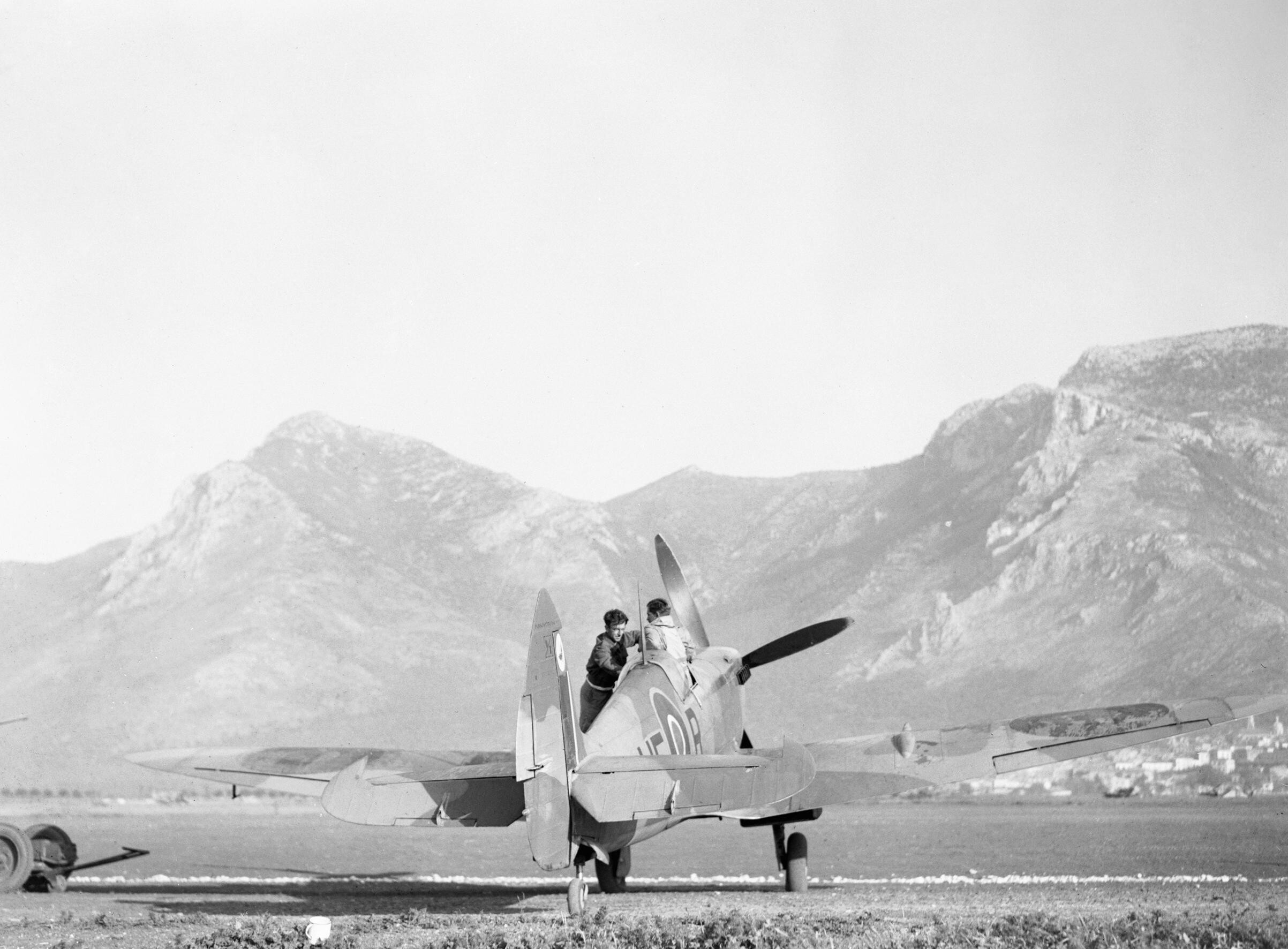
A ground crewman helps an RAF pilot into a Spitfire at Venafro before a sweep supporting Operation Diadem in May 1944.
G. Woodbine, RAF official photographer / Imperial War Museums (CNA 2829) · Public domain · Original recordImage changes
Display copies resized; original downloaded JPEG preserved.
The words
Albaneta
A farm on the Cassino massif that was a first objective of the Polish Corps’ May 1944 attack.
Did you know?
On March 19, 1944, an “armoured hook” of New Zealand Shermans and Honey tanks from Indian and American units climbed Cavendish Road and pushed past Albaneta toward the abbey, but with no infantry it was recalled.
Kay, Cassino to Trieste, ch. 1.III (opens a new tab) · IPN, Monte Cassino anniversary (opens a new tab) · Phillips, Sangro to Cassino, ch. 13.III (opens a new tab)
Aquino
A Liri valley town forming a Hitler Line strongpoint between Piedimonte and Pontecorvo.
Did you know?
Thomas Aquinas, the medieval philosopher, was born near Aquino around 1225. As a child he studied at the monastery of Monte Cassino, where his parents hoped he would one day play a leading role.
Fisher, Cassino to the Alps, ch. 2 (opens a new tab) · Kay, Cassino to Trieste, ch. 1.IV (opens a new tab) · Fisher, Cassino to the Alps, ch. 4 (opens a new tab) · Stanford Encyclopedia: Thomas Aquinas (opens a new tab)
Diadem
Operation Diadem opened an hour before midnight on May 11, 1944, when 1,660 Allied guns fired along a 25-mile (40 km) front from Cassino to the sea, and both Allied armies attacked within the hour.
Did you know?
When Diadem struck, the German Tenth Army’s commander, Generaloberst (general) Heinrich von Vietinghoff, had left for Germany to receive a decoration from Hitler, and a key corps commander was on home leave: “an extraordinary situation,” says the US Army history.
Fisher, Cassino to the Alps, ch. 1 (opens a new tab) · Fisher, Cassino to the Alps, ch. 2 (opens a new tab) · Fisher, Cassino to the Alps, ch. 3 (opens a new tab) · Kay, Cassino to Trieste, ch. 1.I (opens a new tab) · Fisher, Cassino to the Alps, ranks table (opens a new tab)
French Corps
General Alphonse Juin’s French Expeditionary Corps, 99,000 strong by early May, attacked through the mountains south of the Liri. Its Moroccans breached the Gustav Line at Monte Majo on May 13, 1944.
Did you know?
In the late afternoon of May 13, 1944, a battalion on Monte Majo raised a French tricolor on an improvised flagstaff, large enough, the US Army history says, to be seen from Monte Cassino to the Tyrrhenian Sea.
Fisher, Cassino to the Alps, ch. 5 (opens a new tab) · Fisher, Cassino to the Alps, ch. 2 (opens a new tab) · Fisher, Cassino to the Alps, ch. 3 (opens a new tab)
Gari River
South of Cassino, British 13 Corps made Diadem’s main river assault across the swift Gari on the night of May 11, 1944. Many assault boats capsized, but 8th Indian Division bridged it south of Sant’Angelo.
Did you know?
Canadian Captain Tony Kingsmill had a 100-foot (30 m) Bailey bridge carried by one Sherman tank and pushed by another. On May 12, 1944, the carrier tank sank in the Gari, though less deeply than expected, and the bridge was in place.
Fisher, Cassino to the Alps, ch. 2 (opens a new tab) · Kay, Cassino to Trieste, ch. 1.III (opens a new tab) · Fisher, Cassino to the Alps, ch. 3 (opens a new tab) · Military Museums: Kingsmill Bridge (opens a new tab) · CMEA: Capt. Tony Kingsmill, MC (opens a new tab) · Wikipedia: Gari (river) (opens a new tab)
Goumiers
Soldiers of a goum (Maghrebi Arabic for “tribe”), a company of about 200 Moroccan irregulars under French officers, usually Atlas Mountain Berbers.
Juin’s Goumiers fought through the Aurunci Mountains in May 1944. Italy’s Il Sole 24 Ore newspaper says French colonial troops, “particularly the Goumiers,” committed the mass rapes of Italian civilians that followed, remembered as the “marocchinate.”
Did you know?
A Tabor, the Goumiers’ unit somewhat larger than a battalion, usually had about 65 French officers and NCOs, 859 Moroccan NCOs and men, and 247 horses and mules.
Fisher, Cassino to the Alps, ch. 2 (opens a new tab) · Kay, Cassino to Trieste, ch. 1.I (opens a new tab) · Fisher, Cassino to the Alps, ch. 3 (opens a new tab) · Treccani: Goum (opens a new tab) · Il Sole 24 Ore: war-rape remembrance bill (opens a new tab) · Larousse: goum (opens a new tab) · Wikipedia: Moroccan Goumier (opens a new tab) · Kay, Cassino to Trieste, ch. 1.III (opens a new tab) · Avvenire: 2018 Ciociaria war-rape inquiry (opens a new tab)
Hangman's Hill
Point 435 below the abbey, seized and held by Gurkhas in the March 1944 battle until withdrawn.
Did you know?
To keep the withdrawal secret, the order went by word of mouth. On the night of March 23–24, 1944, three volunteer officers set out separately across the hillside, each with a carrier pigeon to report success. Two got through.
Phillips, Sangro to Cassino, ch. 12.II (opens a new tab) · Phillips, Sangro to Cassino, ch. 14.IV (opens a new tab)
Hitler Line
Known to the Allies as the Hitler Line, this second German defense line ran 5 to 10 miles (8–16 km) behind the Gustav Line. Canadian troops broke it near Pontecorvo on May 23, 1944.
Did you know?
Its first German name, Führer Riegel, used the military word for a “switch position” (literally, a door bar). After the Anzio landing of January 1944, Hitler had it renamed the Senger Line, for General der Panzertruppe (lieutenant general) Fridolin von Senger und Etterlin.
Fisher, Cassino to the Alps, ch. 2 (opens a new tab) · Kay, Cassino to Trieste, ch. 1.I (opens a new tab) · Fisher, Cassino to the Alps, ch. 1 (opens a new tab) · Fisher, Cassino to the Alps, ch. 5 (opens a new tab) · Kay, Cassino to Trieste, ch. 1.V (opens a new tab) · Lexikon der Wehrmacht: Senger und Etterlin (opens a new tab) · Neue Deutsche Biographie: Senger (opens a new tab) · Fisher, Cassino to the Alps, ranks table (opens a new tab)
Liri Valley
Eighth Army made Diadem’s main thrust up the Liri valley, the only ground in the Allied sector where its superiority in artillery, armor and aircraft counted most, and “the shortest and best road” to Rome.
Did you know?
Allied staff officers had a name for the neck of land between the Gari and the Liri, just before the rivers meet about 6 miles (10 km) south of Cassino to form the Garigliano: the Liri “appendix.”
Fisher, Cassino to the Alps, ch. 2 (opens a new tab) · Fisher, Cassino to the Alps, ch. 3 (opens a new tab)
Monte Cassino
The Germans slipped away overnight, and at 10:20 a.m. on May 18, 1944, a Polish lancer patrol raised its standard over the abbey ruins, ending the fourth battle for the height since January.
Did you know?
Within minutes of the German order to abandon Cassino going out by radio on the night of May 17, 1944, British Intelligence had deciphered it and passed the news to Churchill, Alexander and the US Chiefs of Staff.
Fisher, Cassino to the Alps, ch. 4 (opens a new tab) · Kay, Cassino to Trieste, ch. 1.IV (opens a new tab) · IPN, Monte Cassino anniversary (opens a new tab)
New Zealand
After failing at Cassino, the New Zealand Corps was disbanded on March 26, 1944. In Diadem, the 2nd New Zealand Division, in 10 Corps, held Eighth Army’s mountain sector, its guns supporting the Polish attacks.
Did you know?
New Zealanders cut off below Hangman’s Hill lived on air drops. On March 24, 1944, one brought sardines, tea, cigarettes and “eight gallons of rum” (about 36 liters), but as they began collecting it, word came to withdraw.
Kay, Cassino to Trieste, ch. 1.I (opens a new tab) · Fisher, Cassino to the Alps, ch. 2 (opens a new tab) · Kay, Cassino to Trieste, ch. 1.IV (opens a new tab) · Phillips, Sangro to Cassino, ch. 14.IV (opens a new tab)
Piedimonte
Piedimonte San Germano, a hill town about 4 miles (6 km) west of Cassino, anchored the Hitler Line’s northern end. German paratroopers held it against Polish attacks until they withdrew around May 25, 1944.
Did you know?
The name describes the place: Piedimonte sits at the foot of Monte Cairo, and San Germano was the old name of Cassino itself until 1863.
Fisher, Cassino to the Alps, ch. 2 (opens a new tab) · Kay, Cassino to Trieste, ch. 1.V (opens a new tab) · Fisher, Cassino to the Alps, ch. 5 (opens a new tab) · Wikipedia (Italian): Piedimonte San Germano (opens a new tab) · Store norske leksikon: Cassino (opens a new tab)
Polish Corps
Lieutenant General Władysław Anders’s 2nd Polish Corps attacked the Cassino heights on May 12 and 17, 1944. Poland’s Institute of National Remembrance counts 923 killed, 2,931 wounded and 345 missing in 13 days and 20 hours of fighting.
Did you know?
At noon on May 18, 1944, a Polish bugler, Emil Czech, played the Hejnał over the ruins: the call a trumpeter sounds every hour from the highest tower of St. Mary’s Church in Kraków.
Fisher, Cassino to the Alps, ch. 3 (opens a new tab) · Fisher, Cassino to the Alps, ch. 2 (opens a new tab) · Kay, Cassino to Trieste, ch. 1.III (opens a new tab) · Fisher, Cassino to the Alps, ch. 4 (opens a new tab) · IPN, Monte Cassino anniversary (opens a new tab) · Wikipedia: St. Mary's Trumpet Call (opens a new tab)
Rapido River
With steep banks and a swift current, the Rapido at Cassino was a formidable obstacle on the Gustav Line. Along its west bank the Germans added wire, minefields, pillboxes and concrete emplacements.
Did you know?
Strictly, the river south of Cassino is the Gari, as New Zealand’s official history calls it. The US Army’s history names it the Gari in one chapter, then puts the May 1944 crossing on the Rapido in the next.
Fisher, Cassino to the Alps, ch. 2 (opens a new tab) · Fisher, Cassino to the Alps, ch. 3 (opens a new tab) · Kay, Cassino to Trieste, ch. 1.III (opens a new tab) · Wikipedia: Rapido (river) (opens a new tab) · Wikipedia: Gari (river) (opens a new tab)
South African
The 6th South African Armoured Division began Diadem in Eighth Army reserve. Its 12th Motor Brigade, serving with the New Zealanders, faked an attack on the Cassino–Atina road on May 14, 1944.
Did you know?
South Africans who volunteered to serve beyond their country’s borders wore red tabs, or the “orange flash,” on their shoulders. Isie Smuts, wife of Prime Minister Jan Smuts, known as Ouma (“Grandmother”), called them the “anywhere boys.”
Fisher, Cassino to the Alps, ch. 2 (opens a new tab) · Kay, Cassino to Trieste, ch. 1.I (opens a new tab) · Kay, Cassino to Trieste, ch. 1.III (opens a new tab) · DSAE: red tab (opens a new tab) · Wikipedia: Isie Smuts (opens a new tab)
Sources
- Cassino to the Alps, Chapter I: Spring in Italy--1944U.S. Army Center of Military History (HyperWar mirror)
- Cassino to the Alps, Chapter II: Preparing for a New OffensiveU.S. Army Center of Military History (HyperWar mirror)
- Cassino to the Alps, Chapter III: DIADEM's First Day--11 MayU.S. Army Center of Military History (HyperWar mirror)
- Cassino to the Alps, Chapter IV: Collapse of the Gustav LineU.S. Army Center of Military History (HyperWar mirror)
- Cassino to the Alps, Chapter V: Breakthrough on the Southern FrontU.S. Army Center of Military History (HyperWar mirror)
- Italy Volume II: From Cassino to Trieste, Chapter 1 (The Battle for Rome), I: The Armies RegroupHistorical Publications Branch, Wellington (NZETC, Internet Archive copy)
- Italy Volume II: From Cassino to Trieste, Chapter 1, III: The Destruction of the Gustav LineHistorical Publications Branch, Wellington (NZETC, Internet Archive copy)
- Italy Volume II: From Cassino to Trieste, Chapter 1, IV: The Capture of CassinoHistorical Publications Branch, Wellington (NZETC, Internet Archive copy)
- Italy Volume II: From Cassino to Trieste, Chapter 1, V: The Breaking of the Hitler LineHistorical Publications Branch, Wellington (NZETC, Internet Archive copy)
- Italy Volume I: The Sangro to Cassino, Chapter 12 (The March Attack: Break-in), II: 16 MarchHistorical Publications Branch, Wellington (NZETC, Internet Archive copy)
- Italy Volume I: The Sangro to Cassino, Chapter 14 (The March Attack: Deadlock), IV: 23–26 MarchHistorical Publications Branch, Wellington (NZETC, Internet Archive copy)
- Celebrations of the 81st anniversary of the Battle of Monte Cassino in Italy — 18 May 2025Institute of National Remembrance (IPN), Poland
- Italy Volume I: The Sangro to Cassino, Chapter 13, III: 19 MarchHistorical Publications Branch, Wellington (NZETC, Internet Archive copy)
- War Rape, a day to remember the victims of the Second World WarIl Sole 24 Ore
- Définitions : goum - Dictionnaire de français LarousseLarousse
- Moroccan GoumierWikipedia
- Dopo 75 anni aperta inchiesta sugli stupri di guerra in CiociariaAvvenire
- GoumTreccani (Istituto della Enciclopedia Italiana)
- 107 Kingsmill BridgeThe Military Museums, Calgary (Mural of Honour)
- Capt Tony Kingshill, MC, RCEMECanadian Military Engineers Association
- Gari (river)Wikipedia
- Rapido (river)Wikipedia
- Thomas AquinasStanford Encyclopedia of Philosophy
- St. Mary's Trumpet CallWikipedia
- red tab, noun phraseDictionary of South African English (Dictionary Unit for South African English)
- Isie SmutsWikipedia
- Piedimonte San GermanoWikipedia (Italian)
- CassinoStore norske leksikon
- Cassino to the Alps, Appendix A: Table of Equivalent RanksU.S. Army Center of Military History (HyperWar mirror, ibiblio.org)
- Fridolin von Senger und EtterlinLexikon der Wehrmacht
- Senger und Etterlin, Fridolin vonNeue Deutsche Biographie 24 (2010), Deutsche Biographie online