
World War II
Puzzle 33 · Anzio to the Gothic Line · Page 54 in print
Cisterna Breakout
Truscott’s VI Corps launched its final assault on Cisterna on 23 May 1944.
Jump to a word
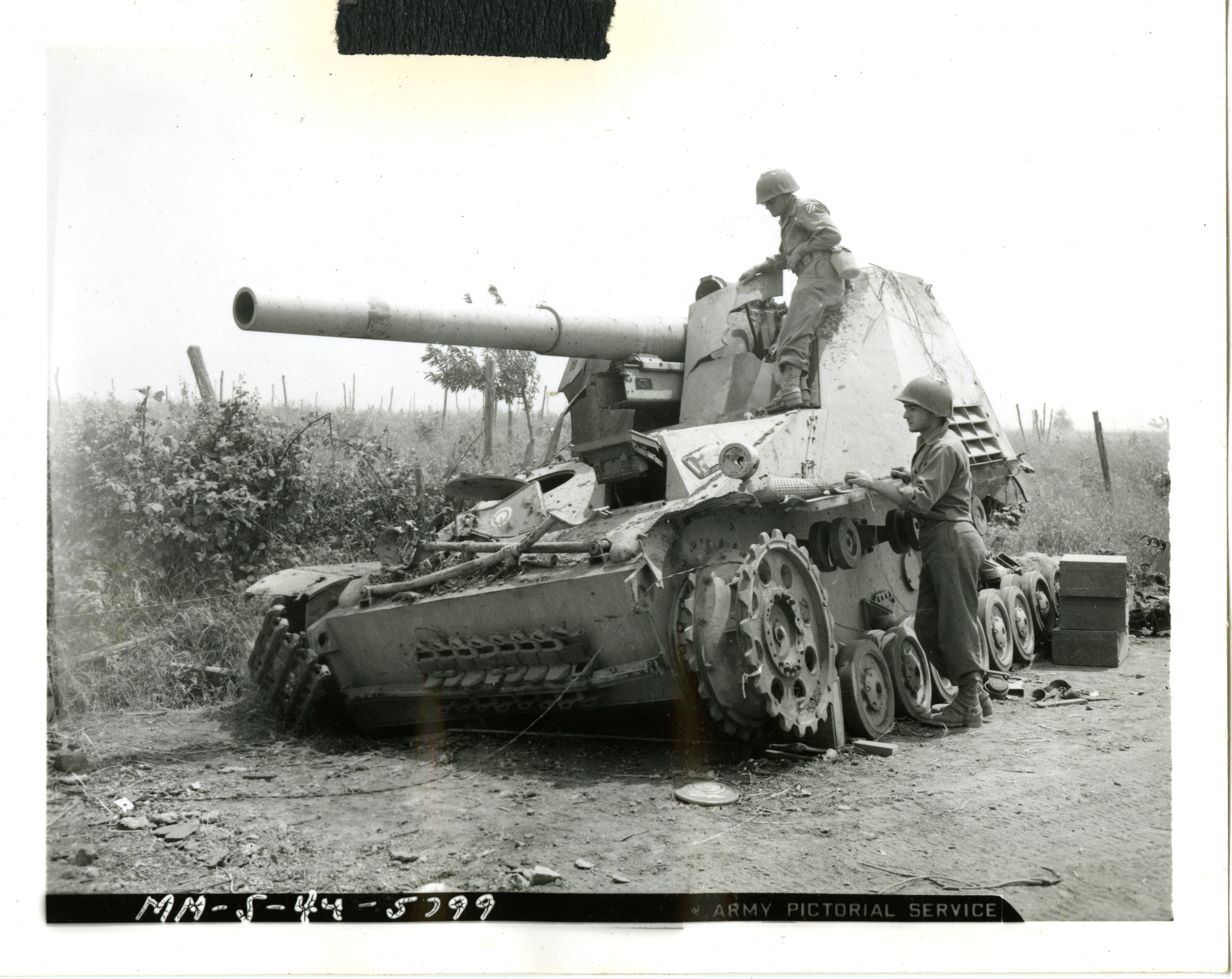
American soldiers inspect a knocked-out German self-propelled gun near Cisterna on May 29, 1944.
U.S. Army Signal Corps / Signal Corps Archive · Public domain · Original recordImage changes
Display copies resized; original downloaded JPEG preserved.
The words
Breakout
At 7:31 a.m. on May 25, 1944, engineers pushing south from the beachhead met II Corps troops racing north from Terracina across the Pontine Marshes. “Anzio was a beachhead no longer,” the Army’s Anzio study says.
Did you know?
On May 22, 1944, the eve of the breakout, troops spent what the US Army history calls “a lovely spring day that invited lounging in the sunshine” crouched in dugouts, ruined farmhouses and groves, hidden from German observers.
Fisher, Cassino to the Alps, ch. 8 (opens a new tab) · Fisher, Cassino to the Alps, ch. 6 (opens a new tab) · Anzio Beachhead, The Breakthrough (opens a new tab)
Breakthrough
On May 23, 1944, 1st Armored Division tanks pierced the German line to a depth of almost a mile (1.6 km). Next day they split the German 362d Infantry Division’s front, leaving Cisterna almost isolated.
Did you know?
Engineers’ “Snakes,” 400-foot (120 m) steel pipes filled with explosive, were pushed into minefields by tanks and set off with machine-gun fire. On May 23, 1944, they blasted two gaps 25 feet (8 m) wide into the German defenses.
Anzio Beachhead, The Breakthrough (opens a new tab) · Fisher, Cassino to the Alps, ch. 7 (opens a new tab) · Fisher, Cassino to the Alps, ch. 8 (opens a new tab)
Cisterna
The Germans ringed Cisterna’s ruined center with strongpoints, the hinge of their forward defenses. Late on May 25, 1944, a tank, with men of the 7th Infantry close behind, rolled into the town hall’s courtyard, and resistance collapsed.
Did you know?
When the order came to pull Cisterna’s garrison out, its German division commander, Generalleutnant (major general) Heinz Greiner, could not pass it on: the radio had gone dead. “Cisterna antwortete nicht mehr,” he wrote: “Cisterna no longer answered.”
Fisher, Cassino to the Alps, ch. 6 (opens a new tab) · Anzio Beachhead, The Breakthrough (opens a new tab) · Fisher, Cassino to the Alps, ch. 8 (opens a new tab) · Fisher, Cassino to the Alps, ranks table (opens a new tab)
Cori
VI Corps meant to anchor its right flank on the heights behind Cori, an ancient fortress town on the Lepini slopes. At twilight on May 25, 1944, 15th Infantry patrols found no enemy: German reinforcements never arrived.
Did you know?
Cori was ancient Cora. Italy’s Treccani encyclopedia says it keeps massive polygonal walls, parts of them from the 5th century BC, and a Doric temple of about 100 BC attributed to Hercules.
Fisher, Cassino to the Alps, ch. 8 (opens a new tab) · Anzio Beachhead, The Breakthrough (opens a new tab) · Fisher, Cassino to the Alps, ch. 7 (opens a new tab) · Fisher, Cassino to the Alps, ch. 6 (opens a new tab) · Treccani: Cori (opens a new tab) · Wikipedia: Cori, Lazio (opens a new tab)
Littoria
Littoria, a modernistic provincial capital 15 miles (24 km) east of Anzio, faced the beachhead’s right flank as the Germans’ southern strongpoint. On May 23, 1944, fighter-bombers diverted by overcast hit Cisterna, then attacked Littoria and Sezze.
Did you know?
Littoria, whose first stone was laid on June 30, 1932, was named for the fascio littorio, the bundle of rods around an ax that was Fascism’s emblem. A decree of April 9, 1945, authorized a new name: Latina.
Fisher, Cassino to the Alps, ch. 6 (opens a new tab) · Fisher, Cassino to the Alps, ch. 7 (opens a new tab) · Anzio Beachhead, The Anzio Landing (opens a new tab) · Treccani: Latina (opens a new tab) · Decree of April 9, 1945, no. 270 (Littoria) (opens a new tab) · Treccani Vocabolario: littorio (opens a new tab) · Wikipedia (Italian): Latina (opens a new tab)
Panther
On May 25, 1944, rugged terrain, antitank guns and a counterattack led by Mark V Panthers held the 1st Armored Division’s Combat Command A short of Velletri. The day cost it 17 tanks damaged or destroyed.
Fisher, Cassino to the Alps, ch. 8 (opens a new tab) · Anzio Beachhead, The Enemy Attacks (opens a new tab)
Panzer
German for “armor,” via Middle High German from Old French panciere, a coat of mail, literally a “belly piece.”
Cisterna lay at the center of the German LXXVI (76th) Panzer Corps. On May 23, 1944, the only major reserve left, the Hermann Göring Panzer Division, started south from the Ligurian coast, over 150 miles (240 km) away.
Did you know?
On May 24, 1944, a swarm of American light tanks heading for the Colle di Torrechia overran a Tiger, its 88-mm gun in full working order. Its crew, apparently deciding against battle, escaped on foot.
Anzio Beachhead, The Breakthrough (opens a new tab) · Fisher, Cassino to the Alps, ch. 8 (opens a new tab) · Fisher, Cassino to the Alps, ch. 7 (opens a new tab) · Dictionary.com: panzer (opens a new tab)
Pontine
The beachhead lay on the partly drained Pontine Marshes, “one of the agricultural show places of Mussolini’s government,” the US Army history says. In May 1944 their ditches hemmed in tanks and sheltered crawling infantry.
Did you know?
Most of the beachhead lay inside the reclamation and resettlement project. Standardized two-story farmhouses, built for new settlers, stood at regular intervals along its roads, and both armies fought for the cover they gave.
Fisher, Cassino to the Alps, ch. 6 (opens a new tab) · Fisher, Cassino to the Alps, ch. 7 (opens a new tab) · Anzio Beachhead, The Anzio Landing (opens a new tab) · Anzio Beachhead, The Allied Offensive (opens a new tab)
Rangers
On January 30, 1944, two Ranger battalions crept along a ditch toward Cisterna and were ambushed as they emerged. Only 6 of 767 men returned, the US Army history says; the rest were dead or, in most cases, captured.
Fisher, Cassino to the Alps, ch. 6 (opens a new tab) · Anzio Beachhead, The Allied Offensive (opens a new tab) · Blumenson, Salerno to Cassino, ch. 22 (opens a new tab)
Route Seven
Highway 7 ran 30 miles (48 km) northwest from Terracina to Cisterna. By noon on May 23, 1944, the American-Canadian 1st Special Service Force had crossed it; that night German tanks briefly drove the Force back.
Did you know?
Highway 7 follows the Appian Way, the Roman road the censor Appius Claudius Caecus began in 312 BC. Between Cisterna and Terracina it runs so straight that it is called the “fettuccia di Terracina,” the Terracina ribbon.
Fisher, Cassino to the Alps, ch. 8 (opens a new tab) · Anzio Beachhead, The Breakthrough (opens a new tab) · Fisher, Cassino to the Alps, ch. 6 (opens a new tab) · Fisher, Cassino to the Alps, ch. 7 (opens a new tab) · Wikipedia: Strada statale 7 Via Appia (opens a new tab) · Treccani: Appia (opens a new tab) · Wikipedia: Appian Way (opens a new tab)
Salient
From Latin salire, “to jump”: an outward-projecting angle of a fortification, or a part of a battle line that juts toward the enemy.
A bulge pushed into enemy lines, like the 7th Infantry's exposed salient near Cisterna on February 1, 1944.
Did you know?
The 7th Infantry’s commander in that attack on Cisterna was Colonel Harry B. Sherman. This puzzle’s other Sherman is the M4 tank, which the British named for General William Tecumseh Sherman of the Civil War.
Anzio Beachhead, The Allied Offensive (opens a new tab) · Dictionary.com: salient (opens a new tab) · Wikipedia: M4 Sherman (opens a new tab)
Sherman
The American M4 medium tank; many were knocked out in the mine fields near Cisterna on May 23, 1944.
Did you know?
Combat Command A’s Shermans carried sandbags, held by steel rods, on their hulls’ fronts and sides. On May 23, 1944, the few rockets from bazooka-like Panzerfausts that hit, the US Army history says, “exploded harmlessly” against them.
Anzio Beachhead, The Allied Offensive (opens a new tab) · Anzio Beachhead, Major German Offensive (opens a new tab) · Fisher, Cassino to the Alps, ch. 7 (opens a new tab)
US Army
On May 23, 1944, a well dug-in enemy held the 3d Infantry Division to “relatively modest gains,” the US Army history says. It gives the division 1,626 casualties that day, including 107 killed.
Did you know?
Major General John W. O’Daniel of the 3d Division devised “battle sleds”: steel tubes on runners, each carrying one prone infantryman, towed by tanks. Their only test, on May 23, 1944, ended at a ditch too wide to cross.
Anzio Beachhead, The Breakthrough (opens a new tab) · Fisher, Cassino to the Alps, ch. 7 (opens a new tab) · Fisher, Cassino to the Alps, ch. 6 (opens a new tab)
Velletri
Velletri stands where Highway 7 climbs into the Alban Hills, and from it the Germans overlooked the beachhead. By nightfall on May 24, 1944, 1st Armored Division scouts were within 4 miles (6 km), ready to probe its defenses.
Did you know?
Velletri was ancient Velitrae, home of the Octavii, the family of the emperor Augustus. Suetonius records that when lightning struck its wall, one of its citizens was foretold to rule the world, an omen that, he says, meant Augustus.
Fisher, Cassino to the Alps, ch. 6 (opens a new tab) · Fisher, Cassino to the Alps, ch. 8 (opens a new tab) · Suetonius, Life of Augustus (Loeb, 1913) (opens a new tab) · Wikipedia: Velletri (opens a new tab)
VI Corps
Major General Lucian K. Truscott Jr.’s VI Corps, with two British divisions, mustered about 90,000 men by April 1944. On the night of May 24, 1944, Truscott shifted the 34th Division to close a gap between his diverging armored columns.
Did you know?
VI Corps’ cover plan, HIPPO, had the British 1st and 5th Divisions attack on the far left the night before the breakout. Fearing a main blow there, the German army commander held back reinforcements from Cisterna until May 24, 1944.
Fisher, Cassino to the Alps, ch. 6 (opens a new tab) · Anzio Beachhead, The Breakthrough (opens a new tab) · Anzio Beachhead, The Anzio Landing (opens a new tab) · Fisher, Cassino to the Alps, ch. 7 (opens a new tab) · Fisher, Cassino to the Alps, ch. 8 (opens a new tab)
Sources
- Cassino to the Alps, Chapter VI: The Anzio BeachheadU.S. Army Center of Military History (HyperWar mirror, ibiblio.org)
- Cassino to the Alps, Chapter VII: The First DayU.S. Army Center of Military History (HyperWar mirror, ibiblio.org)
- Cassino to the Alps, Chapter VIII: Breakout From the BeachheadU.S. Army Center of Military History (HyperWar mirror, ibiblio.org)
- Anzio Beachhead (American Forces in Action): The BreakthroughWar Department Historical Division / U.S. Army CMH (HyperWar mirror)
- Anzio Beachhead (American Forces in Action): The Allied Offensive (30 January-1 February)War Department Historical Division / U.S. Army CMH (HyperWar mirror)
- Anzio Beachhead (American Forces in Action): The Enemy Attacks (3-12 February)War Department Historical Division / U.S. Army CMH (HyperWar mirror)
- Anzio Beachhead (American Forces in Action): The Major German Offensive (16-20 February)War Department Historical Division / U.S. Army CMH (HyperWar mirror)
- Anzio Beachhead (22 January-25 May 1944): The Anzio Landing (22-29 January)U.S. War Department Historical Division, American Forces in Action series (HyperWar Foundation mirror)
- Salerno to Cassino, Chapter XXII: The Opening Battles at AnzioU.S. Army Center of Military History (HyperWar Foundation mirror)
- PANZER Definition & Meaning | Dictionary.comDictionary.com (Random House Unabridged Dictionary; Collins English Dictionary)
- SALIENT Definition & Meaning | Dictionary.comDictionary.com (Random House Unabridged Dictionary; Collins English Dictionary)
- M4 ShermanWikipedia
- Cori - EnciclopediaTreccani (Istituto della Enciclopedia Italiana)
- Cori, LazioWikipedia
- Latina - EnciclopediaTreccani (Istituto della Enciclopedia Italiana)
- Decreto luogotenenziale 9 aprile 1945, n. 270: Modificazione della denominazione del comune di LittoriaNormattiva (Italian Government; Istituto Poligrafico e Zecca dello Stato)
- Littòrio - Significato ed etimologia - VocabolarioTreccani (Istituto della Enciclopedia Italiana)
- LatinaWikipedia (Italian)
- Suetonius, The Life of Augustus (Loeb Classical Library translation, 1913)LacusCurtius (Bill Thayer, University of Chicago)
- VelletriWikipedia
- Appia - EnciclopediaTreccani (Istituto della Enciclopedia Italiana)
- Strada statale 7 Via AppiaWikipedia
- Appian WayWikipedia
- Cassino to the Alps, Appendix A: Table of Equivalent RanksU.S. Army Center of Military History (HyperWar mirror, ibiblio.org)