
World War II
Puzzle 30 · Sicily to Cassino · Page 49 in print
Gustav Line
The Gustav Line incorporated natural barriers like the Rapido River and the massif of Monte Cassino to impede Allied breakthroughs through the winter of 1943-44.
Jump to a word
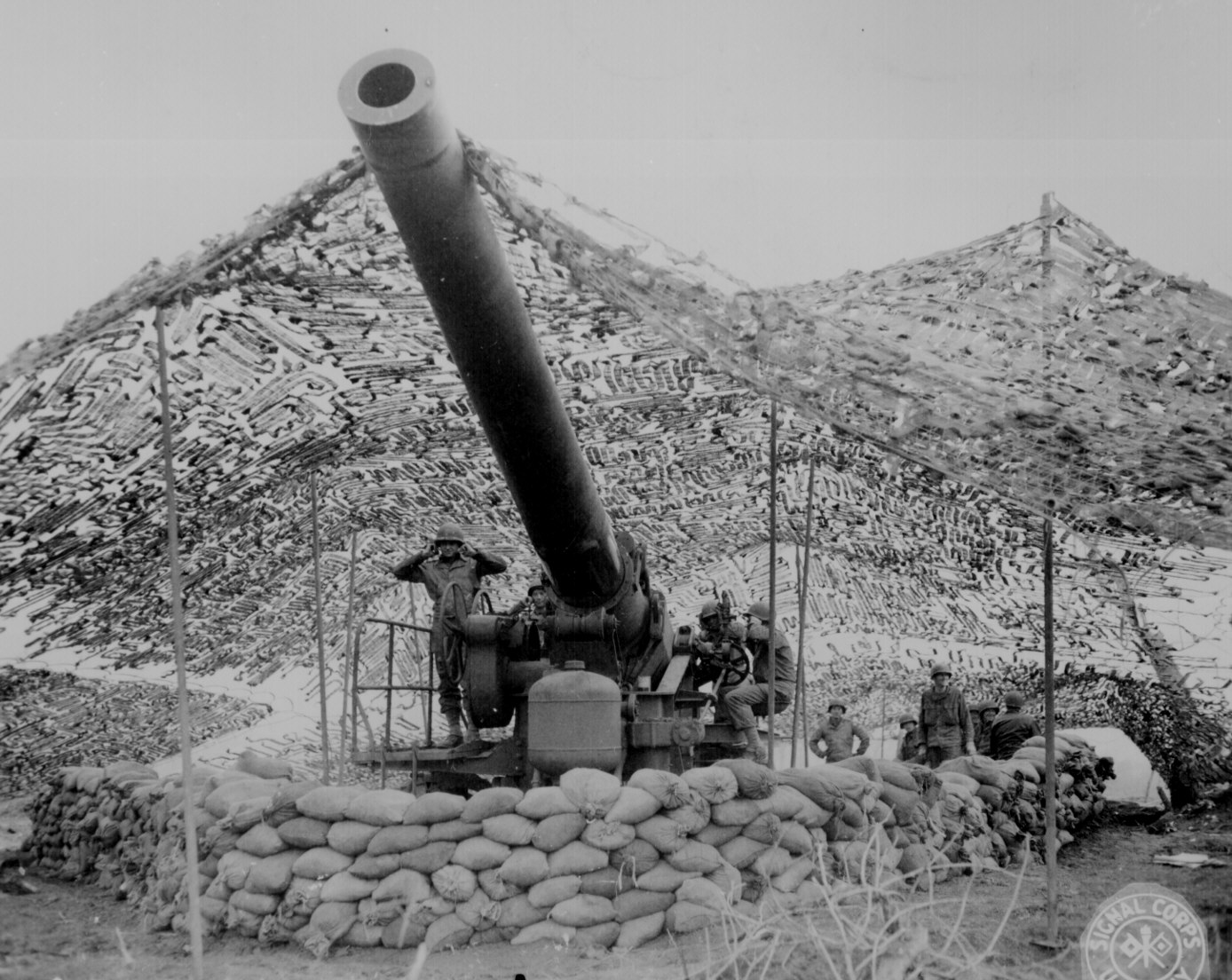
A 240 mm howitzer of the 697th Field Artillery Battalion near Mignano, Italy, on January 30, 1944.
Boyle / U.S. Army Signal Corps / National Archives (111-SC-187126) · Public domain · Original recordImage changes
Display copies resized; original scan preserved.
The words
Barbed Wire
Barbed wire stretched along the defended riverbank with mines and pillboxes. These obstacles formed a belt covered by German artillery and mortar fire.
Ch. II, The German Defenses · Fisher: the Gustav defenses (opens a new tab)
Bernhardt
The Army history calls this forward belt the Bernhard Line. It covered mountain positions ahead of the stronger Gustav defenses and delayed the Allied advance.
Ch. XIII, the German defensive belts · Army history: into the Winter Line (opens a new tab)
Bridges
After infantry crossed the Volturno, bridges brought jeeps and trucks forward. Engineers had to repair shell damage while preparing heavier crossings for tanks.
Ch. XII, bridging the Volturno · Army history: crossing the Volturno (opens a new tab)
Crossings
At the Volturno, soldiers waded out to fix guide ropes for assault boats. Swift water, collapsing rafts and German fire disrupted the crossing.
Ch. XII, the 7th Infantry crossing · Army history: crossing the Volturno (opens a new tab)
Engineers
Engineer bridge parties suffered casualties under German fire at the Volturno. Shells damaged floats, and mines blew up trucks near the crossing sites.
Ch. XII, engineer bridge construction · Army history: crossing the Volturno (opens a new tab)
Front Line
Winter fighting changed parts of the front. British troops had crossed the Garigliano, leaving some German positions south of the Liri valley outside their original defenses.
Ch. II, changes to the German front · Fisher: the Gustav defenses (opens a new tab)
Garigliano
At the western end of the Gustav system, the Garigliano reached the Tyrrhenian Sea. The river and nearby mountains helped anchor the coastal defenses.
Ch. II, the western defensive sector · Fisher: the Gustav defenses (opens a new tab)
Gustav
The Gustav Line was intended to hold the Allies south of Rome through the winter. Its river barriers and mountain positions required repeated attacks to overcome.
Defence lines; Monte Cassino · Army Museum: the battle for Italy (opens a new tab)
Minefields
German minefields blocked routes into the Gustav positions. Wooden box mines were especially difficult to detect because they contained very little metal.
Ch. XVIII, prepared German defenses · Army history: the Gustav river barriers (opens a new tab)
Pillboxes
A small, low fortification for machine guns or antitank weapons.
The riverbank defenses included pillboxes and concrete emplacements. German artillery and mortar fire covered the fortified zone and the approaches to it.
Fisher: the Gustav defenses (opens a new tab) · Merriam-Webster: pillbox (opens a new tab)
Rapido
A Canadian wartime report calls the river “Rapido (Gari).” German positions on its west bank formed the Gustav barrier south of Cassino.
Report No. 121, para. 10 · Canadian report: the Liri valley (opens a new tab)
Redoubts
The Gustav defenses linked strongpoints that could support one another with fire. Covered shelters and weapon positions formed parts of this fortified zone.
Did you know?
German troops turned stone-house cellars into weapon positions. They piled rubble above them as overhead protection.
Ch. II, supporting positions and shelters · Fisher: the Gustav defenses (opens a new tab)
Rivers
Rivers forced repeated crossings as the Allies advanced north. Mountain slopes and bad weather made it difficult to move vehicles, supplies and wounded men.
Rough terrain; Defence lines · Army Museum: the battle for Italy (opens a new tab)
Valleys
The Liri valley’s entrance lay between defended heights. German observers on the mountainsides directed artillery and mortar fire against troops approaching the valley.
Ch. II, the Liri valley defenses · Fisher: the Gustav defenses (opens a new tab)
Volturno
Fifth Army crossed the Volturno in October 1943, before reaching the Winter Line. Floodwater and demolished bridges complicated the advance toward the next river barriers.
Ch. XII, river conditions and crossings · Army history: crossing the Volturno (opens a new tab)
Sources
- Salerno to Cassino, Chapter XVIII: The Preliminaries for AnzioMartin Blumenson; US Army Center of Military History, HyperWar transcription
- Salerno to Cassino, Chapter XIII: Into the Winter LineMartin Blumenson; US Army Center of Military History, HyperWar transcription
- Salerno to Cassino, Chapter XII: The Volturno CrossingMartin Blumenson; US Army Center of Military History, HyperWar transcription
- Cassino to the Alps, Chapter II: Preparing for a New OffensiveErnest F. Fisher Jr.; US Army Center of Military History, HyperWar transcription
- The battle for ItalyNational Army Museum, London
- Canadian Operations in the LIRI Valley (Italy), May–June 1944, Report No. 121Historical Officer, Canadian Military Headquarters, August 8, 1944; HyperWar transcription
- PillboxMerriam-Webster.com Dictionary